














What is Replit?
Replit is a cloud-based development environment that removes the friction of local software setup by hosting a complete, multiplayer collaborative IDE directly in your browser. Its core bet is that software development belongs entirely in the cloud, where teams can code synchronously in dozens of programming languages without downloading virtual machines, environment files, or package managers. By combining a browser-based coding canvas with autonomous agentic capabilities, it attempts to bridge the gap between human instruction and instant deployment.
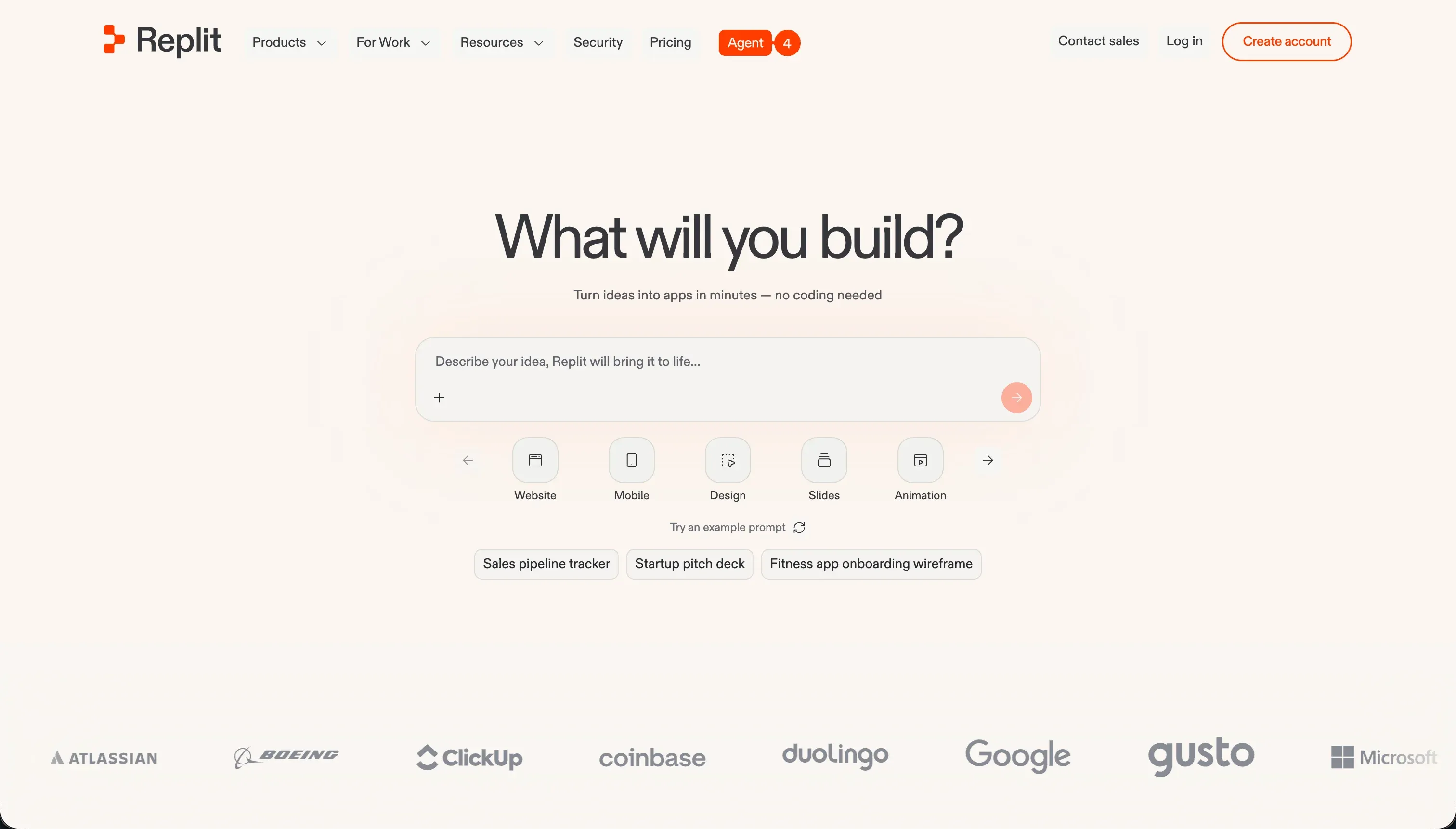 Replit homepage snapshot
In daily practice, Replit works by spinning up sandboxed virtual machines called Repls, which are fully equipped with live terminals, database layers, and package managers for over 50 programming languages. A developer can write code manually or leverage the Replit Agent to autonomously scaffold, test, and host entire web applications using plain-language instructions.
The core design philosophy of Replit is to couple rapid AI-powered execution with professional-grade developer tools. Rather than completely shielding users from code, Replit exposes the underlying server layers, hosting specifications, and Git repositories, giving builders the freedom to start with a prompt and dive straight into the raw codebase to tweak properties manually.
Replit is built specifically for technical builders, curious operators, and students who understand basic development concepts and want to experiment with code without environment configuration. It deeply frustrates non-technical software buyers who expect a visual editor and instead find themselves dealing with terminal outputs, database migrations, and manual package debugging.

What can you build with Replit?
The absolute sweet spot for Replit is building interactive software prototypes, multi-language coding experiments, automated task scripts, and cloud-hosted data engines. It is a highly capable engine for scaffolding apps that require custom backend logic and unique API integration.
- Multi-language SaaS MVPs built by using the Replit Agent to write backend frameworks, connect databases, and spin up frontend React portals.
- Automated tasks and Slack bots designed via natural-language developer scripts to run background routines, trigger Slack notifications, and handle webhooks.
- Collaborative live reviews where remote engineering teams use multiuser workspaces to pair-program, test container structures, and resolve compilation errors synchronously.
- Autoscaling APIs and microservices deployed directly from the IDE to active web addresses with one-click PostgreSQL configurations.
Where Replit stops is in the reliable execution of production-grade business applications that require role-based access security, visual data models, and strict maintenance scopes. The agent is highly prone to hallucinating architectural blueprints on Day Two, leaving you with unstructured code repositories that break silently because a server package or database connection string was misconfigured.

What users are saying
The consensus on Reddit communities like r/replit and technical review sites points to a sharp divide: developers praise the zero-config terminal setups, but users are increasingly vocal about the costly AI credit drain and circular bug-fixing loops.
- Technical users laud the multiplayer coding workspace and browser-based terminals for making educational sandbox testing and script writing incredibly fast.
- Non-technical operators criticize the Replit Agent for falling into endless loops where it creates secondary software bugs while trying to fix primary execution errors.
- Experienced builders complain about sudden, unpredictable database checkpoint charges and complex debugging bills that accrue while the agent is running reflection loops.
- Many developers report that the engine frequently throttles the AI context window, leading to forgotten project structures and forced regenerations.
I go around in circles with the agent telling me it fixed basic bugs, only to have to repeatedly paste screenshots proving to it that they still exist. I have even had false reports of fixes and summarized wrong workflows.
Our read: Replit is a premier software playground for technical exploration, but trusting its autonomous agent to safely build and maintain your live business workflows is a massive gamble. The moment your app moves beyond a simple script, you inherit the manual plumbing duties of a senior developer.
What it costs in practice
Replit has shifted from a cheap training playground to an enterprise-skewed, credit-based commercial pricing engine. The starter tier is strictly limited in computational resources, while elite features depend entirely on high monthly credit packages.
| Plan | Price | What you get | Best for |
|---|---|---|---|
| Starter | $0 | Daily dynamic credits, built-in database, and 1 public project. | Students and basic syntax learning. |
| Replit Core | $20/mo | $25.00 monthly credits, 5 collaborators, and 2 parallel agents. | Solo builders testing simple concept applications. |
| Replit Pro | $95/mo | $100.00 monthly credits, 15 collaborators, 10 parallel agents, and 28-day database rollbacks. | Professional development teams and heavy agent operators. |
In real-world usage, Replit’s costs can be highly erratic and stressful to predict. Because AI execution is effort-priced based on compilation time and query complexity, a loop running wild on live database migration runs can consume hundreds of dollars in custom credit overages in a single day.
What are Replit’s common alternatives?
Choosing the right alternative to Replit depends on whether you seek the infinite flexibility of generated code or want to avoid developer maintenance altogether.
| If you want… | Look at | Why |
|---|---|---|
| A visual no-code business app | Softr | It operates as a dedicated visual builder with built-in hosting, user auth, and server-side database security out of the box. |
| A terminal-rich desktop coding environment | Claude Code | It builds directly inside your local shell using Anthropic’s reasoning engines without web container lag. |
| An AI-first custom IDE desktop app | Cursor | It wraps a familiar desktop developer workspace with inline predictions and codebase-wide context editing. |
| A quick browser-based UI wrapper | v0 | It builds polished frontend UI layouts from text prompts that are easily exported to custom React codebases. |
If your target project is a custom software tool designed to manage internal team operations or client portals, look closely at Softr. While Replit forces you to write code, configure database schemas, and debug live API environments, Softr packages modern data portals, permission rules, and interactive charts into visual, click-to-configure components. It completely bypasses the maintenance and security vulnerabilities of raw code generation, keeping your team focused on daily operations instead of coding errors.
On the other hand, if you are a technical engineer who wants visual code execution without Replit’s hosting fees, Cursor delivers a locally run desktop development editor with deep AI autocomplete contexts. It gives developers total command-line freedom over their repositories without exposing them to Replit’s variable token billing.
Who Replit is for (and who it isn’t)
Replit is our cloud-native choice for technical builders and learners who want to generate, test, and host software experiments in a single collaborative interface. It is a fantastic collaborative sandbox for remote coders who are willing to manage backend servers and write code manually when the AI agent hits its limits.
Skip it completely if you are a business manager trying to build a secure app like a custom portal, team intranet, or partner dashboard. Instead of wading through fragile environments and surprise credit bills, use Softr to launch a fully hosted, role-secured client CRM in a single afternoon with zero technical debt.
