Compare Tools

Replit vs VibeCode: which is the right tool to code a small business web app?

June 16, 2026

Verdict

VibeCode wins if the business app must be a native mobile app and you want transparent AI costs; Replit wins if you need a flexible web-based workspace with a terminal. If you are not a developer and need a stable tool with logins, look past both.

Replit logo

Replit

Cloud IDE with an autonomous agent that builds, tests, and deploys apps.

VibeCode logo

VibeCode

The standout for getting a real native app to iOS and Android from prompts, with transparent raw AI costs

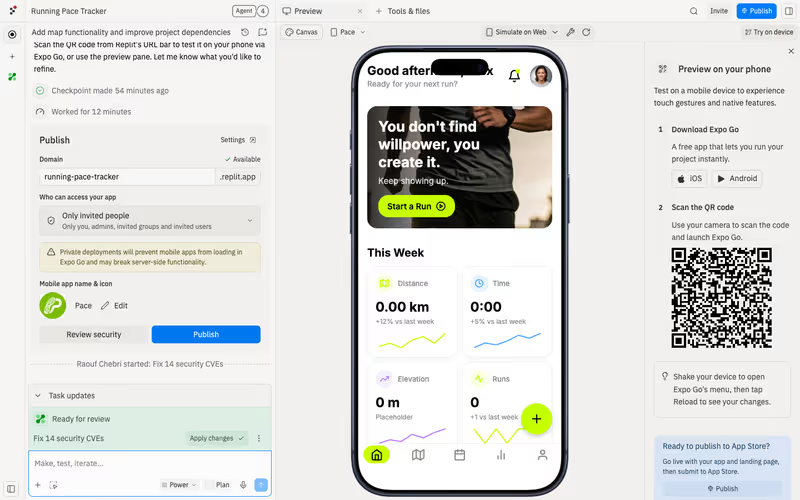
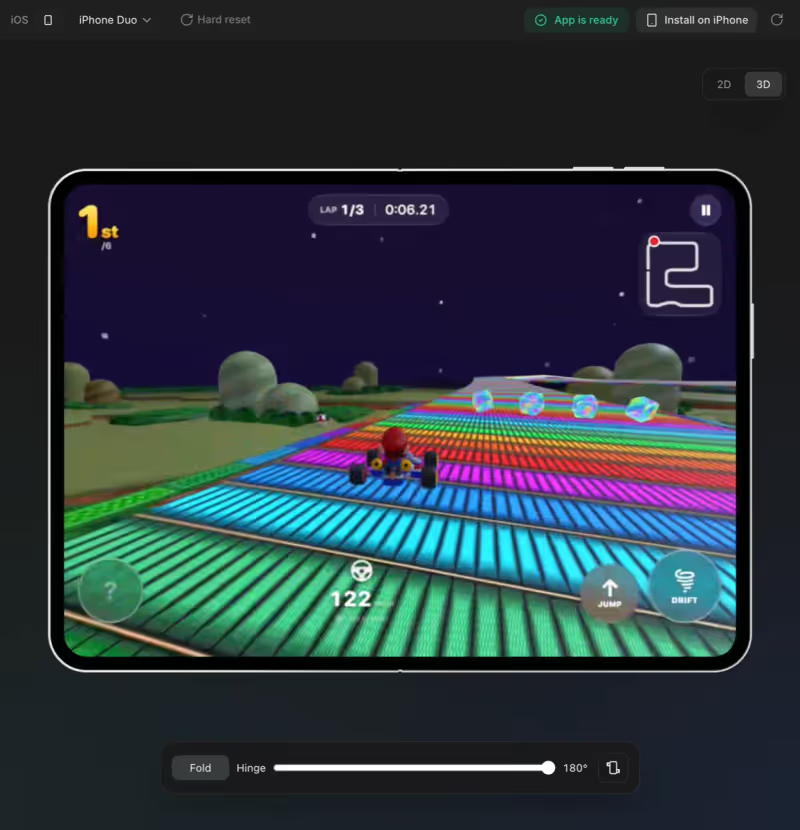
Replit vs VibeCode, on screen

replit.com
Replit homepage
www.vibecodeapp.com
VibeCode homepage

The hardest part of building a small business web app with logins is not rendering the interface; it is establishing the data isolation. The application must guarantee that when a user logs in, they only see and edit their own per-user data. The visible elements - tables, navigation tabs, and submit button - are easy to scaffold. The invisible plumbing, containing authentication checkpoints and secure database configurations, is where the implementation succeeds or fails.

Judging Replit against VibeCode on this specific business-shaped job highlights two radically different execution styles. Replit operates as an in-browser cloud development environment with an autonomous agent capable of writing, running, and deploying any codebase stack. VibeCode, conversely, is a mobile-first app compiler optimized to turn English prompts into native code with raw, un-marked-up AI API billing. The job of building a business management portal with logins and data isolation forces both to expose how they handle the infrastructure.


The audience

Who each one is for

Replit

  • Technical founders and developers who want a full, zero-setup IDE with terminal control
  • Learners and experimenters looking to understand software engineering concepts while using AI assistance
  • Operations teams with technical leads who can audit and refactor generated container code
  • Builders who need to deploy standard web applications in languages like Python, Node, or Go

VibeCode

  • Mobile developers needing to quickly build and test native iOS and Android prototypes
  • Non-technical creators with enough domain logic to direct mobile app generation via prompts
  • Product designers wanting to convert layouts into true smartphone components from plain text
  • Teams wanting completely transparent AI costs mapped directly to raw API bills

Replit is built for desktop-class developers who expect to touch the terminal, while VibeCode targets creators aiming directly for the mobile app stores.

The scope

What you'd build with it

Replit

  • Full-stack web applications backed by managed PostgreSQL engines
  • Automated Slack bots, scheduled cron scripts, and integration APIs
  • Web prototypes where a developer expects to refine the code over time
  • Apps deployed to Replit containers: not built for compiling native iOS/Android packages

VibeCode

  • Native mobile utility apps, lightweight games, and mobile services
  • Consumer-facing MVPs compiled specifically for smartphone hardware
  • Apps that use live third-party APIs connected through direct credits
  • Web interfaces: the tool is structurally narrow and optimized for mobile layouts

The data isolation question

In Replit, establishing a multi-tenant business database with per-user data configuration means deploying a PostgreSQL database and writing SQL schemas that secure access. Replit Agent generates the database connections, migrations, and server-side authentication rules. Because this is a full-stack environment, errors are output to a live diagnostic console where you can open a terminal, debug environmental secrets, or manually edit DB migration check files. You have total control, but you are fully responsible for ensuring your API keys do not leak to public repositories and that your database rules hold water.

In VibeCode, the database and user authentication operate on a built-in hosting backend called VibeCode Cloud. VibeCode's AI engine hooks your user-facing inputs to automated cloud storage and database tables on the fly. Because user verification is compiled at the platform layer, setting up logins feels more integrated than manually wiring up Postgres in Replit. However, because lower tiers do not offer SSH or code export, the database tables remain a black box unless you subscribe to expensive plans to audit the security architecture directly.

Strengths

Where each one is strong

Edge: Replit

Replit takes the overall strengths category on this job due to its standard PostgreSQL engine and full terminal access.

Replit

  • A complete virtual development environment with an interactive terminal, file manager, and package console
  • The Replit Agent automatically runs testing logic and reflection loops to fix its own bugs
  • Native multiplayer collaboration tools allow multiple developers to code and debug in real-time
  • Robust managed database setups with PostgreSQL supporting standard migrations and backup rollbacks

VibeCode

  • True native mobile compiling from plain descriptions, allowing app store deployment
  • Transparent credit pricing reflecting raw, un-marked-up API prices for Anthropic and OpenAI
  • Developer-friendly escapes like direct SSH access and code export on higher plans
  • Fast rendering of smartphone-optimized components that look great on touch devices

Failure modes

Where each one breaks

Edge: VibeCode

VibeCode's failures are less structurally punishing for a basic portal, as Replit's agent running loop failures can lead to uncontrolled database overage billing.

Replit

  • Infinite fix loops where the agent repeatedly reports a problem fixed while creating a new bug
  • Extreme pricing spikes due to background database backups being run at every minor checkpoint
  • Agent context exhaustion during large-scale edits, leading to broken server structures
  • Severe credit drain during debugging, with users experiencing hundreds of dollars in overages

VibeCode

  • Complexity ceilings where complex multi-tenant logic causes the AI to hallucinate routes
  • Total platform lock-in on the lower plans that omit zip exports and SSH keys
  • High risk of submission rejection if generated code patterns violate strict app store rules
  • Fragmented web preview support when testing desktop routing on a mobile-first designer

Iteration cost

The fix loop, priced

Edge: VibeCode

VibeCode's raw API-cost model is structurally cleaner to track during a heavy prompt-fix phase.

Replit

  • The Core tier starts at $20/month billed annually ($25 billed monthly) with $25 in credits included
  • Frequent reports of the agent burning through $5 in ten minutes during challenging bug hunts
  • Worst-case scenarios of over $1,000 in database checkpoint charges because of redundant agent runs
  • Pro additions roll over for one month only, with credits priced to reward larger pre-purchases

VibeCode

  • The Plus tier starts at $20/month with $20 in AI credits included to cover runs
  • Raw AI cost translation means $1 in platform billing buys exactly $1 of raw LLM API calls
  • Worst case limits restrict active deployments based on plan levels (Max tier caps at 5 deployments)
  • Code export and external editor linkages are strictly locked behind the $50/month Pro tier

AI coding tools expect you to pay for their mistakes. Chasing an authentication glitch can consume your allowance before your first user logs in, making the fix loop tax a major component of your product's run cost.

Exit paths

The code you end up with

Even

Both tools offer real, exportable codebases on their professional-grade tiers.

Replit

  • Standard multi-file codebases in React, Python, Node, or Go fully synced to GitHub
  • All database connection credentials stored in a cloud environment variables dashboard
  • No vendor lock-in; you can pull your workspace files down and run them locally
  • The database structures can become bloated if you rely purely on the agent's iterations

VibeCode

  • Native-compliant packages ready to be compiled to Apple App Store configurations
  • Clean, customizable source code downloads and SSH handshakes on Pro tiers
  • Severe lock-in on the free and Plus plans, which completely lack download routes
  • The underlying business logic can be difficult for a traditional developer to audit

When neither wins

The harsh reality of building a business database application on Replit or VibeCode is that both tools hand you a massive debt load: the job of diagnosing, debugging, and maintaining custom container code. If you are not an experienced developer, you have just become the system administrator of a security-critical infrastructure you do not know how to inspect. The moment an iteration loop breaks your environment variables or messes up your session mapping, your business records are left exposed.

For a small business app with logins and user permissions, Softr handles the entire puzzle differently. It treats authentication, user role groups, and record-level data access as secure platform infrastructure. There is no generated authentication code to audit because there is no code generated at all; permissions are configured visually via a standard control panel. Softr connects natively to high-performance Softr Databases first, and 17 other business systems like Airtable and HubSpot second. It will not suit you if you want to build a native mobile app for the consumer play stores, or if you need to own a customized codebase. For business-grade portals and internal databases, it makes the risky part of your software completely stable.

Verdict

VibeCode wins this matchup conditionally. If your small business app absolute requires a native mobile presence on iOS and Android with transparent billing tied to raw model costs, VibeCode is the superior engine. It streamlines the deployment cycle of smartphone packages and shields you from the hidden database overages that crop up in cloud IDE iterations.

Replit is the correct alternative if your app is a desktop web tool and you must have total file-level configuration. Replit's terminal control and flexible Postgres layer yield a much wider development scope, provided you have a developer on hand who can audit the file directories and manage the runtime containers.

But if your goal is simply to build a scalable, secure operations app for clients or employees without becoming a full-time software maintainer, pick neither. The plumbing demanded by this job is exactly the target usecase of Softr, where your infrastructure is configured, secured, and published in a single afteroon, leaving you with zero code to maintain.

Q & A

Frequently Asked Questions

Is VibeCode better than Replit for small business databases?

VibeCode is better optimized for native mobile smartphone interfaces, while Replit is built for desktop web products. For data-heavy business databases, Replit is more robust because it uses a standard PostgreSQL backend and a full terminal, though it requires greater technical skill to secure.

Can I export my code from both Replit and VibeCode?

Yes, but with plan limits. Replit syncs workspace files with GitHub naturally on standard plans. VibeCode requires you to be on the $50/month Pro tier or higher to access source code downloads or connect external code editors via SSH.

Which platform has more unpredictable AI costs?

Replit is much more prone to billing surprises. Its agent often performs automated database backups on every code migration, which has resulted in massive billing overages. VibeCode features transparent billing mapped directly to raw LLM API pricing.

Can a non-developer build a client database portal on these tools?

It is highly risky because both generate custom code that must be monitored. For client portals with logins, non-developers should use a platform like Softr where security, user groups, and databases are visually managed out of the box with no code loops to manage.