Compare Tools

Replit vs Zite: which one survives a small business web app?

June 16, 2026

Verdict

Replit wins if you want a custom developer-designed codebase; Zite wins if you are building an operational database tool but will accept rigid templates. For non-developers, look past both.

Replit logo

Replit

Cloud IDE with an autonomous agent that builds, tests, and deploys apps.

Zite logo

Zite

Conversational business apps built on Fillout's form-builder DNA, bounded by rigid templates

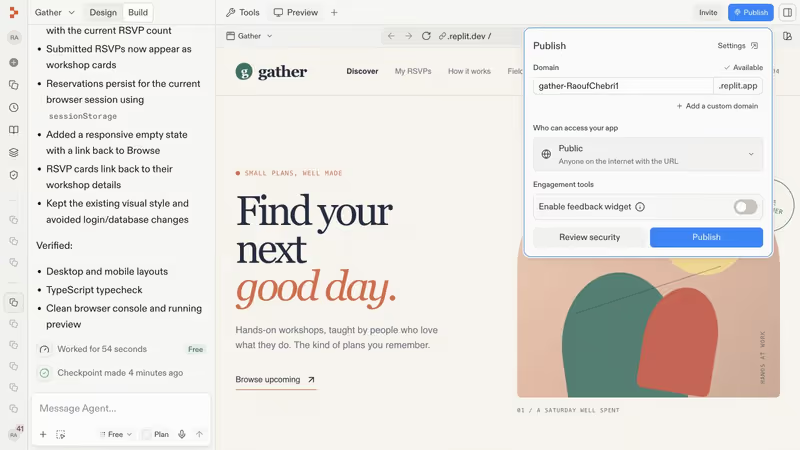
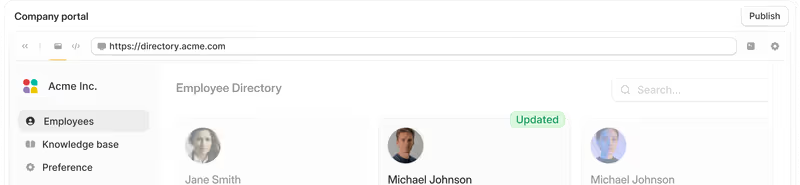
Replit vs Zite, on screen

replit.com
Replit homepage
zite.com
Zite homepage

The fairest way to compare Replit and Zite is to judge them on a concrete operational job: a small business web app where employees log in and see only their own assigned clients. This job requires three main parts: a responsive front-end layout, a robust data layer, and secure user permissions to keep customer data strictly isolated.

This business-shaped application is thin on custom visuals but heavy on secure plumbing. Testing the platforms on this scenario exposes the exact places where AI-first application creation diverges from developer-focused environments, forcing you to choose between managing raw, generated code and working inside rigid visual templates.


The audience

Who each one is for

Replit

  • Developers and technical builders who want to code alongside an autonomous AI agent in a browser.
  • Non-technical founders looking to learn software development by reading under-the-hood application code.
  • Teams wanting to build custom, flexible backends in Python or JavaScript from a single text description.
  • Makers comfortable managing packages, container environments, and environment secrets manually.

Zite

  • Business managers and operators who want to prompt complete tools without looking at a line of code.
  • Teams needing to collect data via pre-built form logic without configuring database schemas from scratch.
  • Solopreneurs looking for a fast, templated interface without managing hosting or local development pipelines.
  • Builders who are comfortable working within rigid layouts to gain speed and skip system staging.

Replit appeals to developers who expect to touch the code eventually; Zite targets business operators who want the code entirely abstracted.

The scope

What you'd build with it

Replit

  • SaaS MVPs that require unique, custom server-side logic and custom packages.
  • Slack bots, automation scripts, and background tasks using multi-language containers.
  • Complex web projects where the final deliverable must be a clean, portable codebase.
  • Basic consumer web utilities - but avoiding any project requiring rigid, pre-built enterprise-governed workflows.

Zite

  • Client portals, internal directory tools, and lightweight CRM applications rapidly.
  • Highly conditional data entry forms built on standard relational spreadsheet databases.
  • Multi-step CRUD tools where layout constraints are less important than visual speed.
  • Simple internal operational trackers - but avoiding custom visual layouts that require responsive UI tweaks.

Who governs the data layer

Under the hood, Replit Agent provisions a PostgreSQL database and writes raw database queries or uses ORM libraries inside a custom Node.js or Python backend. This approach gives you limitless architectural freedom, but the security and integrity of your database are governed entirely by the code the AI generates. If the agent fails to implement strict server-side checks, your per-user data isolation will contain open exploits - a common issue when delegating user access control to an LLM.

Zite operates on a unified, spreadsheet-like SQL backend with pre-configured relational linkage. It manages tables, linked records, and row permissions at the platform level, using native form routing inherited from Fillout. However, Zite's database currently lacks complex SQL custom views and advanced roll-up logic, meaning complex calculations must be handled through visual workflow combinations rather than robust database schemes.

Strengths

Where each one is strong

Edge: Replit

Replit takes the strengths category by giving builders a real, functional development environment with zero platform lock-in.

Replit

  • An actual browser-based IDE containing package managers, a full terminal, and live previews.
  • Replit Agent autonomous runs that can install packages, write code, run cycles, and fix errors.
  • Multi-language support for complex projects including Go, Python, Node.js, and rust.
  • Collaborative multiplayer code editing in real time with billing controls and voice channels.

Zite

  • Unlimited users on all free and paid plans with zero seat-licensing fees.
  • Turnkey SQL database integration that functions like a spreadsheet with instant visual tables.
  • Plan Mode guardrails that show a markdown summary of changes before consuming AI credits.
  • Deep form validation rules, translation engines, and multi-step configurations.

Failure modes

Where each one breaks

Edge: Zite

Zite takes the edge here because its visual boundaries, while strict, protect you from catastrophic code failure and manual database migrations.

Replit

  • Infinite bug-generation loops where the agent repeatedly invents and 'fixes' its own bugs.
  • Catastrophic data loss and silent database overrides when the AI agent receives raw write access to production.
  • Context window limits that stall progress and cause the agent to forget early architectural patterns.
  • Hidden database checkpoint and migration charges that scale rapidly during development cycles.

Zite

  • Rigid layout options that severely limit design modifications outside of the AI's standard template.
  • Workflow run consumption loops where every single data read and page reload eats your monthly quota.
  • Undisclosed pricing gates, including business-tier restrictions on custom login designs and schedules.
  • Excessive workflow generation behind the scenes, leaving your workspace completely cluttered.

Iteration cost

The fix loop, priced

Even

Both tools lock you into credit consumption during iteration, making active debugging expensive.

Replit

  • Replit Core starts at $25/month for dynamic credits, with Pro scaling to $100/month.
  • Reported pricing spikes can burn $350 in a single day of active agent iterations.
  • Worst-case scenarios have resulted in over $1,500 in unexpected database checkpoint billing fees.
  • Pro plans allow tiered credit add-ons with dynamic monthly rollover limits.

Zite

  • Zite Pro costs $19/month for 100 AI credits and 5,000 monthly workflows.
  • Active design chat, planning, and code changes consume the exact same credit pool.
  • Active user page reloads can deplete your workflow limits in days as each read counts as a run.
  • Credit packages can scale the Pro plan up to $89/month for 800 credits.

Both tools charge you for fixing their own generated errors. If your build requires heavy revisions, you will pay the the fix loop tax as you iterate.

Exit paths

The code you end up with

Edge: Replit

Replit wins the export fight by outputting real, framework-standard repositories with no platform layer.

Replit

  • Clean, standard repositories in JavaScript, Python, or Go.
  • One-click server deployments with custom domain routing and SSL certificates out of the box.
  • Zero proprietary framework layers, making it easy to download your codebase and host it anywhere.
  • Full Git version history that tracks every modification and command line update.

Zite

  • No codebase export paths, leaving you completely locked into their proprietary systems.
  • No GitHub replication or synchronization paths to back up your frontend components.
  • All hosting handled natively on their internal infrastructure with no self-hosting exit route.
  • Database contents are retrievable through REST APIs, but the frontend layouts cannot travel.

When neither wins

If you are a non-developer building this application for a real business, this matchup holds a dangerous trap. Replit hands you the keys to an raw container where you must securely manage Postgres migrations, environment variables, and authentication rules. Zite abstracts the code but locks you inside rigid layouts, charging you workflows for every page read while hiding custom login screens behind steep Business gates. Both options force you into unpredictable prompting cycles to get simple layouts right.

For business-shaped portals, Softr treats authentication, user roles, and record permissions as platform infrastructure. You build your client app using native, responsive blocks on a visual SQL database with no code to generate or verify. It will not work for developers seeking a custom backend or a code repository to export, but it makes the difficult parts of business software secure by default.

Verdict

Replit wins this matchup if you are a technical builder or developer who want complete ownership over an application codebase. While the Replit Agent can fall into circular debugging loops, the final deliverable is a standard, framework-compliant repository that you can export, modify, and self-host on any platform without vendor lock-in.

Zite is the right choice if you want to scaffold a simple, form-heavy internal database tool and do not mind rigid cosmetic boundaries. It completely skips the database hosting setup, but you must keep an eye on active user traffic to avoid hitting workflow limit thresholds.

If you are non-technical and building a critical business application, choose Softr. Configuring roles, logins, and database filters visually in a secure no-code ecosystem is much safer than trusting an AI agent with your production data permissions.

Q & A

Frequently Asked Questions

Is Zite better than Replit for building small business web apps?

Zite is faster for non-developers because it structures data on a spreadsheet-style database and uses built-in form logic. Replit is a professional IDE that requires developer expertise to handle Docker containers, server scaling, and database migrations securely.

Can I export my code from Replit and Zite?

Yes, Replit allows full codebase export, and you can download standard files to run locally or host on Vercel or Railway. Zite is a proprietary platform with no raw code export or GitHub sync, meaning you cannot leave their ecosystem without recreating your interface.

Which costs more to run and scale, Replit or Zite?

Replit's credit bills can scale rapidly if the agent struggles with a bug, occasionally costing hundreds of dollars in a single day. Zite is cheaper upfront but counts page reloads and database reads as workflow runs, which quickly exhausts monthly plan limits on active applications.

Why should a non-developer use Softr instead of Replit or Zite?

Softr provides a secure, fully hosted platform where user logins, permissions, and database operations are managed visually. It eliminates the risk of AI-generated bugs, technical security breaches, and unpredictable credit billing loops on business-critical applications.