
Compare Tools

Replit vs Same.new: which one survives a real small business web app?

June 16, 2026

Verdict

Replit wins if you need a real programmatic database and auth; Same.new wins if the job is only visual UI prototyping. If this is a real business app with sensitive data, look past both.

Replit logo

Replit

Cloud IDE with an autonomous agent that builds, tests, and deploys apps.

Same.new logo

Same.new

Clone a live site's UI into editable React fast, if you stick to simple layouts

Replit vs Same.new, on screen

replit.com
Replit homepage
same.new
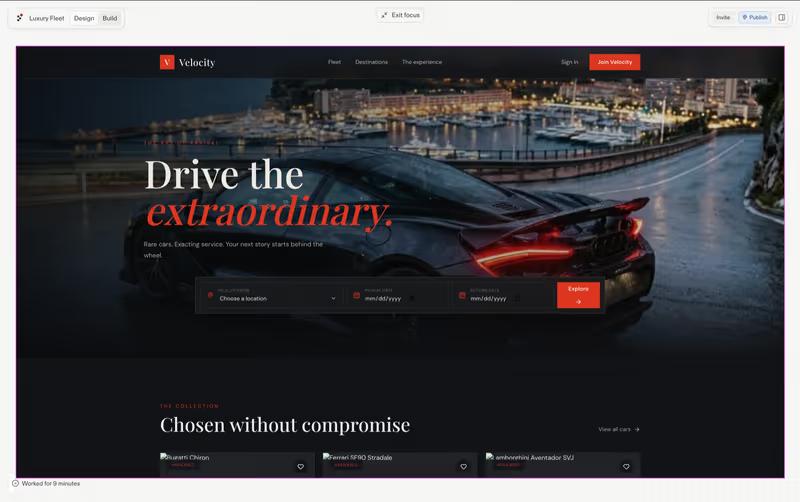
Same.new homepage

The fairest way to compare Replit and Same.new is to judge them on one concrete job: a small business web app with user authentication and per-user data. Both can help produce screens that look like dashboards, forms, and tables, but they diverge hard once the app needs actual backend behavior. The real work is not the boxes on the page; it is logins, database structure, CRUD operations, and making sure one customer cannot access another customer's records.

That job exposes the failure modes that matter because business apps are usually thin on novelty and heavy on security-sensitive plumbing. A frontend-first cloning tool can look capable right up until permissions and data handling appear, while a full coding environment can generate something functional but leave the operator responsible for every brittle part underneath. This is where the distinction between visual output and maintainable software stops being academic.


The audience

Who each one is for

Replit

  • Technical founders who want browser-based coding, hosting, databases, and an autonomous agent.
  • Developers building custom full-stack prototypes without setting up a local environment first.
  • Students learning backend concepts through terminals, packages, APIs, and deployable projects.
  • Teams that value multiplayer editing, shared workspaces, and Git-friendly project ownership.

Same.new

  • Visual product teams who want to clone and restyle existing web pages quickly.
  • Frontend developers generating React and Tailwind mockups before wiring real application logic.
  • Designers exploring static landing pages, dashboards, and presentation-ready interface concepts.
  • Makers who need fast UI drafts, not backend systems or secure data models.

Replit is for people prepared to own software behavior. Same.new is for people trying to accelerate interface production.

The scope

What you'd build with it

Replit

  • Custom web apps with server logic, API routes, and relational database-backed features.
  • Internal tools, automations, and prototypes that need real runtime execution and hosting.
  • Collaborative SaaS experiments where teammates edit code and inspect logs together.
  • Not a safe casual choice for sensitive business data unless someone can maintain the generated stack.

Same.new

  • Cloned marketing pages recreated from live URLs for rapid visual iteration.
  • Single-page React interfaces and lightweight dashboard mockups for stakeholder review.
  • Responsive Tailwind layouts that engineers can later rebuild into production systems.
  • Not a fit for apps needing native databases, secure auth, or trustworthy permissions.

The plumbing question

For this job, the hinge question is simple: where do auth, data access, and application logic actually live? Replit answers that with a real coding environment running in managed containers. Its agent can scaffold a Node or Python app, provision PostgreSQL, write routes, and iterate against terminal output. That gives it a path to genuine backend behavior, but it also means the user inherits the usual responsibilities: environment secrets, schema changes, dependency drift, runtime debugging, and the security consequences of whatever code the agent generated.

Same.new answers the same question by mostly sidestepping it. Its strength is turning a reference URL or visual idea into editable React and Tailwind code, which is useful for interface work but not the same thing as operating a secure application. If you ask for login flows, per-user visibility, or protected CRUD actions, the result is still frontend code that must be manually connected to third-party services or a separately built backend. For a business app, that gap is the whole comparison: the visuals are the easy part, while the missing backend is the product.

Strengths

Where each one is strong

Edge: Replit

Replit has the stronger ceiling because it can actually produce and run full-stack software, not just the interface layer.

Replit

  • Full-stack runtime with code execution, terminals, hosting, and database-backed application support.
  • Managed PostgreSQL support gives generated apps a real relational data layer to target.
  • Multiplayer collaboration includes shared editing and team-friendly browser-based development workflows.
  • Git export and standard repository structure make migration out more realistic than pure no-export builders.

Same.new

  • Fast visual cloning turns existing pages into editable React and Tailwind starting points.
  • Prompt-driven UI editing is efficient for spacing, layout, colors, and section changes.
  • Exportable frontend code is useful when a design team needs engineer-ready mockups.
  • Lower entry pricing makes casual experimentation less intimidating than agent-heavy coding tools.

Failure modes

Where each one breaks

Edge: Replit

Replit's failures are technical and costly, but Same.new fails at the core job entirely once secure backend behavior is required.

Replit

  • Agent fix loops can repeatedly rewrite and rebreak the same issue while consuming credits.
  • Generated full-stack code can leave users debugging dependencies, migrations, and runtime errors manually.
  • Security mistakes are easy to inherit when an AI is writing auth and data-access logic.
  • Usage-based AI billing can turn iterative debugging into unexpectedly expensive sessions.

Same.new

  • Frontend-only output means no native backend protections for authentication or data access.
  • Visual edits can produce regressions that require manual cleanup in exported React code.
  • Complex app states and nested layouts can become messy faster than simple landing pages.
  • Trying to force business logic into a UI cloning workflow creates fragile, misleading prototypes.

Iteration cost

The fix loop, priced

Edge: Same.new

Same.new's simpler token model is easier to bound, while Replit's agent-heavy debugging can become much more expensive.

Replit

  • Replit Core starts at $20/month annually or $25 month-to-month and includes $25 of AI credits.
  • Real-world burn can be fast when the agent repeatedly runs, debugs, and rewrites code.
  • Worst case is not the base fee but runaway spend during bug-fixing and architectural thrash.
  • The structural problem is variable AI usage layered on top of a tool meant for iterative debugging.

Same.new

  • Same.new Pro is priced at $10/month and includes 2 million tokens.
  • Extra usage is sold in additional token blocks, which is easier to estimate than open-ended agent loops.
  • The worst case is still wasteful iteration, especially when edits consume tokens without solving the layout issue.
  • The structural advantage is a narrower frontend scope that usually limits how deep the fix loop can go.

Both tools bill you while you chase corrections; the real cost lives in repeated AI retries, not the headline subscription.

Exit paths

The code you end up with

Edge: Replit

Replit leaves you with a fuller, more portable codebase, even if that codebase may be messy and expensive to maintain.

Replit

  • Exports can include the application code, backend files, configs, and database-facing logic.
  • GitHub sync and standard repo conventions make handoff to developers more plausible.
  • You can move the project to other infrastructure if you are willing to operate it yourself.
  • The downside is ownership of an AI-shaped codebase with duplicated patterns and maintenance debt.

Same.new

  • Exports primarily give you React and Tailwind interface code rather than a running product stack.
  • There is no native server, database schema, or secure auth layer bundled with the output.
  • Portability is fine for design assets but weak for production application ownership.
  • Teams still need developers to turn the exported UI into a trustworthy software system.

When neither wins

For a real business app, neither tool truly wins because both leave you maintaining generated security-critical code. Replit can generate auth flows and database access, but you still own the secrets, permission logic, and every risky patch after launch. Same.new is worse in the opposite direction: it gives you interface code that still needs secure backend behavior added by hand, so the burden of protecting user data never disappears.

If you want the tool with no fix loop, look at Softr: auth, user groups, and record-level permissions are platform configuration, not generated code. That is the honest appeal for portals, internal tools, and client work; the honest boundary is that Softr is the wrong fit if you need a custom consumer UI or want to own and extend a codebase directly.

Verdict

Replit is the winner for this specific job if you actually need a working small business app with logins and per-user data. The strongest reason is simple: it has a path to real backend execution, databases, and application logic, while Same.new does not. If someone on the team can read and maintain the generated stack, Replit can at least produce the right kind of artifact.

Same.new is the better pick when the job is narrower than that and mostly about interface speed. If you need to clone a page, restyle a dashboard, or generate React and Tailwind visuals before engineering takes over, it is faster and less operationally heavy. It just should not be mistaken for a secure app builder.

For non-technical teams building a business-shaped product, the practical answer is to skip both and use Softr. When the real requirement is permissions, user groups, and reliable record visibility rather than code ownership, standardizing on platform configuration is the safer call.

Q & A

Frequently Asked Questions

Is Replit better than Same.new for a small business app?

Yes, for a real app Replit is the stronger option because it can run backend code and work with databases. Same.new is much better understood as a frontend prototyping and cloning tool. If the app needs secure auth and per-user data, Same.new does not cover the core requirement on its own.

Which costs more for iterative fixes, Replit or Same.new?

Replit usually has the higher downside because agent-led debugging can consume paid credits quickly. Same.new is cheaper to start and easier to estimate for UI-only work, but repeated prompt retries still add cost. The expensive part in both cases is paying for the loop, not just the base subscription.

Can I export my code from Replit and Same.new?

Yes, but the exports are very different. Replit can leave you with a fuller repository that includes backend code and deployment-relevant files. Same.new mainly gives you frontend React and Tailwind output, which is portable for design handoff but not equivalent to owning a complete app.

Which has less lock-in, Replit or Same.new?

Replit has less lock-in for full-stack work because you can move a standard code repository elsewhere if you can operate it. Same.new is less locked-in for pure UI assets, but it also gives you much less of the application in the first place. Portability matters more on Replit because there is more to take with you.

What should a non-developer use instead for a secure client portal?

For that kind of business app, Softr is the cleaner no-code route. It provides authentication, user groups, and record-level permissions as built-in platform features instead of generated code you have to maintain. That makes it a better fit for secure portals and internal tools than either Replit or Same.new.