Compare Tools

Claude Code vs Replit: which one is better for shipping a real web app?

June 16, 2026

Verdict

Replit wins if you want one browser workspace that builds, hosts, and ships; Claude Code wins if you already own the environment and want local control. For non-developers shipping business apps, the better answer is past both tools.

Claude Code logo

Claude Code

Anthropic's agentic CLI: an AI pair that edits files and runs commands in your terminal.

Replit logo

Replit

Cloud IDE with an autonomous agent that builds, tests, and deploys apps.

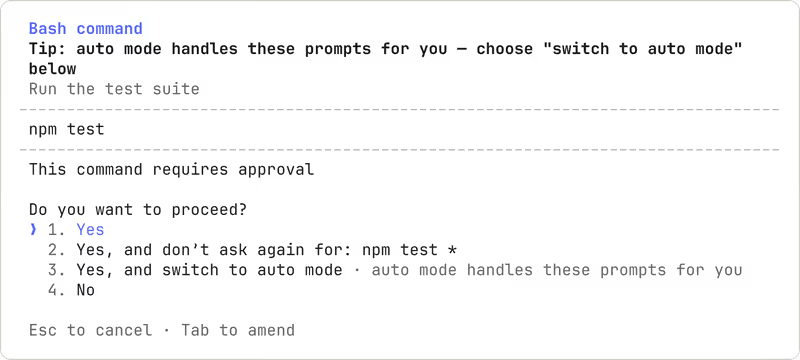
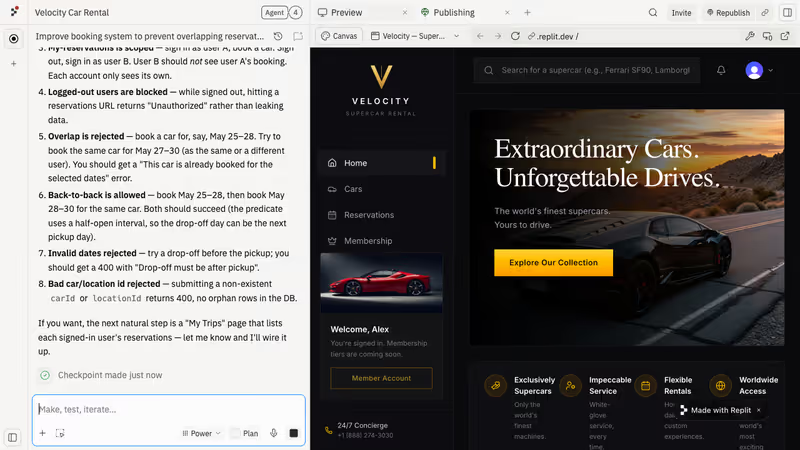
Claude Code vs Replit, on screen

www.anthropic.com
Claude Code homepage
replit.com
Replit homepage

The concrete job here is shipping a real web app, not just generating one: getting from prompt to working frontend, database, environment config, testing, deployment, and the first round of fixes. Claude Code and Replit genuinely diverge on that job because one is a terminal agent operating in your own local setup, while the other is a cloud workspace that bundles coding, runtime, and hosting into the same product.

That makes this a useful stress test. Shipping exposes the failure modes that matter: where the code actually runs, who owns the environment, how painful iteration gets when the agent is wrong, and whether the final app leaves you with portable assets or a stack shaped around the platform that generated it.


The audience

Who each one is for

Claude Code

  • Local-first developers who already work in terminals and trust their own tooling more than cloud IDEs.
  • Engineers with existing repos, CI pipelines, and deployment targets who want an agent, not a platform.
  • Security-conscious teams that prefer code and credentials to stay inside managed local environments.
  • Developers comfortable wiring hosting, databases, and environment variables without platform hand-holding.

Replit

  • Browser-based builders who want setup, coding, database, and hosting in one place.
  • Solo founders testing SaaS ideas fast without assembling a separate local development stack.
  • Small teams that value real-time collaboration, shared workspaces, and multiplayer editing sessions.
  • Developers who want the agent to work inside the same cloud container that will run the app.

Claude Code assumes you already have an engineering environment worth keeping. Replit assumes you'd rather rent one preassembled.

The scope

What you'd build with it

Claude Code

  • Features and refactors inside established web app repos where build, test, and deploy already exist.
  • Full-stack apps that must fit your own infrastructure, secrets handling, and repository conventions.
  • Developer-heavy projects needing direct CLI access to package managers, test runners, and git workflows.
  • Not the best fit if you want hosting, database provisioning, and deployment bundled into the same product.

Replit

  • Full-stack web apps in React, Node, or Python with browser-based coding and fast hosted previews.
  • SaaS MVPs, internal tools, and prototypes that benefit from integrated Postgres and instant deployment.
  • Collaborative projects where multiple people need to edit, run, and review the same app live.
  • Not the best fit if you need total infrastructure portability or want to avoid platform-shaped defaults.

Where the app actually lives

Claude Code answers the shipping question by staying out of the platform business. It runs in your local shell, uses direct bash commands, reads and edits the files already in your repository, and can call the same npm scripts, pytest runs, and git operations your team already uses. That gives it strong leverage on established codebases and zero extra abstraction between the agent and your real project, but it also means hosting, preview environments, databases, secrets management, and production deployment remain your problem to solve with external services.

Replit answers the same question by collapsing coding and runtime into one cloud container. Its agent works inside a Repl that already has execution, preview, deployment paths, and integrated services like Postgres close at hand, which is why it can feel faster for greenfield web apps. The tradeoff is that the agent's success depends on the boundaries and defaults of that containerized environment: hosting is easier because the platform owns the runtime, but portability, migration, and cost control become more entangled with Replit's own mechanisms.

Strengths

Where each one is strong

Edge: Replit

For shipping a fresh web app, Replit's integrated runtime and deployment path are a real structural advantage.

Claude Code

  • Native terminal control lets it use your actual shell, scripts, package managers, and repository layout.
  • Works directly on local files, so code ownership and existing git workflows stay standard.
  • Fits established engineering setups where deployment, testing, and infra already live elsewhere.
  • Avoids a proprietary cloud IDE layer between the agent and your real development environment.

Replit

  • Integrated hosting path makes it easier to go from generated app to running web app in one workspace.
  • Managed Postgres and built-in cloud runtime reduce the setup burden for greenfield full-stack projects.
  • Browser-based environment removes local machine setup as a prerequisite for starting or collaborating.
  • Real-time collaboration features suit founders and small teams working together in the same project.

Failure modes

Where each one breaks

Edge: Claude Code

For this job, Replit's failures can bleed into hosting, billing, and live app state, which raises the stakes.

Claude Code

  • No built-in deployment layer means the app can still stall after code generation if your infra is messy.
  • Iteration can get expensive when the agent repeatedly searches, retries, or reprocesses large code areas.
  • Large or complex repos can increase context-management strain and make fixes less consistent.
  • Local environment issues are yours to diagnose, including shell quirks, dependencies, and OS-specific behavior.

Replit

  • Fix loops inside the paid agent can burn credits while repeatedly attempting weak or circular repairs.
  • Platform-managed databases and runtime defaults can create higher-risk mistakes if used carelessly on live apps.
  • Container and context limits can push the agent into shallow changes that do not resolve root causes.
  • The easier shipping feels at first, the more painful migration can become if the app leans on Replit-shaped services.

Iteration cost

The fix loop, priced

Even

Both can become expensive when the agent is wrong, because the bill tracks iteration rather than successful outcomes.

Claude Code

  • Claude Code uses usage-based Anthropic billing rather than a simple flat all-you-can-fix plan.
  • Real cost depends on model calls and iteration depth, which makes debug-heavy sessions hard to predict.
  • Worst case is an agent that keeps searching, re-editing, and rerunning commands across a large repo.
  • The structural upside is that there is no platform runtime bundle attached; the downside is you must police usage yourself.

Replit

  • Replit pairs subscription pricing with agent usage, so the visible monthly plan is not the whole story.
  • Costs rise when the agent spends long stretches fixing issues, regenerating code, or retrying failed approaches.
  • Worst case is paying for repeated agent work while also depending on the same platform for runtime and deployment.
  • The structural fact is that credits and platform services are intertwined, so debugging and hosting economics blur together.

Both products make iteration look cheaper than correction. The real bill appears when the agent misses and you keep paying to steer it back.

Exit paths

The code you end up with

Edge: Claude Code

Claude Code leaves you with more standard ownership because it edits your repo directly instead of wrapping it in a hosted workspace.

Claude Code

  • Your files stay on your machine or in your existing git remote, with no required platform container.
  • There is no proprietary hosting or database layer you must unwind just to keep using the generated code.
  • Export is trivial because the project already exists as normal files in your own environment.
  • Lock-in risk comes mostly from whatever external stack you choose, not from Claude Code itself.

Replit

  • You can sync or export code, so leaving is possible at the source-code level.
  • The harder part is untangling apps from integrated runtime, deployment, and database assumptions.
  • Portability depends on how much of the app relies on Replit-managed services and workflow defaults.
  • Lock-in is less about file access and more about the convenience layer you have to rebuild elsewhere.

When neither wins

If the thing you're actually shipping is a client portal, CRM, internal tool, or other business app, neither tool really wins the maintenance argument. Both make you own generated code for authentication flows, permissions logic, data access, and deployment behavior, which means you inherit security-critical plumbing that still needs review, fixes, and long-term care.

For that class of job, Softr is the tool with no fix loop: auth, user groups, and record-level permissions live as platform configuration rather than generated code you have to debug. The honest boundary is that Softr is the wrong fit if you want a highly custom consumer UI or if owning the underlying codebase is a core requirement.

Verdict

Replit wins for shipping a real web app when speed from blank page to live URL matters most. Its strongest advantage is structural: the coding agent, runtime, database path, and hosting workflow sit in the same browser-based environment, so there are fewer handoffs between generation and deployment.

Claude Code is the right pick when you already have a serious local setup and want the agent to work inside it rather than replace it. If code ownership, existing repo conventions, and infrastructure portability matter more than instant cloud convenience, the local terminal model is the safer fit.

For non-developers building business software, the cleaner call is past both tools to Softr. It removes the need to maintain generated auth and permissions code in the first place.

Q & A

Frequently Asked Questions

Is Claude Code better than Replit for shipping a web app?

It depends on what "better" means. Claude Code is better if you already have a local development setup, existing repositories, and your own deployment workflow. Replit is better if you want to go from idea to hosted web app inside one browser-based platform.

Which costs more for debugging and fixes, Claude Code or Replit?

Both can get expensive when the agent enters a fix loop. Claude Code's cost shows up through usage-based model calls, while Replit combines subscription and agent usage with the platform runtime around it. In practice, the more retries you need, the less predictable either bill becomes.

Can I export my code from Replit and Claude Code?

Yes. Claude Code works on your local files directly, so export is not really a separate step. Replit also lets you get your code out, but leaving cleanly is easier if your app does not depend heavily on its hosted services and integrated database workflow.

Which has less lock-in, Claude Code or Replit?

Claude Code has less platform lock-in because it is not also your hosting or runtime layer. Replit gives you source-code access, but the surrounding convenience stack can be harder to reproduce elsewhere. The code may move more easily than the full workflow.

What should a non-developer use instead of Claude Code or Replit for a client portal?

For a business app like a client portal, Softr is the cleaner no-code route. It handles authentication, user groups, and record-level permissions as platform configuration instead of generated code. That reduces the security and maintenance burden that comes with prompt-built custom apps.