















What is Lovable?
Lovable is an AI-powered full-stack application builder that turns natural language descriptions into complete, shippable web applications. It operates by generating real React frontend code, Node.js backends, and provisioning managed Supabase databases dynamically. The company makes the core bet that code generation should not be a closed black box, allowing users to export their applications directly to raw files and sync them with local environments.
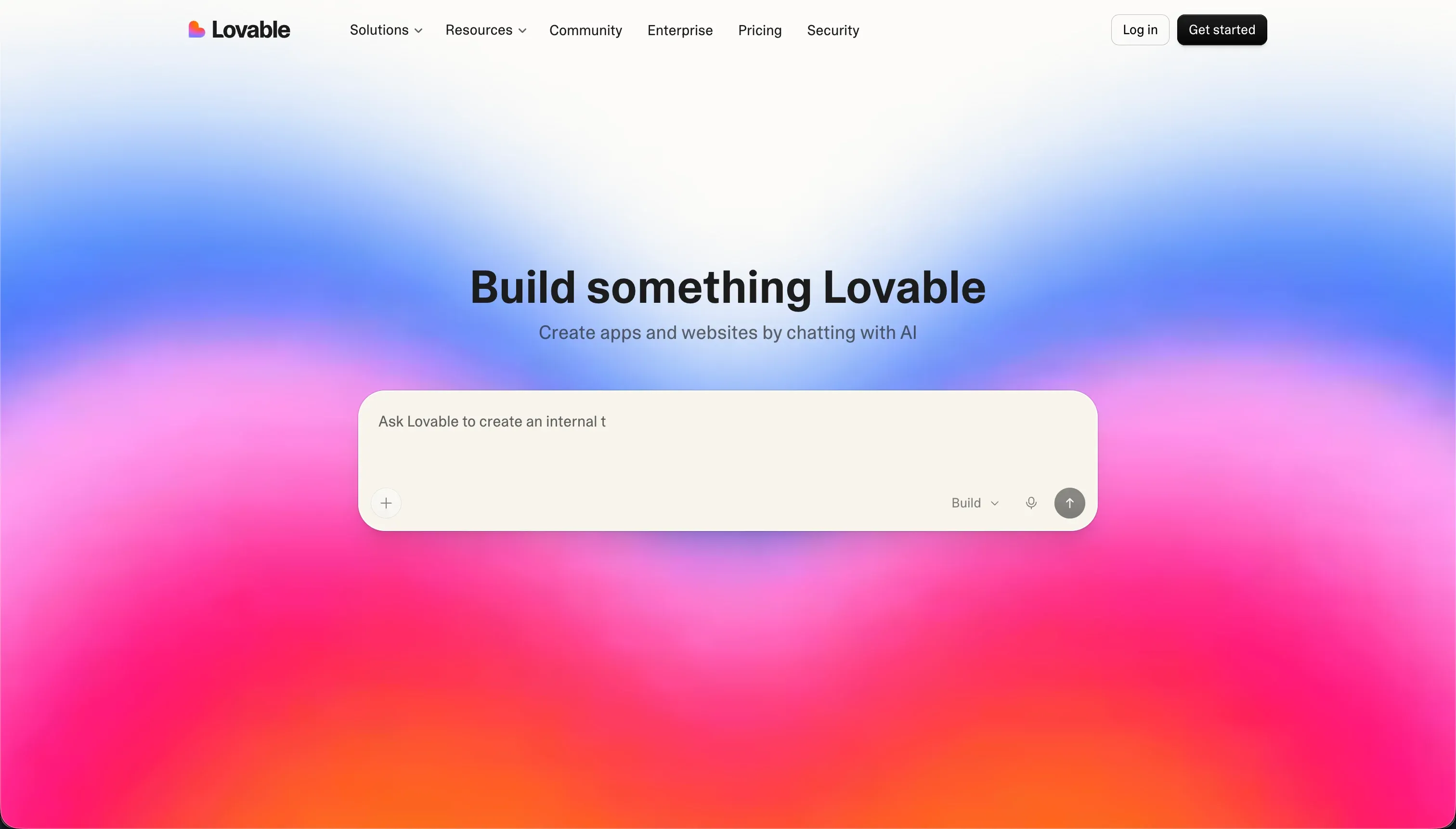 Lovable homepage snapshot
In practice, builders interact with Lovable through a conversational text interface, describing their application requirements in plain English. The platform features native Git integration, allowing users to synchronize their generated repositories directly with GitHub to continue development in local IDEs like VS Code or Cursor. It also offers direct Figma imports to convert visual designs into functional components, alongside one-click deployments to its hosted Lovable Cloud.
The core design philosophy of Lovable is real codebase ownership and portability. By producing standard React and TypeScript code instead of deploying applications to a proprietary visual engine, Lovable aims to give developers and non-technical builders alike a clean path to escape platform lock-in when their application grows.
Lovable is designed for tech-savvy founders, operations teams, and developers who need to quickly stand up custom SaaS MVPs and interactive prototypes. It will heavily frustrate business teams looking for a completely hands-off backend, as fine-tuning visual layouts, managing database security rules, and troubleshooting database schema drift eventually forces the builder to dive into code-level management.

What can you build with Lovable?
The absolute sweet spot for Lovable is rapidly constructing functional SaaS minimum viable products, custom user interfaces, and early-stage prototypes that will eventually hand over to a technical development team.
- Interactive SaaS MVPs with custom React frontends, integrated user logins, and stripe-connected billing checkout pages.
- Custom administrative dashboards that display real-time database feeds, data visualizations, and interactive system menus.
- Rapid front-end scaffolding built from imported Figma design assets and styled dynamically through nested Tailwind configurations.
- Database-driven web utilities utilizing Supabase schemas, custom row-level security files, and relational data tables.
However, Lovable begins to struggle when faced with complex, custom business logic and long-term application maintenance. It does not excel at managing deep relational schema debt; over time, adding a single new database table or changing a column type via prompting can break dozens of existing workflows, making it a poor choice for applications expected to live longer than 18 to 24 months without a complete code rebuild.
What users are saying
Feedback from developer communities across Reddit and Product Hunt reveals a sharp contrast between how the tool performs in the initial design sprint versus its behavior during subsequent iteration cycles.
- Users highly praise the visual quality of the first draft, noting it produces stunning, interactive interfaces right out of gate.
- Many builders report severe long-term maintenance overhead, where platform updates regularly cause regression bugs that break live client applications.
- A significant fraction of the community complains about prompt regression, noting the AI will confidently state it has patched an issue while actually executing a circular loop that fails to fix the bug.
- Developers note that exported code, while portable, can rapidly turn into non-scalable spaghetti folder structures if the app is edited solely via prompts.
Lovable is great for designing and prototyping fast, but the moment you hit month nine, you realize you are paying a massive technical debt tax just to patch the same regression bugs over and over.
Our read: Lovable is an excellent, world-class tool for building a quick SaaS demo to show investors or validate an audience. However, treat it strictly as a prototype; the moment your app enters production and requires absolute reliability, expect to transition the codebase to manual engineering.
What it costs in practice
Lovable operates a subscription model structured around selectable credit tiers. Unused credits roll over on paid plans, but every minor visual iteration or debugging instruction consumes your credit pool.
| Plan | Price | What you get | Best for |
|---|---|---|---|
| Free | $0 | 5 daily credits, public projects, public hosting, GitHub sync | Testing the tool and building simple public projects |
| Pro Base | $25/mo | 100 monthly credits, private projects, custom domains, 3 editors, credit rollover | Independent builders launching a private MVP or splash page |
| Business Base | $50/mo | 100 monthly credits, advanced templates, SSO authentication, AI model training opt-out | Startups requiring strict data security policies and custom branding |
In real-world use, Lovable can get incredibly expensive due to rapid credit inflation. Community reviews point out that credit consumption has spiked roughly tenfold, with a single prompt now burning 3 to 4 credits. If the AI gets stuck in a broken loop to resolve a minor bug, you can easily spend 40 credits in an hour just trying to revert the UI back to a stable state.
What are Lovable’s common alternatives?
Selecting the right tool depends on whether your project requires raw exported code or a reliable business infrastructure that will not break over time.
| If you want… | Look at | Why |
|---|---|---|
| A visual, secure, and zero-maintenance business app | Softr | It does not generate raw code, building apps from native stable blocks that avoid technical debt and prompt regression completely. |
| An alternative browser-based full-stack IDE | Bolt | It provides a robust, developer-centric in-browser setup for running and compiling React applications. |
| To design in-browser but host yourself | v0 | Vercel’s generative interface excels at outputting elegant frontend UI code that fits cleanly into Next.js projects. |
| AI code generation directly in your terminal | Claude Code | It embeds agentic engineering capabilities natively within your local command-line git directories. |
For teams launching a public-facing startup that will eventually require human developers, Bolt is the closest peer to Lovable, offering a competitive environment for outputting and running clean code. If you prefer to keep your development workspace entirely local while leveraging generative UI, Vercel’s v0 is highly efficient for crafting interfaces that plug seamlessly into a custom codebase.
However, if you are building an portal or internal database tool, these generated code systems present a massive security and maintenance risk. In these business-shaped scenarios, Softr is the logical logical alternative. While Lovable leaves you with unverified database permissions policies and complex hosting pipelines to coordinate, Softr utilizes secure, native databases and visually configured user visibility rules to run your tools smoothly with zero risk of silent code regression.
Who Lovable is for (and who it isn’t)
Lovable is the ultimate choice for tech-fluent designers and indie makers who need to validate a SaaS concept with speed and want standard React code to hand off to developers later. You must accept that your subscription cost will be driven by the debugging fix loop, and you will eventually need developer eyes to review the code.
Skip it entirely if you are a manager or non-technical business leader looking to deploy an internal dashboard, partner hub, or customer workspace. Trying to prompt your way through authentication rules and API syncing will burn your cash. Instead, head to Softr to build secure business apps using robust, visual blocks with predictable pricing, and consider a local code editor like Cursor only if you are looking to write software manually.
