Compare Tools

Base44 vs Lovable: which one survives a real client-facing booking app?

June 16, 2026

Verdict

Neither wins this booking app: Lovable leans to developer handoff, Base44 to an all-in-one setup, but both leave a non-technical builder maintaining code they cannot own. For real clients, look past both to a no-code platform like Softr.

Base44 logo

Base44

All-in-one conversational app builder with bundled database, auth, and hosting.

Lovable logo

Lovable

Prompt-to-app builder that generates full React frontends from plain English.

Base44 vs Lovable, on screen

base44.com
Base44 homepage
lovable.dev
Lovable homepage

The fairest way to compare Base44 and Lovable is to judge them on a concrete, everyday assignment: a small client-facing booking app. This app requires a calendar interface where clients can view open slots, choose a time, input personal details, and process a payment. Beyond the visual calendar, the real product constitutes the back-end plumbing - guaranteeing that Client A can never see, modify, or overwrite Client B's appointments, while updating a central calendar in real-time.

This booking app is a typical transactional workflow that sits between a simple landing page and a complex SaaS. For vibe-coding and prompt-to-app tools, this specific middle ground exposes significant structural risks. If user registration, slot booking, and payment mapping are generated on the fly via iterative natural-language prompts, you introduce critical failure loops. Any minor layout fix or database adjust risks breaking the underlying relational links, resulting in duplicate bookings or leaked client slot data.

The audience

Who each one is for

Base44

  • Non-technical operators wanting to prompt an app into existence with databases and auth fully handled.
  • Makers looking for a single dashboard that avoids multi-platform setup and hosting orchestration.
  • Founders seeking to build operational prototypes without touching terminal commands or deployment pipelines.
  • Small business builders who prefer visual clicking paired with simple conversational prompt tweaks.

Lovable

  • Product teams wanting to scaffold clean frontends from Figma designs and prompt descriptions.
  • SaaS founders who plan to start with AI but eventually hand the code to developers.
  • Builders comfortable navigating Supabase configurations, database schemas, and git repositories from the start.
  • Developers looking for readable React and TypeScript scaffolding to accelerate their initial setup.

Base44 is designed for non-technical operators who want backend complexity hidden behind a unified interface; Lovable is built for product teams and founders who prioritize high-fidelity React codebases and database portability.

The scope

What you'd build with it

Base44

  • Internal operational booking utilities, basic schedules, and customer directories.
  • SaaS MVPs that do not require complex, fine-grained multi-tenant row-level access control.
  • Fast operational workflow tools where layout precision is secondary to core utility.
  • Portals that must remain strictly inside Base44 - it cannot be packaged for app stores.

Lovable

  • High-fidelity SaaS software prototypes, interactive web directories, and aesthetic front-end booking views.
  • React and TypeScript web applications paired with a direct Supabase database backend.
  • Figma-to-code components and single-page marketing landing pages that do not iterate ongoingly.
  • Apps meant to run for under 18 months - experience shows complexity limits require future rewrites.

The plumbing question

Base44 approaches database management by automating PostgreSQL schemas, hosting, and auth configuration into a single black-box pass from your initial prompt. For a booking app, this means the calendar logic, slot allocations, and client tables are constructed dynamically behind the scenes by the AI. While this saves you from manually configuring endpoints: you are entirely locked into Base44's closed infrastructure, backend functions cannot be edited direct, and user reviews note that trying to scale complex multi-user parameters or account-level isolation rules runs into structural bottlenecks because the platform lacks native tenant architecture.

Lovable builds its data architecture by direct integration with Supabase, transforming structured prompts into a white-labeled database backend. For our booking app: the relationships between clients, booked slots, and payment states are mapped directly to a live PostgreSQL database where security relies on row-level security policies. While this provides code-level visibility, it creates a massive technical burden. Because RLS must be configured via prompt loops rather than visual panels, builders risk security vulnerabilities if they cannot read raw code to verify that the AI's generated database rules actually prevent Client A from accessing Client B's appointments.

Strengths

Where each one is strong

Edge: Lovable

Lovable takes the edge on strengths due to its higher-fidelity visual output and cleaner developer handoff.

Base44

  • Turnkey full-stack setup from one pass: no database configuration, hosting setup, or API endpoints to wire up.
  • Visual click-to-tweak design tool allows non-technical builders to adjust simple styling parameters without prompting.
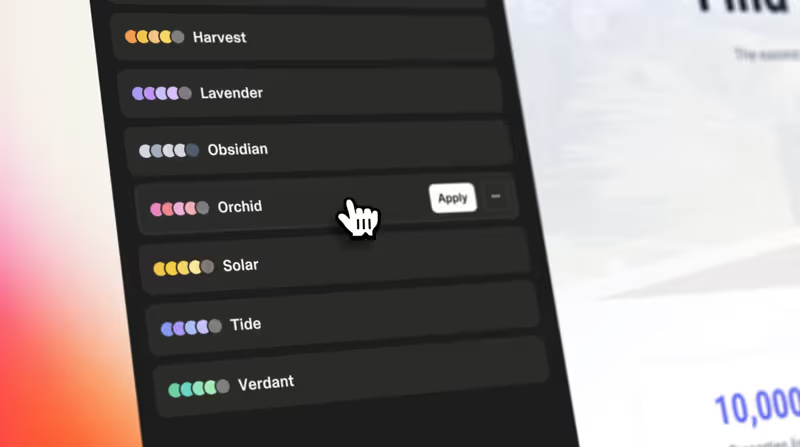
  • Idea Library and design tokens help scaffold common booking interfaces and themes with single-word prompts.
  • Generous free plan includes a managed PostgreSQL database, authentication, and core analytic features.

Lovable

  • Exceptional first-draft visual quality with clean React, TypeScript, and modern, responsive frontend components.
  • Direct Supabase database integration handles transactional data, user registration, and real-time syncing.
  • Built-in Figma import makes it simple to convert design tokens direct into working layouts.
  • Pre-publish safety checks automatically scan generated code and database row rules before going live.

Failure modes

Where each one breaks

Edge: Lovable

Lovable's failure modes are slightly less punishing because you can export the codebase when things break, whereas Base44 locks you into its environment.

Base44

  • Damaging regression loops: community reports highlight that Base44's editing agent frequently introduces old bugs when attempting new fixes.
  • Frequent server issues, builder instability, and apps breaking in production have caused serious customer trust complaints.
  • Wasted credit consumption during iterative chats where the AI repeatedly fails to solve hidden backend flaws.
  • Severe scale caps caused by dependency on LiteLLM connections, which introduces processing latency under load.

Lovable

  • Severe credit inflation: community builders report prompt consumption increasing up to ten-fold for simple fixes.
  • The AI-constructed schema trap results in compounding database structural debt by month six, fighting future changes.
  • Regression failures where the chat editor reports a booking bug is fixed when it remains broken.
  • Discrepancies between the preview environment and live deployment, where code fails to build silently.

Iteration cost

The fix loop, priced

Even

Both platforms require paying for the AI's mistakes during iterative bug-fixing loops.

Base44

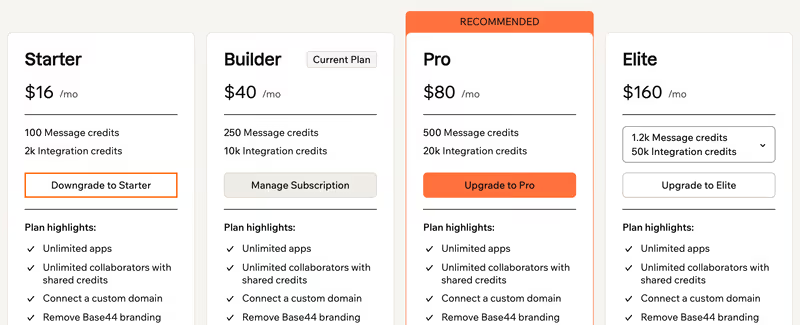
  • Starter plan costs $20/month with 100 message credits and 2,000 integration credits.
  • Every single prompt and user action inside the published app consumes credits.
  • Users report burning 400+ credits simply to fail at breaking out of looping bugs.
  • Credits do not roll over monthly, making software maintenance costs unpredictable.

Lovable

  • Pro plan starts at $25/month for 100 base credits with scalable higher tiers.
  • Credit pricing on the Business plan costs roughly double compared to Pro to scale.
  • Users report massive credit consumption to patch code regressions generated by the AI.
  • Unused credits roll over on paid plan tiers as long as the subscription is active.

Iterating on a booking app's validation or payment logic will rapidly exhaust base allowances, forcing you to pay for the debugging cycles detailed in the fix loop tax.

Exit paths

The code you end up with

Edge: Lovable

Lovable wins the export category because it does not lock your database or backend in a closed system.

Base44

  • Frontend React components can be exported directly to standard GitHub repositories.
  • The database is trapped inside a closed, proprietary infrastructure with no clean export paths.
  • High cost barriers exist, with users reporting having to pay for a full year's Builder plan just to get their files off.
  • No programmatic access or offline migration paths exist for the managed PostgreSQL backend.

Lovable

  • Generated React and TypeScript syncs direct to GitHub for local development in Cursor or VS Code.
  • The Supabase backend maintains standard SQL schema formats with no proprietary locking layers.
  • Exported React code is styled nicely but can be messy and hard to read for downstream developers.
  • Experienced builders advise migrating to a code-first stack for apps needing to survive past 24 months.

When neither wins

Here is the uncomfortable reality of building a client-facing booking app with these contenders: booking utilities are 80% database, auth, and logic plumbing paired with a calendar user interface. Both tools generate this plumbing as code, meaning you are completely responsible for auditing, securing, and maintaining it. If Client A tries to book a slot, you must trust that the generated database queries, status updates, and session variables run safely. One prompt regression can break the calendar database, corrupt scheduling calculations, or leak customer email data.

For builders who do not want to manage technical debt, the right choice is Softr. Softr treats calendars, conditional forms, user registration, and data security as visual platform infrastructure. There is no generated authentication code to audit because there is no generated code at all. You connect data, map booking tables, and restrict calendar access visually with zero risk of code regressions. While Softr is not suited for custom consumer-facing software or builders demanding physical code ownership, it turns the most dangerous part of booking infrastructure into a reliable, no-code setting.

Verdict

Lovable wins this matchup, but only if you have developers on hand to inspect what has been generated. The clean visual outputs and standard React and TypeScript database structures synced direct to GitHub give you a robust foundation. Just ensure you budget for token burn during the booking validation fix loop, and prepare to configure your database rules inside Supabase rather than relying on AI prompts.

Choose Base44 only if you want to assemble a fast mock-up and completely avoid setting up database hosts. Since Base44 bundles the hosting, PostgreSQL database, and user directories in a single environment, you can scaffold transactional utilities extremely quickly. However, prepare for ongoing platform instability, vendor lock-in, and unpredictable integration billing as users load the app.

If you are a business operator building this booking utility for real clients, look past both options: do not use code-generation tools to secure client data. The plumbing required for secure customer sessions is exactly what a no-code platform like Softr delivers natively. Use a platform that simplifies the structural risks.

Q & A

Frequently Asked Questions

Is Base44 better than Lovable for business booking apps?

Base44 is faster to get running because it automatically manages databases and hosting inside one dashboard, but it suffers from severe database lock-in. Lovable provides higher-quality visual components and syncs standard code to GitHub, making it a better choice if you have a developer to review the generated booking views.

Can I export my database and code from Base44 and Lovable?

Lovable outputs clean React, TypeScript, and a standard Supabase backend, enabling you to export and walk away at any time. Base44 allows you to export your frontend to GitHub, but keeping your relational database requires paying a high runtime premium because the backend logic stays locked within their closed infrastructure.

Which tool costs more to maintain, Lovable or Base44?

Both tools can quickly become expensive due to prompt-driven fix loops. Lovable uses credit-based pricing where fixing visual and validation bugs consumes tokens, while Base44 uses a dual-credit structure where you are billed for building prompts and charged integration credits whenever booking users query your database.

What should non-technical teams use to build a secure booking app instead?

For client-facing databases where data isolation is critical, non-technical builders should use Softr. Softr handles calendars, customer login, payment integrations, and row-level data visibility through visual configuration panels, removing the risk of AI-generated bugs corrupting your schedules.