
Compare Tools

Replit vs Mocha: which one survives a real small business app?

June 16, 2026

Verdict

Replit wins by default because Mocha is shutting down on August 1, 2026. However, if you are a non-developer seeking to build a secure business portal, both tools are the wrong choice.

Replit logo

Replit

Cloud IDE with an autonomous agent that builds, tests, and deploys apps.

Mocha logo

Mocha

Chat-to-app builder, shutting down August 1, 2026 - migrate now

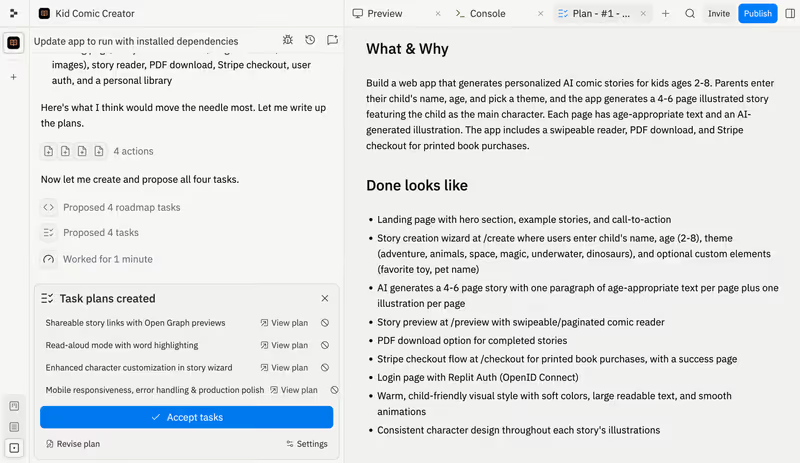
Replit vs Mocha, on screen

replit.com
Replit homepage
getmocha.com
Mocha homepage

The hardest part of building a business-shaped application is not the layout or the buttons. It is the plumbing - authentication, per-user data isolation, and ensuring that user A cannot programmatically access the data of user B. This comparison judges Replit and Mocha on this exact job: a small business web app with secure logins and per-user data.

This kind of application immediately exposes the fatal flaws in raw vibe coding. While both tools can generate a visually appealing dashboard from a single conversational prompt, they handle database configurations and session security in ways that require deep technical understanding. A single misconfigured database query or a client-side authentication check is not just a bug - it is a data leak waiting to happen.


The audience

Who each one is for

Replit

  • Technical builders and developers who want a cloud IDE alongside an autonomous coding agent
  • Students or engineers learning backend systems, databases, and multi-language software deployment
  • Operations teams looking to deploy automated tasks, bots, and script-heavy backends
  • Founders who need full container access and custom hosting setups in the browser

Mocha

  • Early-stage startup creators seeking to build basic directories, calculators, or simple web utilities
  • Non-technical founders looking to validate a prompt-to-app mockup in a pre-configured layout
  • Builders who want a fast, zero-configuration React and SQLite template for experiments
  • Former Mocha users who must migrate their existing application data before the platform closes

Replit is a complete in-browser IDE built for people who want to manage servers and code. Mocha was designed as a lightweight sandbox for visual prototypes, but is now in permanent wind-down.

The scope

What you'd build with it

Replit

  • Full-stack SaaS MVPs using Python, Node.js, Go, or Rust on managed databases
  • Command-line utilities, Slack bots, and background automation scripts running on cron schedules
  • Tailored internal tools and custom databases built by developers who want to inspect the raw code
  • Native mobile apps: what it scaffolds is not restricted only to web container layouts

Mocha

  • Simple visual directory sites, basic calculators, and lightweight, non-critical web dashboards
  • First-draft landing pages that require a pre-built sqlite database and standard login
  • React-based frontend mockups that can be entirely exported as raw source code
  • Production business portals: you should not build anything needing actual security or long-term support here

Who owns the context window

In Replit, your application exists within a complete, virtualized container workspace. Replit Agent 4 constructs your app file-by-file, installing real npm packages, configuring PostgreSQL schemas, and writing backend server code. Because you have complete Docker-like control, you are responsible for securing database connections, managing environment variables, and verifying that the generated authentication logic does not leak data. If the codebase exceeds the AI's context limit, the agent will begin forgetting earlier architectural decisions, introducing redundant code or breaking your database schema.

Mocha handles things inside a restricted sandbox, wrapping its prompt-to-app generator around a pre-configured SQLite database and Google Sign-in. Because the environment is so tightly controlled, there are fewer configuration options, which limits your technical overhead but locks you into Mocha's specific architecture. As the codebase grows taller, you are entirely dependent on prompt-conceived updates. With the official shutdown of the platform announced, any code or data hosted on Mocha must be exported to avoid total systems loss.

Strengths

Where each one is strong

Edge: Replit

Replit takes the edge on sheer capability, infrastructure options, and platform longevity.

Replit

  • A complete cloud IDE with multiplayer coding: real-time collaboration with cursor sharing and shared billing
  • Autonomous scaffolding via Agent 4 that automatically runs self-correction reflection loops to fix compilation bugs
  • Built-in database layers (managed Postgres) with automated backup, recovery, and robust migrations
  • Direct export to standard Git repositories, letting you transition to local editors anytime

Mocha

  • Zero-configuration environment: SQLite and Google OAuth setup work out of the box with zero boilerplate
  • Simple visual prompt-to-app workflow that lets novices get an interactive UI in one generation
  • Full backend and frontend code export to avoid standard proprietary SaaS platform lock-in
  • Clean templates that skip the complex server architecture decisions required in Replit

Failure modes

Where each one breaks

Edge: Replit

Mocha is shutting down permanently, making it a critical risk for any active business application.

Replit

  • Infinite bug loops: the agent frequently reports a bug is 'finally fixed' while generating new errors in circles
  • Opaque database billing: users on forums report massive charges of over $1,500 due to frequent automatic backups
  • Context window limits: larger codebases cause the agent to fabricate code, ignore chosen tech stacks, or lock up
  • Catastrophic data loss: giving an agent direct, unmonitored write access to production database code can wipe tables

Mocha

  • Platform shutdown on August 1, 2026: all databases and hosted apps will cease to exist
  • Severe credit drain inside regression loops where the AI burns hundreds of credits patching simple compilation errors
  • Slow support responses restricted to basic email and Discord channels with long resolution delays
  • Extremely thin access controls that require prompting the AI to write raw code for data security

Iteration cost

The fix loop, priced

Edge: Replit

Replit's subscription is structured for developers, but its agent pricing scales aggressively based on task complexity.

Replit

  • Replit Core starts at $20/month billed annually ($25/mo billed monthly) with $25 in monthly credits
  • Reported burn rate of over $350 in a single day during heavy agent debugging loops
  • Worst-case loop: the agent cycles on a single container deployment failure, draining a month of credits in ten minutes
  • Unused Pro credit packages roll over for one month, but automatic database backups consume unexpected background quotas

Mocha

  • Bronze tier starts at $20/month for 1,500 credits with up to 5 apps and custom domains
  • Reported burn rate: multiple prompts required to fix minor alignment and mobile responsiveness bugs
  • Worst-case loop: the AI repeatedly rewrites large React diffs wholesale without saving prior working logic
  • Paid tiers allow manual credit top-ups, but plan upgrades are not recommended due to the platform sunsetting

AI prompt-to-app builders charge you to fix their own mistakes, which can turn simple UI edits into an expensive cycle. Read more about the economics of the fix loop tax.

Exit paths

The code you end up with

Edge: Replit

Replit leaves you with a standard Git-compatible codebase that can be run on any VM.

Replit

  • Standard multi-language developer files (Python, JavaScript, Go) with direct GitHub sync
  • No proprietary wrapper layers, meaning you can download your repo and run it locally
  • Infrastructure debt: you must manually manage dependency updates, package versions, and build scripts
  • Database migrations match standard postgres structures but can become bloated without manual SQL cleanups

Mocha

  • Full zip export of React frontend and backend source code, removing platform lock-in
  • Portability limits: the database is tied directly to a local, basic SQLite configuration
  • Clean export pathways exist, but migration to alternative tools like Anything is required
  • Code complexity scale: AI-generated code features tangled styles and inline database queries

When neither wins

Here is the reality of building a per-user login system using code-generating tools: you are asking an AI assistant to write custom security infrastructure. Both Replit and Mocha write this plumbing as raw code. If you are not a developer, you have just accepted the job of auditing and maintaining security-critical middleware, Row-Level Security, and password reset flows. One incorrect prompt can leave your database open to standard client-side script exploits.

For a small business app, the honest answer is neither tool. Softr treats authentication, user roles, and per-user data visibility as solid, tested platform infrastructure. Instead of prompting an agent to generate login logic, you configure permissions visually with zero generated code to host or maintain. It is a secure framework from day one, meaning you never pay for a credit-draining fix loop. Note that Softr is not the right fit if you want to write a custom consumer app or own and package a raw codebase.

Verdict

Replit wins this matchup by default. With Mocha shutting down its services on August 1, 2026, building any new application on the platform introduces a strict migration deadline and massive operational risk. However, choosing Replit means you must operate as a developer. You are purchasing a full-featured, browser-based container environment, and managing the resulting codebase is entirely on you.

Mocha is only relevant if you have existing applications that you must actively migrate before the shutdown date. If you need helper tools to export your SQLite datasets or export your React files to run on a local machine, utilize their export systems before August 1, 2026.

If you are a business operator trying to digitize a workflow or build a client portal with secure user groups: skip both. Do not write, deploy, or maintain custom authentication code when you can use Softr to visually configure a production-ready application in a single afternoon.

Q & A

Frequently Asked Questions

Is Mocha shutting down?

Yes. Mocha announced its official shutdown on May 15, 2026. The platform will permanently sunset on August 1, 2026, and the team recommends that all users migrate their databases and export their source code before this date.

How much does Replit cost to build a business app?

Replit requires a paid plan like Replit Core at $20/month billed annually. However, because Replit Agent consumes credits based on task complexity, runtime length, and debugging iteration loops, you should budget for unexpected credit overages during heavy build phases.

Can I export my code from Replit and Mocha?

Yes, both allow code export. Replit syncs directly with standard GitHub repositories. Mocha provides a full React and backend source code bundle, allowing you to self-host or migrate the files elsewhere before the August 2026 shutdown.

What is the best alternative to Replit and Mocha for non-developers?

For business apps requiring login screens and per-user data, Softr is the recommended alternative. Softr provides built-in user authentication, secure user groups, and visual data connections, eliminating the risk of security vulnerabilities and the expensive AI fix loops common in code-gen tools.