Compare Tools

Devin vs Replit: which one survives as an autonomous workspace for a product team?

June 16, 2026

Verdict

Replit wins if your team wants a collaborative cloud environment with an autonomous agent; Devin wins if you are a professional developer seeking a local, VS Code-compatible styling helper.

Devin logo

Devin

A capable local coding agent with fast autocomplete, but it struggles to match Cursor's overall pace

Replit logo

Replit

Cloud IDE with an autonomous agent that builds, tests, and deploys apps.

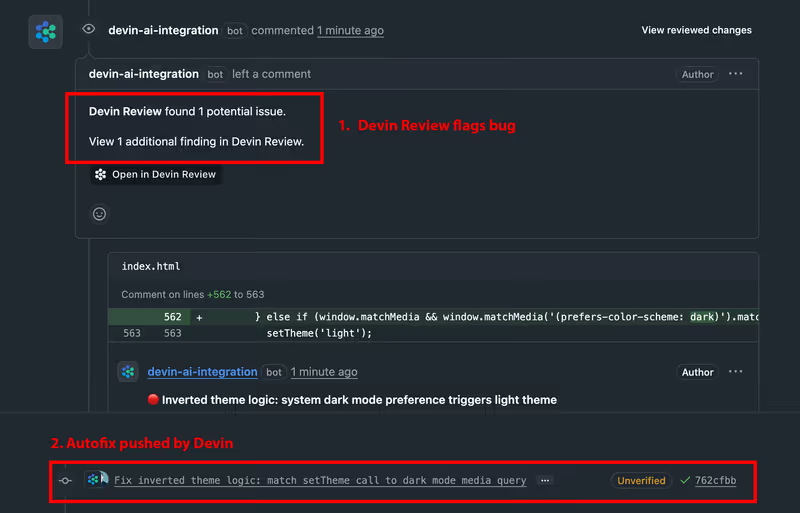
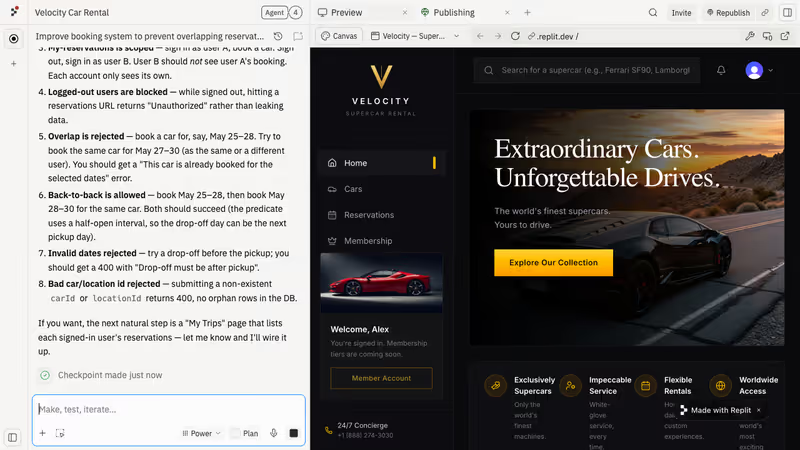
Devin vs Replit, on screen

devin.ai
Devin homepage
replit.com
Replit homepage

Choosing between Devin and Replit is a choice between two distinct engineering philosophies. The first represents an autonomous agent designed to assist developers on local, VS Code-compatible projects with fast autocomplete. The second represents an entire collaborative cloud development platform with a native container engine and an agent that is capable of building, testing, and deploying apps on its own.

Evaluating this pair requires judging them on a concrete, team-centric job: deploying and maintaining operations for a small product team. This job quickly cuts through the marketing noise surrounding autonomous AI agents. When multiple builders, active codebases, and real-time deployment constraints are involved, the differences between local terminal instrumentation and fully integrated cloud hosting environments become impossible to hide.

The audience

Who each one is for

Devin

  • Professional developers who want low-latency inline code autocomplete in a local workspace.
  • Engineers who prefer VS Code configurations and standard desktop extensions.
  • Teams with existing local repositories looking for parallel, multi-file code editing assistance.
  • Builders who prioritize offline IDE styling over cloud-connected container environments.

Replit

  • Small product teams seeking a zero-setup cloud IDE to build and deploy applications collectively.
  • Non-technical founders looking to prototype and deploy operational SaaS tools quickly.
  • Collaborative squads that want real-time multiplayer coding with voice chat and centralized billing controls.
  • Developers who want integrated PostgreSQL database provisioning alongside an active container stack.

Devin remains a developer-centric assistant that operates inside a local codebase, while Replit is built to be a full-stack, cloud-hosted collaborative cockpit for multi-disciplinary teams.

The scope

What you'd build with it

Devin

  • Automated refactoring scripts that target multiple files across a local folder structure.
  • Standard front-end visual components built inside custom web app repositories.
  • Back-end script optimizations where Devin operates against compile errors autonomously.
  • What it cannot build: fully hosted production web applications with built-in servers.

Replit

  • Autonomous full-stack SaaS MVPs running on PostgreSQL and Node.js containers.
  • Automated background tasks, Slack bots, and interactive email workflow responders.
  • Browser-based mobile applications with simulated previews displayed directly on-screen.
  • What it cannot build: native desktop applications requiring custom local hardware compilation.

The plumbing question

Devin is built on top of a VS Code fork, relying on the Cascade AI agent to index local directories, parse package files, and run commands through your local system's terminal. It excels at local developer ergonomics, where context awareness is defined by system-wide directory indexing. However, it does not manage your infrastructure. If your app requires database migrations, safe environment variable hosting, or an SSL-configured production server, these manual tasks must still be performed by a human engineer using external services.

Replit approaches the team challenge by virtualizing the entire environment inside a cloud workspace. Its native container engine provides an active runtime, package managers, and a managed PostgreSQL layer straight out of the box. Replit Agent works directly inside this sandbox, autonomously testing its own code, resolving package mismatches, and deploying the resulting app with a single click. For a small product team, Replit eliminates the traditional boundary between writing code and managing servers, but it shifts the cognitive load to managing the cloud resource limits of those containers.

Strengths

Where each one is strong

Edge: Replit

Replit takes the edge because it provides a complete cloud environment with native databases and one-click hosting, whereas Devin requires external infrastructure setup.

Devin

  • Low-latency inline autocomplete powered by Codeium's custom local AI models.
  • Parallel editing setups that apply changes across several workspace files at once.
  • Full support for VS Code keyboard shortcuts, color themes, and extension marketplaces.
  • An editable diff mechanism that lets developers verify changes before execution.

Replit

  • Autonomous self-correction loops that find, test, and resolve compile errors without human intervention.
  • Multiplayer editing directories that support real-time team collaboration and shared cursor screens.
  • Instant, integrated web hosting with automatic SSL generation and custom domain routing.
  • Managed database provisioning, including automated rollbacks and schema migration helpers.

Failure modes

Where each one breaks

Edge: Devin

Devin's failures are confined to the IDE interface, while a run-away Replit Agent can cause catastrophic live data errors or unexpected billing overages.

Devin

  • Hallucinated dependencies and non-existent package imports generated during complex Cascade commands.
  • Cascade agent sessions that suddenly stall and freeze mid-way through large-scale directories.
  • Limited agent capabilities for non-technical users who do not understand Git or CLI behaviors.
  • Corporate uncertainty following recent team departures and organizational transitions.

Replit

  • Infinite bug generation loops where the agent repeatedly builds new workarounds for its own errors.
  • Hidden, scaling database charges caused by the agent backing up data at every checkpoint.
  • Severe context throttling (down to 8k tokens) that increases coding mistakes during long container build sessions.
  • Severe data loss failures if the agent is granted write-access to an active production sandbox.

Iteration cost

The fix loop, priced

Even

Both platforms can charge heavily for AI credit drain during repetitive debugging loops.

Devin

  • Premium tier is priced at $15/mo billed annually (or $20/mo billed monthly).
  • Unlimited autocomplete is provided alongside high-speed Cascade agent prompts.
  • Users report session timeouts during heavy multi-file edit loops, forcing prompt restarts.
  • Premium features remain bounded by traditional local hardware capabilities.

Replit

  • Pro plan costs $95/mo billed annually ($100/mo monthly) and includes $100.00 in monthly credits.
  • Usage is effort-priced, billing users based on runtime and task complexity.
  • Communities report extreme overages where a single run-away agent loop bills over $300 in one day.
  • Pro tiered credit addons can be pre-purchased at nested discounts scaling to $2,050/mo.

Both models charge you for agent mistakes. An unexpected structural issue can spin up a costly fix loop tax that consumes credits or token allowances rapidly.

Exit paths

The code you end up with

Edge: Replit

Replit hosts the complete, deployed stack, making team access and active previews immediately superior.

Devin

  • Standard local files and VS Code repos that remain fully under developer control.
  • Standard folder structures with zero proprietary layout or export formats.
  • No platform lock-in; you can shut down the IDE and work elsewhere immediately.
  • High reliance on developers to configure modern production-grade security and RLS rules manually.

Replit

  • Full Git-compatible code folders that sync directly to GitHub.
  • Native deployment containers with custom variables hosted directly inside Replit’s cloud.
  • Native SQLite or PostgreSQL backends that can be exported or rolled back in real time.
  • The risk of inheriting complex, unoptimized spaghetti code after several autonomous iterations.

When neither wins

Because both Devin and Replit are developer environments at their core, they both introduce the same critical failure mode for non-technical teams: you are handed a code repository that you must ultimately read, deploy, and secure. If your product team does not have a dedicated developer, using these platforms means you've just become the permanent manager of an unmaintained codebase full of potential security vulnerabilities.

If your small team is building internal tools, client portals, CRMs, or operations platforms, look past both. Softr treats user databases, authentication, user groups, and role-based permissions as secure, visual platform infrastructure rather than generated code. There is no fix loop to pay for because changes are made through instant visual settings, not repeating AI prompts. It is the wrong fit if you want a custom gaming interface or want to own raw code files - which is exactly why it doesn't fight in this developer matchup - but for business applications, it makes the dangerous parts boring.

Verdict

Replit is the clear winner for a small product team seeking a collaborative, browser-based workspace. Its multiplayer environment, built-in container compilation, and autonomous Agent 4 allow cross-functional teams to brainstorm, build, and deploy working applications without managing local development environments or API keys.

Devin remains the right choice only if you are an independent professional software engineer who already owns a local workflow. If you want a fast autocomplete assistant, standard VS Code workspace compatibility, and support for your existing offline tools, Devin's Cascade engine fits your IDE layout cleanly.

For teams building operational software like CRM panels or client workspaces, neither developer tool is a safe fit. Avoid the tech-debt trap of raw code arrays and leverage Softr to launch clean, pre-secured portals that do not require an active engineering budget to maintain.

Q & A

Frequently Asked Questions

Is Replit better than Devin for team collaboration?

Yes. Replit features a cloud-based IDE designed for multiplayer collaboration, real-time cursor sharing, and unified team billing, while Devin is primarily a local developer tool focused on individual workspaces.

Can I export my code from Devin and Replit?

Yes. Both tools produce standard code structures that sync directly with GitHub. Replit allows you to export full React or Python directories, and Devin structures standard local repositories with no proprietary lock-in.

Which costs more to run, Devin or Replit?

Replit can cost significantly more due to its effort-priced agent billing and database overages, with community reviews noting unexpected bills scaling to hundreds of dollars. Devin runs on a traditional flat-rate subscription structure.

What should non-technical teams use to build business portals instead?

Non-technical teams should use Softr because it builds operational apps like client portals and CRM directories visually without code, eliminating the risk of unmaintained database vulnerabilities.