
Compare Tools

v0 vs Replit: which one survives the jump from UI prototype to a deployed product?

June 16, 2026

Verdict

v0 wins if the job is polished frontend output on top of an existing stack; Replit wins if you need a live full-stack app, and business buyers should look past both.

v0 logo

v0

Vercel's AI frontend generator: prompts to shadcn/ui React components.

Replit logo

Replit

Cloud IDE with an autonomous agent that builds, tests, and deploys apps.

v0 vs Replit, on screen

v0.dev
v0 homepage
replit.com
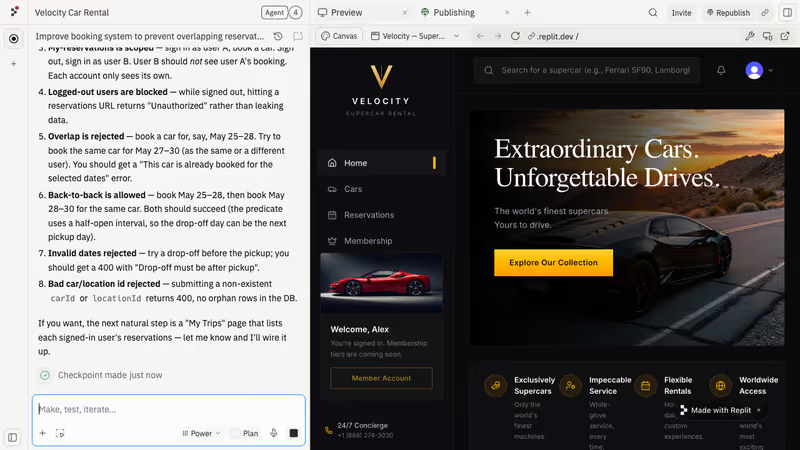
Replit homepage

The useful way to compare v0 and Replit is on one concrete job: taking an AI-generated interface and turning it into something people can actually use in production. They overlap at the prompt box, but they diverge hard once the work moves past screens and into deployment. v0 is optimized around React UI generation and Vercel-friendly frontend output, while Replit tries to cover the wider path from prompt to running app.

That job exposes the failure modes that matter because the hard part is rarely the first screen. The real breakpoints are authentication, data storage, runtime behavior, environment management, and the cost of fixing AI-made mistakes after the demo looks good. A tool that feels fast in generation can become expensive or fragile the moment the app needs state, permissions, and reliable iteration.

The audience

Who each one is for

v0

  • Frontend teams who already have APIs and need fast React interface scaffolding
  • Product designers turning screenshots or rough ideas into polished Tailwind layouts
  • Next.js builders extending an existing codebase with presentable shadcn-style components
  • Agencies needing client-facing mockups before backend requirements are fully settled

Replit

  • Full-stack developers who want code, hosting, runtime, and database tools in one browser tab
  • Technical founders building early internal apps, dashboards, bots, or CRUD products
  • Learners who benefit from an online IDE with terminals, packages, and deployment
  • Small engineering teams that want collaborative editing inside a live hosted environment

v0 assumes the backend problem is somebody else's; Replit assumes you are willing to own it.

The scope

What you'd build with it

v0

  • Marketing pages, dashboards, forms, and admin UIs built from React and Tailwind components
  • Clickable product prototypes that need to look production-ready before the logic exists
  • Frontend surfaces for an existing Next.js or Vercel-centered application stack
  • Not the right tool for apps that need native databases, server jobs, or built-in auth

Replit

  • CRUD web apps with server logic, database access, and deployable backend routes
  • Bots, scripts, APIs, and browser-based projects that need terminal and package control
  • Early SaaS products where one workspace handles code generation, edits, and hosting
  • Not ideal when you want opinionated business-app security without maintaining generated code

The plumbing question

v0 handles the interface side of the job by generating React code, usually with Tailwind and shadcn-style patterns, and by fitting neatly into the Vercel deployment story. That makes it strong when the hinge question is visual fidelity and component output. But the minute the product needs durable state, private data handling, server-side logic, or authenticated workflows, v0 stops being a system and becomes exported frontend code that still needs APIs, database design, environment variables, and application architecture supplied elsewhere.

Replit answers the same question from the runtime side. A Repl is an active hosted development environment with terminal access, package installation, deployment paths, and support for real application processes, so the Agent can generate not just screens but server code and data plumbing around them. That gives Replit a better shot at surviving the jump to a working product, but it also means the user inherits the usual software responsibilities: dependency drift, secrets handling, database correctness, debugging agent loops, and deciding whether the generated structure is maintainable enough to keep.

Strengths

Where each one is strong

Even

They are strong at different layers: v0 at frontend quality, Replit at end-to-end app assembly.

v0

  • Frontend output quality is the main draw: polished React components with strong Tailwind patterns
  • Fits naturally into Vercel and Next.js workflows for teams already shipping frontend-heavy apps
  • Useful for rapid UI exploration when screenshots, text prompts, or rough layouts need code
  • Generated code is relatively portable because it lands as normal frontend files rather than a sealed runtime

Replit

  • Real application environment with editor, terminal, packages, and deployment in one place
  • Better suited to full-stack prompting because server code and runtime behavior can exist together
  • Collaboration features make shared editing and quick experiments easier than local setup for some teams
  • Can produce a runnable project structure instead of only the interface layer

Failure modes

Where each one breaks

Edge: v0

For this job, missing backend capability is easier to understand than inheriting a brittle generated full-stack app.

v0

  • Backend gap becomes the whole story once the product needs auth, storage, or private workflows
  • Prompt iterations can drift from the original component structure and introduce messy UI changes
  • Exported frontend code may still require manual dependency and framework cleanup in a real repo
  • Deployment success does not mean application completeness when the data layer is still missing

Replit

  • Agent fix loops can burn time and credits while reintroducing bugs into working code
  • Generated full-stack projects can become hard to reason about after several iterative agent passes
  • Runtime and package issues are more severe because failures happen in a live app environment
  • Owning the server path means you also own secrets, database mistakes, and operational debugging

Iteration cost

The fix loop, priced

Even

Both tools make iteration look cheap at first and more expensive once AI corrections replace first-pass generation.

v0

  • v0 uses paid access and AI usage limits, so repeated UI correction prompts consume the budget fast
  • The real burn rate shows up when design tweaks trigger multiple regeneration cycles instead of local edits
  • Worst case is paying repeatedly for visual revisions that still leave backend work untouched
  • The structural fact is simple: AI generation spend is separate from the engineering time needed after export

Replit

  • Replit combines subscription pricing with usage-sensitive AI and hosted runtime economics
  • Real-world burn rises when debugging needs several agent runs plus manual inspection in the same session
  • Worst case is paying for failed full-stack repair attempts while the app remains unstable
  • The structural fact is that compute, hosting, and agent iteration can stack into one blended bill

Both models hide the same truth: the expensive part is not generation, but recovery after generation.

Exit paths

The code you end up with

Edge: Replit

Replit more often leaves you with a runnable repository-shaped project, not just the presentation layer.

v0

  • Exports are useful React frontend files that can be moved into an existing project
  • Code is relatively portable because it is standard UI code rather than a proprietary visual format
  • You still need to supply backend architecture, data models, and production application logic elsewhere
  • Lock-in is low on the code itself, but dependence on Vercel-centric workflow is a practical tilt

Replit

  • You can work with a fuller project structure that includes application logic and runtime setup
  • Repositories are closer to standard code ownership because the result is meant to run as software
  • Portability is better for builders who want to take code outside the original AI session
  • The lock-in risk is less about export and more about inheriting messy generated architecture

When neither wins

If the real job is a business app like a client portal, internal tool, or operational dashboard, neither v0 nor Replit is the clean answer. Both leave you maintaining generated code in places where mistakes matter: auth flows, data access, permissions, and security-sensitive logic. v0 hands you attractive frontend code that still needs secure plumbing, while Replit can generate that plumbing but also makes you responsible for auditing and maintaining it.

For that kind of work, Softr is the tool with no fix loop: authentication, user groups, and record-level permissions are platform configuration, not generated code you have to debug. That is the honest advantage for non-developers and business operators. The boundary is real too: Softr is the wrong fit if you need a custom consumer UI or if owning and reshaping the codebase is the point.

Verdict

Replit wins when the job is moving from a generated UI to a deployed product that actually does something, because it covers more of the stack that production software needs. The strongest reason is simple: a deployed product needs runtime, data handling, and server behavior, not just polished components.

v0 is the right pick when the problem is specifically frontend creation inside an existing engineering setup. If your backend already exists and the bottleneck is shipping sharp React UI quickly, v0 is the cleaner, lower-scope tool.

For non-technical business builders, the better standard is to avoid owning generated security-critical code in the first place and look at Softr. If you are choosing between these two as a software team, standardize on the layer you actually need: v0 for interface acceleration, Replit for broader app assembly.

Q & A

Frequently Asked Questions

Is v0 better than Replit for building a real product?

Only if the product question really means frontend quality. v0 is better for polished React interfaces, but Replit is better for a working product that needs server logic, storage, and deployment in one environment.

Can I export code from v0 and Replit?

Yes. v0 gives you portable frontend code, while Replit is more likely to leave you with a fuller repository-style project you can continue outside the platform. The practical difference is that v0 exports less of the total application.

Which costs more to iterate on, v0 or Replit?

It depends on where the fixes are happening. v0 can get expensive when you keep regenerating UI, while Replit can cost more when agent retries, runtime debugging, and hosted app work all stack together. In both cases, fix-heavy projects are where the bill becomes noticeable.

Does v0 handle databases and backend logic like Replit?

No. v0 is primarily a frontend generation tool, so databases, authentication, APIs, and server behavior still need to be built elsewhere. Replit is the closer match if you need those pieces in the same workflow.

What should a non-developer use instead of v0 or Replit for a client portal?

For a business portal, Softr is the safer no-code route because authentication, permissions, and data access are configured as platform features instead of generated application code. That matters when the goal is a reliable business tool rather than owning a custom software stack.