
Compare Tools

Lovable vs Replit: which one survives a consumer MVP's first hundred users?

June 16, 2026

Verdict

Replit wins if a developer maintains the codebase; Lovable wins if a non-technical founder is driving the initial launch. If the MVP is a business-internal operational tool, both are the wrong choice.

Lovable logo

Lovable

Prompt-to-app builder that generates full React frontends from plain English.

Replit logo

Replit

Cloud IDE with an autonomous agent that builds, tests, and deploys apps.

Lovable vs Replit, on screen

lovable.dev
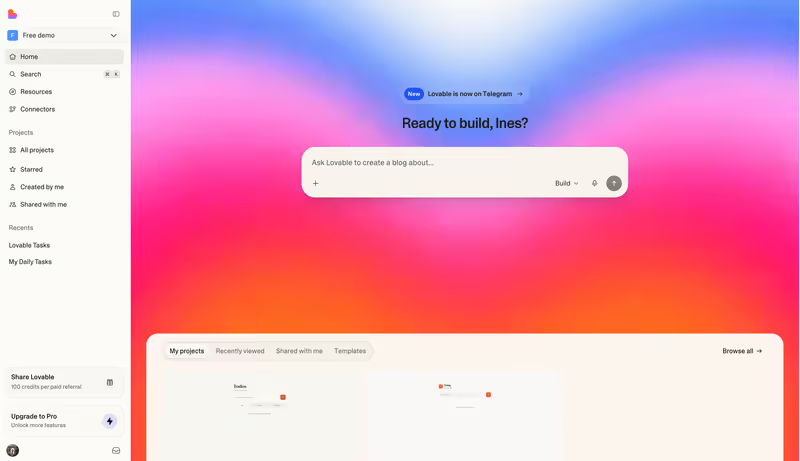
Lovable homepage
replit.com
Replit homepage

The hardest part of a consumer MVP isn't building the landing page; it's surviving the first hundred real users. When user ninety-nine hits a database constraint, or user one hundred registers with an unexpected OAuth format, the app's survival depends on how fast the builder can patch the codebase. This comparison judges Lovable and Replit explicitly on this launch-day transition from isolated environment to living production app.

While Lovable aims to build complete React and Supabase apps out of clean natural language instructions, Replit operates as a full cloud-based IDE backed by an autonomous agent capable of writing, running, and debugging its own full-stack code. The two environments diverge sharply on how they treat the underlying server infrastructure, file dependencies, and database schemas. For a consumer MVP, choosing between them dictates whether your launch day is spent chatting with an interface designer or debugging container memory errors.

The audience

Who each one is for

Lovable

  • Non-technical founders looking to launch a polished React frontend with a turnkey backend
  • Designers wanting a high-fidelity interactive prototype exported directly from Figma components
  • Product managers who need to spin up user interfaces without configuring local packaging pipelines
  • Builders who prioritize presentable visual aesthetic and rapid component alignment over server-level terminal access

Replit

  • Technical builders who expect a real browser-based IDE and complete filesystem terminal access
  • Developers using and refining complex backend packages like python-telegram-bot or server-side scripts
  • Learners wanting an interactive playground to experiment with full-stack programming and custom hosting containers
  • Collaborative dev teams seeking multiplayer coding with live cursor synchronization and centralized billing controls

Lovable is configured for builders who want to describe their way around code, whereas Replit is built for developers who want a direct terminal right next to their AI agent.

The scope

What you'd build with it

Lovable

  • Interactive SaaS interfaces with ready-to-use Supabase databases and standard social logins
  • Figma-scaffolded visual frontends that sync cleanly with underlying TypeScript and Tailwind frameworks
  • Transactional MVPs where backend operations can be wholly managed on client-side React code and serverless DB calls
  • Large-scale programmatic SEO directories or complex mobile app store compiled folders (not supported)

Replit

  • Full-stack applications with custom backend servers running Python, Go, Node, or PostgreSQL frameworks
  • Real-time multiplayer games, web automation frameworks, and interactive discord bots
  • Custom APIs and secure microservices requiring direct environment variable staging and terminal management
  • Turnkey native IOS or Android applications built without manual code packing or submission pipeline struggles

The backend containment question

For a consumer MVP with active users, the core issue is how backend failures are contained. Lovable delegates database and backend architecture to serverless Supabase environments, which isolates the database from frontend crashes. This means if a user action crashes a React component, your database stays healthy and secure behind prompt-configured Row Level Security (RLS) policies. However, the schema design is defined by an AI, which can lead to significant database schema debt if the builder does not understand relational constraints.

Replit runs the frontend, backend, and database within a cloud-hosted virtual machine container. This allows builders to execute real Node or Python backends on custom servers, but introduces structural vulnerabilities on launch day. If a memory leak or a loop error escapes containment, the container crashes, taking your entire MVP offline. Furthermore, because Replit Agent operates with full write access to the workspace, an unconstrained self-correction loop can mistakenly execute destructive file rewrites on a live container.

Strengths

Where each one is strong

Edge: Lovable

Lovable is superior at scaffolding high-quality consumer-ready frontends and wiring standard Supabase layers rapidly.

Lovable

  • Elite visual scaffolding: visually aligns interfaces closer to consumer-expected designs on the first generation
  • Built-in pre-publish security scans that check dependencies and Supabase database RLS policies
  • Clean export of readable React and TypeScript files synced directly to your GitHub repository
  • High-fidelity Figma component imports that convert designer assets immediately into functional React schemas

Replit

  • Direct IDE access: a terminal interface alongside code execution for hands-on debugging and package installation
  • Supports over 50 programming langauges and multi-file framework setups within a shared browser container
  • Excellent real-time multiplayer coding environments with direct live terminal preview options
  • Automated self-correction loops allowing the agent to continuously test, detect, and fix syntax errors

Failure modes

Where each one breaks

Edge: Lovable

Lovable's database relies on external Supabase servers, isolating backend crashes. Replit's combined containers mean an agent-induced bug can knock your entire system offline.

Lovable

  • Severe regression loops: community reports describe Lovable re-breaking clean components when patch prompting
  • Database schema debt, where AI-designed database setups become highly fragile by month six
  • Visual configuration fatigue when a builder tries to prompt pixel-perfect responsive alignments repeatedly
  • High AI credit consumption, with builders reporting costs scaling on simple revision loops

Replit

  • Infinite bug-correction cycles: Agent 3/4 can enter infinite circular runs, claiming database issues are solved when they are not
  • Extreme billing spikes, including documented cases of over $1,000 for server operations and backups
  • Memory crashes and container freezes when working on large, multi-file codebases
  • Self-repair failures where the agent overwrites healthy workspace configurations during automated loops

Iteration cost

The fix loop, priced

Even

Both models charge variable credit premiums for their own diagnostic mistakes, making intensive debugging expensive.

Lovable

  • Pro plan starts at 25€/month ($25) for 100 monthly base build credits
  • Credit burn averages 3-4 credits per prompt, rendering a complex debugging cycle quickly expensive
  • Builders describe credit drainage when chasing agent regressions that reintroduce previously fixed layout bugs
  • Unused monthly base credits roll over cleanly on paid subscription plans

Replit

  • Replit Pro plan starts at $100/month (billed monthly) including $100.00 base credit allowance
  • Credit billing is based on dynamic machine runtime, making iterative background repairs hard to predict
  • Builders document rapid credit depletion, occasionally spending hundreds of dollars on looped execution tasks
  • High tier credits can be purchased in preset bulk bundles at mild discount percentages

Both environments charge you for the attempts their AI agents make to fix their own mistakes. When an MVP meets real-world bugs, the fix loop tax becomes the single largest expense of your software launch.

Exit paths

The code you end up with

Edge: Replit

Replit creates standard developer-friendly directories with no platform constraints, winning the portability category.

Lovable

  • Exports standard React and TypeScript code cleanly synced and committed to external GitHub folders
  • Users highlight that exported directories are often heavily interwoven with Lovable's platform tags
  • Supabase databases are easily reachable but can feel structured like a virtual 'Hotel California' during migrations
  • Developers note that large exported codebases require noticeable structural refactoring for long-term production use

Replit

  • Completely standard repo configurations with zero custom runtimes, wrappers, or proprietary lock-ins
  • Direct one-click export to local machines or public/private Git providers from your workspace tab
  • Clean, conventional directory files that any freelance developer can open and understand instantly
  • Infrastructure is portable to any major cloud provider like Heroku, AWS, or custom VPC systems

When neither wins

The comfortable truth for consumer MVPs is that neither tool protects a non-technical manager. Whether you build a React front-end through Lovable or run container hosts on Replit, taking a code-heavy product to real users places the maintenance responsibility squarely on you. If a database query fails or user auth crashes at midnight, there are no visual buttons to press; you are forced to re-prompt an agent or analyze terminal outputs.

For builders launch-ready with internal business operations, client-facing databases, and custom administrative trackers where visual control is the goal, both tools present unnecessary risk. Softr handles essential operational features like magic-link logins, secure multi-user groups, and record validation visually at the platform level, removing the need for code generation entirely. This completely bypasses the fragile loop of AI debugging or console tracking, separating custom consumer codebases from robust business operations.

Verdict

Replit wins this comparison if the person maintaining the MVP has a developer background or expects to write code. The access to a real filesystem, standard Node container limits, and clean repository formats mean you can step in and debug the agent's work terminal-first. Surviving your first user scaling issues on Replit is a matter of standard engineering control rather than hopeful text prompting.

Lovable wins if the builder is a non-technical founder whose main priority is shipping a visual frontend and simple user flow. It produces far more beautiful, modern, and aligned React code than Replit on the first pass. This design edge is crucial for pitch decks, user acquisition trials, and simple interactive tests where a professional aesthetic dictating trust is your primary metric.

If the application you are launching is not a flashy consumer app but is instead an operational system, portal, or internal business tracker, look past both options. The massive overhead of writing, maintaining, and security-patching AI code is a tax you do not need to pay. Use a visual alternative like Softr to coordinate your workflows securely and run your operations without technical debt.

Q & A

Frequently Asked Questions

Is Replit better than Lovable for custom consumer apps?

Replit is better if you have developer skills and want a full-stack container with shell terminal access. Lovable is superior if you need to build clean frontends with modern UI styling quickly without managing servers.

Can I export my project code from Lovable and Replit?

Yes, both support GitHub sync. Replit exports standard code repositories with absolutely zero proprietary platform layers, whereas Lovable's exported components are sometimes perceived as messy and hard to edit outside their compiler.

Which of these AI platforms is most cost-effective for debugging?

Replit requires a higher base fee of $100/mo on Pro, while Lovable starts at 25€/mo. However, both platforms charge you for their agent's errors, meaning a long self-correction loop can rapidly drain your credits on either tool.

What is the best alternative to Lovable and Replit for non-technical creators?

For business applications like client portals, CRMs, or internal databases, Softr is the best alternative. It replaces generated code with visual configurations, removing the risk of security vulnerabilities and silent failures entirely.