
Compare Tools

Bolt vs Replit: which one survives a full-stack prototype?

June 16, 2026

Verdict

Bolt wins if you need the fastest front-end-heavy prototype loop; Replit wins if your prototype needs real backend runtime, and business apps should often skip both.

Bolt logo

Bolt

In-browser AI dev environment that scaffolds and runs full-stack apps.

Replit logo

Replit

Cloud IDE with an autonomous agent that builds, tests, and deploys apps.

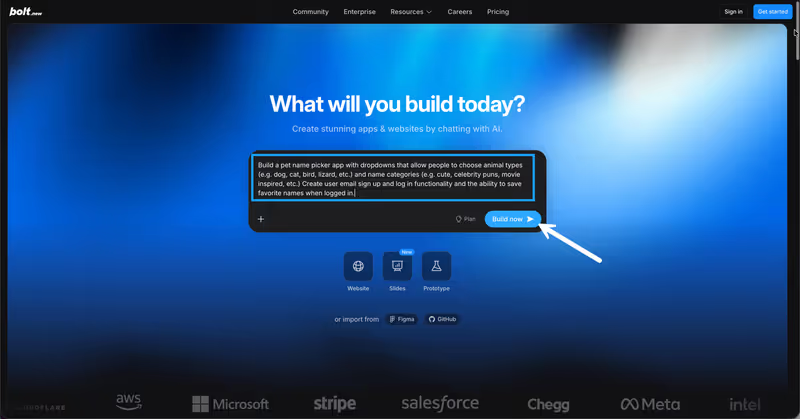
Bolt vs Replit, on screen

bolt.new
Bolt homepage
replit.com
Replit homepage

The fairest way to compare Bolt and Replit is to judge them on one concrete job: building a functional full-stack prototype with user logins, persistent data, and background logic. They genuinely diverge here because Bolt is optimized around in-browser generation and preview, while Replit is built around cloud execution environments that behave more like actual development machines.

That job exposes the failure modes that matter because the first screen is rarely the problem. The real breakpoints show up when generated code needs secrets, database changes, long-running processes, and repeated fixes without collapsing the app or the budget.

The audience

Who each one is for

Bolt

  • Frontend-first builders who want fast visual output and can work inside React-style app structures.
  • Developers mocking SaaS interfaces before the backend architecture is fully decided.
  • Makers comfortable exporting code and finishing deployment outside the generation tool.
  • Small teams testing lightweight web app ideas with limited infrastructure complexity.

Replit

  • Backend-leaning developers who need real runtimes, terminals, databases, and long-running processes.
  • Learners practicing full-stack deployment patterns inside a hosted coding workspace.
  • Collaborative teams editing the same repository with cloud-based development workflows.
  • Builders expecting Python, Node, or other server environments beyond a browser-only loop.

Bolt attracts people optimizing for immediate interface momentum. Replit attracts people who expect the prototype to behave like a small real system.

The scope

What you'd build with it

Bolt

  • React and Vite web prototypes with polished UI and light server-side needs.
  • Landing pages, dashboards, and internal demos connected to simple external APIs.
  • Early SaaS concepts that can lean on Supabase or another hosted backend.
  • Not the right tool for backend-heavy systems with complex jobs, migrations, or persistent workers.

Replit

  • Full-stack web apps using Node, Python, or other server-side frameworks.
  • Bots, automations, and tools that need scheduled jobs or continuous background execution.
  • Database-backed prototypes that require migrations, terminal access, and environment management.
  • Not the cleanest choice when the main goal is ultra-fast visual iteration on a front-end concept.

The runtime question

Bolt's hinge mechanism is its browser-based WebContainers model. That gives it a very fast prompt-to-preview loop for Node-flavored web apps, especially when the job is mostly React, Vite, and UI assembly. The upside is instant iteration without waiting for a remote machine to spin up; the downside is that the environment inherits browser-bound constraints, so larger dependency trees, heavier scripts, and repeated revisions can run into memory and project-scale limits.

Replit answers the same question with hosted cloud containers and a full workspace model. Its agent can work against a real runtime, terminal, package manager, and persistent services, which is why it is better suited to database migrations, background jobs, and multi-language backends. The trade-off is that you pay an infrastructure tax in both complexity and cost: more knobs, more runtime metering, and more chances for an agent loop to keep spending while it chases a fix.

Strengths

Where each one is strong

Even

They are strong in different directions: Bolt in visual speed, Replit in runtime realism.

Bolt

  • Fast WebContainers previews get UI-heavy prototypes running without waiting on a cloud VM.
  • Strong prompt-to-interface flow for React-style apps and modern front-end scaffolding.
  • GitHub sync and standard code export make handoff cleaner than many closed generators.
  • Good fit for quick browser-based iteration when infrastructure complexity is intentionally low.

Replit

  • Real cloud runtime support handles terminals, servers, databases, and longer-lived processes.
  • Works across multiple languages and backend setups instead of only a narrow web stack.
  • Collaborative workspace model supports shared editing and more conventional dev workflows.
  • Better foundation for prototypes that need migrations, cron-like behavior, or persistent services.

Failure modes

Where each one breaks

Edge: Replit

Replit's failures are frustrating but usually still leave you with a real runtime; Bolt can hit hard browser-bound ceilings that stop the job outright.

Bolt

  • Browser memory ceilings can trigger out-of-memory failures as projects and dependencies grow.
  • Large or messy revision cycles can cause wasteful rewrites that undo working changes.
  • Token burn becomes painful when the tool keeps regenerating instead of patching precisely.
  • Project-size limits make it a poor fit once the prototype stops being lightweight.

Replit

  • Agent fix loops can keep iterating without actually resolving the underlying bug.
  • Usage-based billing can climb quickly during long runs, retries, or heavier compute tasks.
  • The agent may choose tools or architectures you did not want, creating cleanup work.
  • More infrastructure surface area means more chances for secrets, ports, or services to misbehave.

Iteration cost

The fix loop, priced

Even

Both pricing models punish indecision and repeated AI repair cycles, just in different units.

Bolt

  • Bolt Pro starts at $25/month and includes a 10 million token allowance.
  • Real-world burn is driven by repeated prompts and rewrites during bug-fixing sessions.
  • Worst case is losing a large share of the monthly token budget on a stubborn build issue.
  • The structure is token-capped rather than open-ended compute, which limits upside and downside.

Replit

  • Replit Core starts at $20/month and includes $25 of usage credit; higher tiers cost more.
  • Real-world burn comes from agent runs and underlying compute rather than prompt count alone.
  • Worst case is overage-style usage growth when long runtimes or attached services keep spending.
  • The structure is metered compute, so the real bill can outgrow the subscription quickly.

Both sell a shortcut, but the expensive part is often paying for the tool to repair code it generated in the first place.

Exit paths

The code you end up with

Edge: Bolt

Bolt generally leaves a simpler front-end-centric export, while Replit can leave you disentangling a fuller hosted workspace setup.

Bolt

  • Exports standard web app code that is easier to move into a normal Git workflow.
  • GitHub synchronization supports a cleaner developer handoff than staying inside the tool forever.
  • The generated structure is usually straightforward when the app stays within its sweet spot.
  • Portability drops once the project depends on external backend services you still need to configure.

Replit

  • You can work with standard repositories and move them to other Linux-based environments.
  • Cloud workspace conveniences do not always translate neatly into a simple local handoff.
  • Database and service setup may require manual recreation when leaving the platform.
  • Heavy unattended agent edits can leave a codebase messier even if the files are technically portable.

When neither wins

If the real job is a business app such as a client portal, internal tool, CRM, or operations dashboard, neither Bolt nor Replit really wins. Both leave you maintaining generated security-critical code for auth flows, session handling, permissions, and data access, which means the burden of checking and fixing that code never goes away just because an AI wrote the first draft.

For that kind of build, Softr is the tool with no fix loop: auth, user groups, and record-level permissions are platform configuration rather than generated code you have to audit. The honest boundary is that Softr is the wrong fit if you need a highly custom consumer UI or if owning and extending the raw codebase is the point.

Verdict

Bolt wins when the prototype is mainly a front-end product story and speed of visual iteration matters more than backend realism. Its biggest advantage is the near-instant browser loop, which makes it easier to get from prompt to believable UI without waiting on cloud infrastructure.

Replit is the better pick when the prototype has to act like a real full-stack system instead of merely looking like one. If you need persistent services, database migrations, background tasks, or a more conventional development environment, its cloud runtime is the stronger foundation.

If you are a non-developer building a business app, the better standardization call is often to skip both and use Softr instead. For that audience, platform-level auth and permissions matter more than owning a pile of generated code.

Q & A

Frequently Asked Questions

Is Bolt better than Replit for full-stack prototypes?

Bolt is better when the prototype is mostly a web front end and speed matters most. Replit is better when the prototype needs real backend processes, databases, and persistent runtime behavior. The right answer depends on whether you are proving the interface or the system.

Which costs more to iterate with, Bolt or Replit?

They become expensive in different ways. Bolt burns through a fixed token allowance when prompts and rewrites stack up, while Replit can keep charging through compute-style usage during longer agent runs and attached services. Replit has the higher overage risk, but Bolt can feel tighter under repeated fixes.

Can I export my code from Bolt and Replit?

Yes, both can leave you with code you can move elsewhere. Bolt usually exports a cleaner standard web project, while Replit may require more manual setup recreation for services and databases. Export is possible in both cases, but the handoff is usually simpler with Bolt.

Which has less lock-in, Bolt or Replit?

Bolt generally has less practical lock-in for front-end-heavy projects because the output is simpler and less tied to hosted workspace behavior. Replit is still portable, but the surrounding environment can be part of what made the app work. That means leaving Replit can involve more rebuild work around services.

What should I use instead for a client portal or internal tool?

For that kind of business app, Softr is often the more sensible option. It handles auth, user groups, and record-level permissions as platform features instead of generated code you must maintain. That makes it a better no-code route for non-developers building operational software.