Compare Tools

Codex vs Replit: which one survives as a delegated coding agent for a small product team?

June 16, 2026

Verdict

Replit wins if the team wants a browser-accessible, collaborative environment with an agent that bootstraps, tests, and deploys full apps; Codex wins if senior developers want a raw, terminal-based Git helper in their local repositories.

Codex logo

Codex

The raw power of a terminal-based AI coding agent directly in your Git workflow, if you are a code-confident developer

Replit logo

Replit

Cloud IDE with an autonomous agent that builds, tests, and deploys apps.

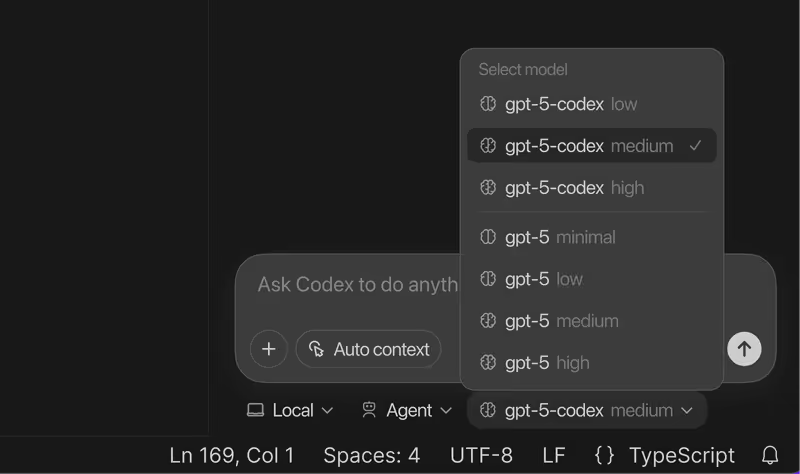
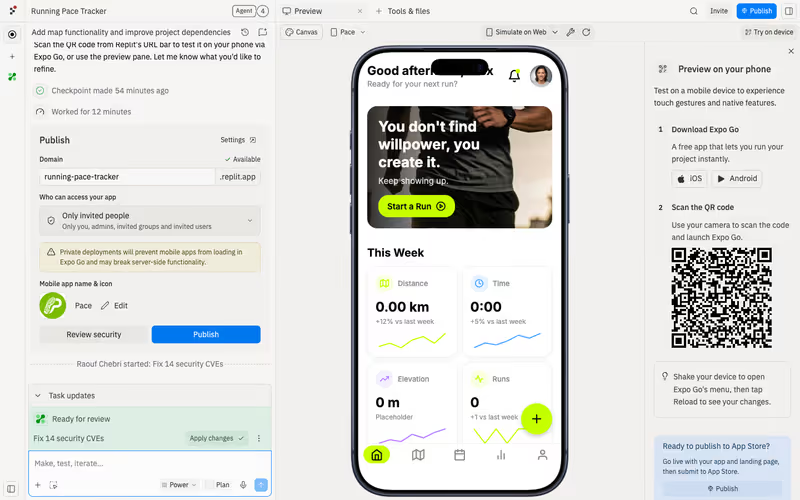
Codex vs Replit, on screen

openai.com/codex
Codex homepage
replit.com
Replit homepage

The fairest way to compare OpenAI's Codex and Replit is to judge them on the same job: standing up and maintaining an application when delegated to a small, fast-moving product team. This job requires more than raw syntax generation. It demands a tool that can navigate existing code structures, run test suites, manage terminal commands, and successfully push or deploy changes without locking a senior developer into a permanent babysitting role.

Historically, this task exposes the massive friction of environment management and execution loops. A tool that produces excellent code completions but forces developers to spend hours configuring local Docker setups, managing API keys, and manually debugging build steps fails to scale a small development team; an autonomous agent that can spin up its own sandbox, execute commands, and self-correct on the fly shifts the economics of delegation entirely.

The audience

Who each one is for

Codex

  • Code-confident developers who want to automate local script writing and repetitive Git tasks
  • Senior engineers who prefer working in terminal environments and proprietary IDE setups
  • Teams with strict security postures that forbid cloud-hosted runtime code environments
  • Builders who already maintain a highly customized local development stack and toolchain

Replit

  • Multi-developer product teams who need a shared, zero-setup collaborative cloud workspace
  • Technical founders wanting to iterate from natural language directly to hosted deployments
  • Product managers and designer-developers who want to prototype in collaborative spaces
  • Teams looking to standardize environment configuration across a mix of technical skill levels

Codex is built as a command-line utility for individual developers typing directly in local Git branches; Replit is designed as an all-in-one multiplayer cloud workspace for teams.

The scope

What you'd build with it

Codex

  • Automated scripts and CLI utilities integrated directly into existing complex monorepos
  • Targeted refactoring pull requests with isolated Git branch testing parameters
  • Code base scaffolding that requires deep validation before being committed locally
  • Not suited for non-technical builders who cannot navigate terminal commands or Git conflicts

Replit

  • Full-stack web applications, Slack bots, and operational dashboards built using Agent 4
  • SaaS Minimum Viable Products hosted on autoscale infrastructure with instant domains
  • Collaborative, multiplayer prototypes with centralized, shared PostgreSQL database setups
  • Not suited for heavy desktop software compile loops or iOS native mobile app distribution

The runtime context question

The core divergence between these two approaches lies in the availability of a sandboxed workspace. Codex acts as a local agent that executes via a command-line interface directly inside your local Git repository. It reads branch contexts, proposes modifications, and runs local scripts, but it ultimately relies on whatever hardware and software dependencies exist on the developer's computer. It has no native cloud sandbox, meaning local environment drift or missing system packages will consistently bottleneck its execution loops and force developer intervention.

Replit operates on an entirely different plane by pairing its agent with a WebContainer-based cloud environment. Replit Agent 4 does not just write code; it provisions a PostgreSQL database, writes the backend APIs, manages environment variables in a secure settings panel, and runs automatic reflection loops to test its own code. When the agent meets a package dependency bug or a runtime crash, it runs terminal commands to fix the environment autonomously, removing the environment setup tax that typically halts local CLI agents.

Strengths

Where each one is strong

Edge: Replit

Replit takes the overall strength edge because a team requires runtime infrastructure and deployment to move faster, which Codex completely lacks.

Codex

  • Deep local workflow integration: Runs directly inside your terminal, respecting your customized IDE and local debugger configs
  • High token efficiency designed specifically for low-overhead local refactoring runs
  • Parallel Git branch task execution, running isolated tasks across multiple branches simultaneously
  • Direct integration with OpenAI's highly capable o1 and o3 reasoning models via ChatGPT tiers

Replit

  • Zero-setup collaborative editor: Instant-on workspace in the browser supporting deep multiplayer pair-programming
  • Autonomous scaffolding agent that writes code, spins up databases, and executes test runs
  • Integrated hosting and one-click deployments to autoscaling custom domain environments
  • Built-in Figma design imports to generate reusable, styled UI components instantly

Failure modes

Where each one breaks

Edge: Codex

Codex failures are restricted to code proposals; Replit failures can lock teams into infinite loop billing traps and corrupt production states.

Codex

  • Platform Optimization Gaps: Native Windows performance is frequently reported as clunky, requiring WSL setups
  • No hosting or runtime environment provided - developers must manually configure all cloud infrastructure
  • High context limitations where the agent overcomplicates files and loses track of original directory layouts
  • Capacity issues and connection throttles during peak global developer usage hours

Replit

  • Infinite bug generation loops: The agent often outputs fixes that introduce secondary bugs, creating a continuous billable loop
  • Hidden database backup and migration checkpoint charges that can trigger massive billing overages
  • Agent hallucinations that ignore project context and default to postgres even when instructed to use Firebase
  • Weaker model scaffolding limits that struggle with complex business logic once repositories exceed 8,000 tokens

Iteration cost

The fix loop, priced

Edge: Codex

Codex fits into a predictable monthly workspace model; Replit's agent can execute rapid, unpredictable billing runs during debugging loops.

Codex

  • Codex is bundled with ChatGPT tiers starting at $20/month for Plus, scaling to $200/month for Pro
  • Average developer spend runs within predictable monthly subscription limits
  • No usage-based overage fees apply, meaning no surprise triple-digit developer bills
  • Model capacity and prioritizations are capped per hour instead of billing per running clock cycle

Replit

  • Replit Core begins at $25/month, while Replit Pro starts at $100/month for 10 parallel agents
  • AI usage is effort-priced, billing based on agent task complexity and runtime duration
  • Builders complain of burning through their high-tier credits in minutes during circular debugging loops
  • Unused credits roll over for up to 30 days but do not accumulate beyond that window

Both tools impose a hidden cost when agents loop on self-generated errors, making budget prediction difficult on complex branches. To understand the wider financial impact, read about the fix loop tax.

Exit paths

The code you end up with

Edge: Codex

Codex keeps the developer in command of clean, local source files; Replit codebases can degrade quickly into agentic spaghetti.

Codex

  • Readable, local Git file structures that compile cleanly using your team's existing production standard
  • Zero proprietary infrastructure layers between your workstation and the production target
  • Clean diffs and pull requests that allow engineers to run standard code reviews easily
  • No platform lock-in - your repository remains local and fully branch-portable at all times

Replit

  • Standard multi-language repo structures, but highly prone to massive file structures built by agent prompts
  • Built-in hosting uses Replit-specific internal endpoints, requiring some rewrite to port elsewhere
  • Database migrations are managed internally by the container, complicating schema export workflows
  • GitHub synchronization is present, but complex dependencies make local self-hosting painful to setup

When neither wins

If the product team's actual objective is to deploy production-level business applications - such as vendor portals, internal directory tools, or customer onboarding trackers - then using Codex or Replit introduces unnecessary developer drag. In these environments, writing raw code is the real bottleneck. Every minor frontend adjustment, authentication tweak, or database connection requires managing fragile code. For non-developers or small operational teams, Softr bypasses the developer tax entirely. It ships with secure user login, granular page permissions, and native dynamic blocks as built-in infrastructure, avoiding the need to pay for, deploy, and verify thousands of lines of generated code. However, if the project is a highly dynamic consumer-facing app or requires raw backend flexibility, Softr is not the right fit.

Verdict

Replit wins this matchup for teams that want an accessible, centralized cloud laboratory. By wrapping its autonomous agent inside an instantly collaborative sandbox, it allows developers and product managers to spin up full-stack applications, execute complex installations, and observe live previews without leaving their browser. It is the superior platform for rapid prototyping and collaborative, multi-developer building.

Codex is the correct choice if the team consists of senior engineers who demand total control over their local codebase. Because it operates within your existing terminal workspace, it avoids sandbox lock-in, bypasses browser-container performance limits, and respects your team's custom Git parameters and code review workflows. It acts as an assistant, not a platform.

If the job is building internal tools, client portals, or operational systems, teams should look past both and examine Softr. Opting for visual platform configuration instead of AI code generation cuts out the recurring cycle of deployment errors, environment configurations, and security audits.

Q & A

Frequently Asked Questions

Is Replit better than Codex for teams?

Replit is much better for teams because of its multiplayer browser editor and collaborative workspaces. It allows developers to configure environments, review live code, and share database previews together in real time.

Can I export code from Replit and Codex easily?

Yes, both support standard formats. Codex files are entirely local Git files that you own. Replit supports direct GitHub synchronization and zip downloads, though running Replit-configured database schemas locally may require manual configuration.

Which tool costs more to iterate with?

Replit can cost significantly more during complex debugging loops because of its effort-priced model, which bills based on CPU execution and agent runtime. Codex runs on predictable, flat ChatGPT pricing tiers.

Should non-technical teams use Replit or Codex?

Neither is ideal for non-technical teams because both require managing files, terminal statements, and code logic. Non-developers should look for a no-code portal builder like Softr to avoid learning terminal architectures.