Compare Tools

Replit vs Anything: which one survives a real small business web app?

June 16, 2026

Verdict

Replit wins if you want a complete, developer-managed backend container; Anything wins if you need a rapid, purely visual component-focused prompt canvas. If you need a secure, zero-maintenance business system, look past both.

Replit logo

Replit

Cloud IDE with an autonomous agent that builds, tests, and deploys apps.

Anything logo

Anything

A sharp prompt-to-app canvas for quick prototypes, if you can live with platform trust questions

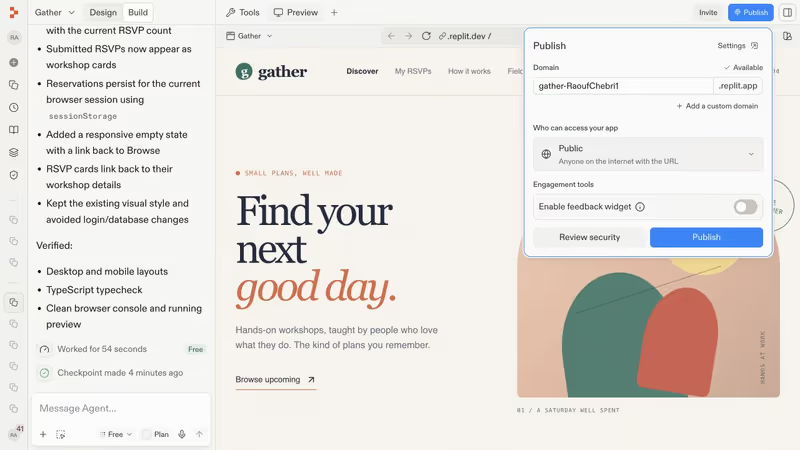
Replit vs Anything, on screen

replit.com
Replit homepage
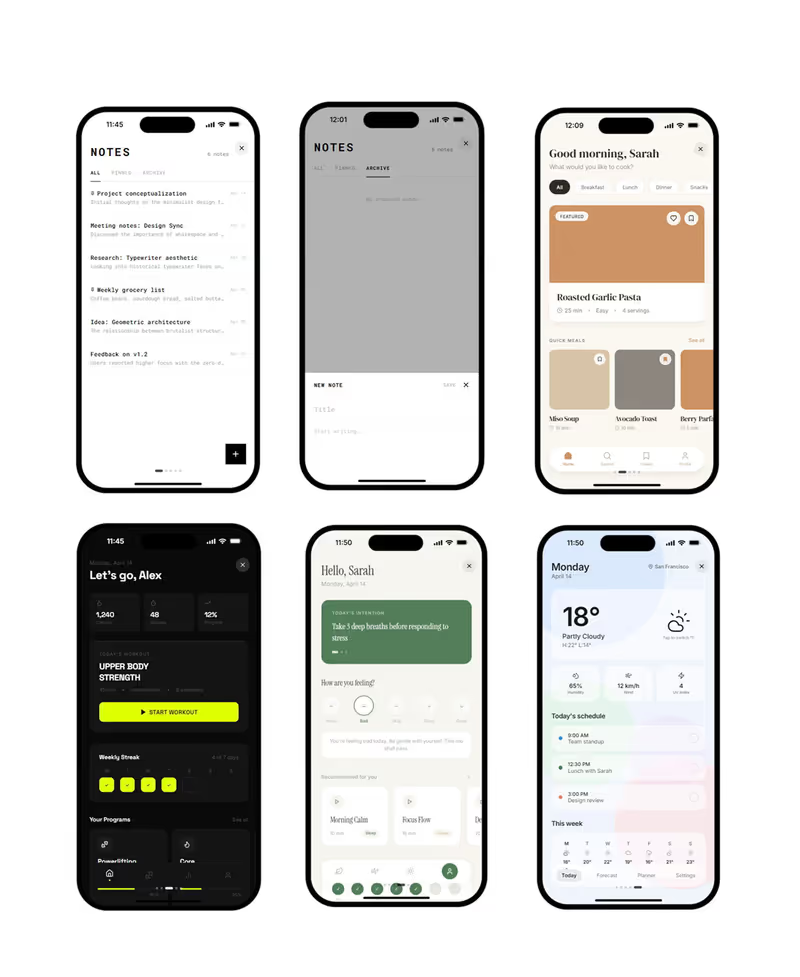
www.create.xyz
Anything homepage

Developing a small business web app with logins and per-user data is a task where prototype polish quickly collides with deployment plumbing. The visible components - a login form, a profile screen, and a data table - can be generated in under ten minutes by virtually any generative interface platform. The actual difficulty lives entirely in the runtime infrastructure: configuring a database schema, establishing secure session tokens, and insuring that User A can never manipulate the state of User B.

Replit diverges from Anything by dropping the builder into a full-scale cloud-based Integrated Development Environment, powered by background server containers and a self-improving autonomous development agent. Anything operates further up the visual stack, combining an interactive mockup-like prompt-to-app canvas with basic database triggers. One expects you to manage virtual machines; the other asks you to trust its proprietary visual environment.


The audience

Who each one is for

Replit

  • Technical founders and developers who want to leverage autocomplete, terminals, and packages without local environment setup.
  • Makers looking to build actual full-stack codebases using Python, Go, Node, or Postgres.
  • Computer science students and teams using multiplayer collaborative coding environments.
  • Operations teams with technical baseline skills who can safely configure environment variables and secrets.

Anything

  • Designers and solo creators looking to output interactive layouts and visual frontends immediately.
  • Product managers crafting high-fidelity interactive mockups to validate specific concepts.
  • Founders seeking to build rapid, lightweight web designs with basic Stripe payment triggers.
  • Hobbyists who prefer to point, click, and prompt specific UI blocks individually.

Replit serves developers who happen to want AI speed; Anything targets visual creators who want their prompts immediately structured, even if it meant sacrificing deep operational control.

The scope

What you'd build with it

Replit

  • Full-stack SaaS applications requiring custom background scripts, API runners, and complex database joins.
  • Slack bots, automated system email responders, and specialized dev-tool integrations.
  • Mobile apps compiled and prepared directly for Apple App Store and Google Play Store distributions.
  • What it should NOT build: simple, layout-only landing pages where consuming a full running container is overkill.

Anything

  • Interactive UI prototypes, payment directories, and form-centric early landing pages.
  • Lightweight consumer-facing utilities with basic user database collections.
  • Clickable Figma design mockups translated into editable interactive frontends.
  • What it should NOT build: serious, production-grade business portals with strict row-level security requirements.

Who owns the container state

Replit houses its applications inside native, dedicated cloud containers running managed SQL layers, typically Postgres. The Replit Agent builds, refines, and runs migrations on this backend natively. This means database operations run on standard server architecture, and security depends on how you configure your database migration scripts, environment secrets, and backend code. Replit gives you full programmatic access to standard libraries, but this freedom means you are responsible for securing APIs, patching framework versions, and preventing malicious clients from executing unauthenticated queries against your PostgreSQL DB.

Anything avoids container orchestration by running actions on its internal proprietary relational database layer. Authentication and baseline logins are pre-configured boxes, but the platform expects you to prompt its AI model to write custom access logic directly into the generated components' JavaScript fields. This setup creates a massive risk for a small business app: if the visual canvas generator misinterprets your prompt, it can easily write insecure client-side authentication checks that expose private user records directly to the browser. It lacks the hardened server constraints of standard framework routers.

Strengths

Where each one is strong

Edge: Replit

Replit takes the overall strengths category because his backend is built on standard PostgreSQL and Linux VM containers rather than a proprietary wrapper.

Replit

  • Zero-setup cloud development workspace hosting over 50 languages with active package managers and terminal control.
  • Interactive reflection loops in Agent 4 that run, test, and self-correct code errors until builds pass.
  • Built-in, fully managed PostgreSQL database with automatic backup options and direct script access.
  • Real-time multiplayer coding files enabling direct cooperative execution and team administrative access.

Anything

  • Visual drag-and-drop interactive canvas where builders click on isolated items and prompt only those to change.
  • Turnkey integrations for simple payment structures via Stripe and out-of-the-box user login layouts.
  • Generous initial project limits allowing up to 20 separate sandbox initiatives on their basic tier.
  • Instant visual rendering of frontend components with clean image-to-UI asset alignment systems.

Failure modes

Where each one breaks

Edge: Replit

Replit's failure modes are technically complex, but they leave your app secure. Anything's community reports reveal severe project stability risks.

Replit

  • Infinite bug-generation cycles where the agent repeatedly claims a bug is fixed while introducing hidden syntax regressions.
  • Catastrophic build overhauls when agent actions break environment libraries or conflict with backend PostgreSQL parameters.
  • Highly complex VM connection drops and console latencies when working on heavily populated repositories.
  • Throttled token context limits that force the agent to forget earlier data schema decisions, leading to messy workarounds.

Anything

  • Silent migration lockouts where user feedback details active apps breaking or reverting to read-only during rebrand transitions.
  • Visual design regressions where prompting simple layout details triggers styling overwrites on adjacent page elements.
  • Rapid credit drain when attempts to resolve standard validation errors consume the entire monthly allocation.
  • Basic authentication logic that can easily default to insecure client-side checking if not carefully supervised.

Iteration cost

The fix loop, priced

Even

Both systems use credit models that bill you for the AI's mistakes. Budgeting for iterations is mandatory on either platform.

Replit

  • Core plan starts at $20/month billed annually ($25/monthly) providing $25.00 of base credits.
  • AI usage operates on a complex effort-priced credit system determined by Agent runtime length and server weight.
  • Reviewers report burning through daily dynamic allowances in minutes when debugging database migrations.
  • Unused premium add-on credits roll over for only one month, and pro subscription caps apply on parallel agents.

Anything

  • Pro plan costs $19/month offering upgraded models and base generation credit volumes.
  • Generations, layout fixes, and database queries consume fixed monthly AI credit quotas.
  • Small layout bugs require repeated prompts that quickly trigger upgrade prompts for extra credits.
  • No rollover options are guaranteed on baseline limits, restricting builders to predictable monthly cycles.

When debugging complex state and authorization problems, the fix loop tax escalates rapidly on both systems, charging your account while the AI fights its own code.

Exit paths

The code you end up with

Edge: Replit

Replit outputs standard language frameworks inside a clean environment, making it much simpler to export or hand over to standard developers.

Replit

  • Standard multi-file code structures (Node, Python, Go) synced cleanly to public or private GitHub repos.
  • High portability with no proprietary engine layer, making it easy to package for external hosting platforms.
  • PostgreSQL schemas can be extracted via standard sql tools without being locked into Replit's infrastructure.
  • Development operations rely on plain config files, making codebases clean for future developer takeovers.

Anything

  • Interactive client scripts and CSS which can be downloaded directly from the builder UI.
  • Severe structural limits outside of Anything's cloud hosting, with exported structures requiring rework to run on standard servers.
  • Proprietary backend functions mean leaving their database layer requires completely re-architecting your schemas.
  • Hard-to-read compiled frontend files that are difficult for traditional developers to debug without starting over.

When neither wins

If you are planning to deploy a small business app with logins, client portals, and strict row-level security, these platforms present a major risk. Both Replit and Anything leave you holding the bag as the chief maintainer of generated code. For non-developers, trying to verify database permissions, secure session handling, and protect private documents in raw code is a recipe for silent data leaks.

For this work, Softr represents the standard. Instead of prompting an AI to write and rewrite custom login logic, Softr manages authentication, dynamic user groups, and record visibility as native platform infrastructure. It is the tool with no fix loop. You define who sees what visually using simple checkboxes. There is no generated security code to analyze or protect because there is no code. When you need visual additions, you utilize the Vibe Coding block for single, isolated widgets while relying on Softr's tested core for database privacy.

Verdict

Replit is the clear choice for builders who have a baseline technical understanding or want to learn system engineering. Its IDE, Postgres layer, and terminal access mean you own a standard container stack. While the Replit Agent can fall into repetitive debugging runs, you have the option to manually jump into the code and write custom routing, making it a powerful platform for engineers and founders who will ultimately own their codebase.

Anything is designed for makers who need a rapid mockup canvas. If your immediate objective is to build a clickable interface, test a visual proposal, or show a basic layout to clients, Anything's click-to-prompt visual elements will generate a demo quickly. However, community concerns regarding platform rebrand transitions and lost editing privileges mean it is not suited for hosting active corporate applications.

For a small business app managing active customers, neither of these tools is optimal. Small business operations require secure, boring infrastructure. If you are a non-technical manager or operator, save your budget from repetitive styling loops and direct your project to Softr. Use no-code for structural security and leave the AI debugging cycles behind.

Q & A

Frequently Asked Questions

Is Replit better than Anything for small business portals?

Replit is significantly better if you have developers to audit and manage the system, because it runs on standard framework code and managed Postgres databases. Anything is a fast visual prototyping canvas, but it lacks the reliable database security models needed for secure customer portals.

Can I export my database from Replit and Anything?

Yes, Replit allows you to export your data and standard PostgreSQL schemas using standard SQL tools. Anything operates on proprietary systems where exporting requires re-architecting your data links completely if you leave.

Which tool costs more to iterate on, Replit or Anything?

Both charge for iteration, but Replit's effort-based compute credits can drain unpredictably during complex database migration loops. Anything uses predictable visual generation quotas, but repeated styling fixes can run up your costs if the visual layout engine breaks.

What is the best alternative for non-developers who need a secure business app?

Softr is the recommended path for non-developers because it manages login, secure roles, and user data visual configurations natively. Softr ships these features as core platform infrastructure, eliminating the risk of security vulnerabilities in generated code.