Compare Tools

Lovable vs Mocha: which one survives a non-developer first business app?

June 16, 2026

Verdict

Neither is the answer: Mocha is a dead end after its August 1, 2026 shutdown, and Lovable leaves you maintaining a standard React repo. For a business database that needs to stay online, look past both to Softr.

Lovable logo

Lovable

Prompt-to-app builder that generates full React frontends from plain English.

Mocha logo

Mocha

Chat-to-app builder, shutting down August 1, 2026 - migrate now

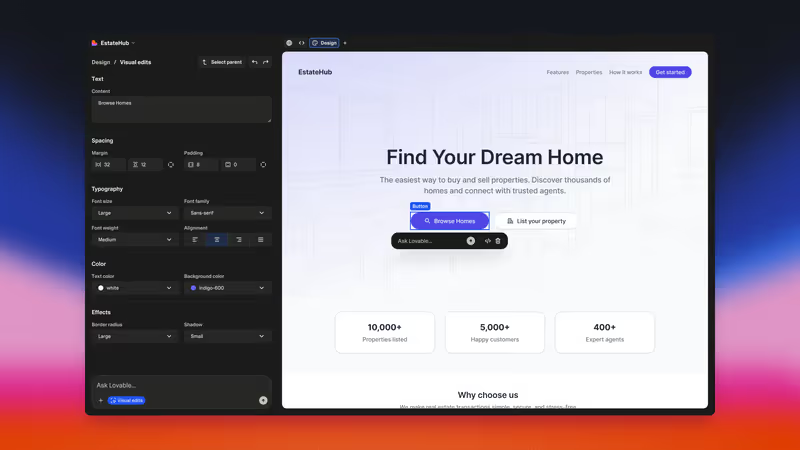
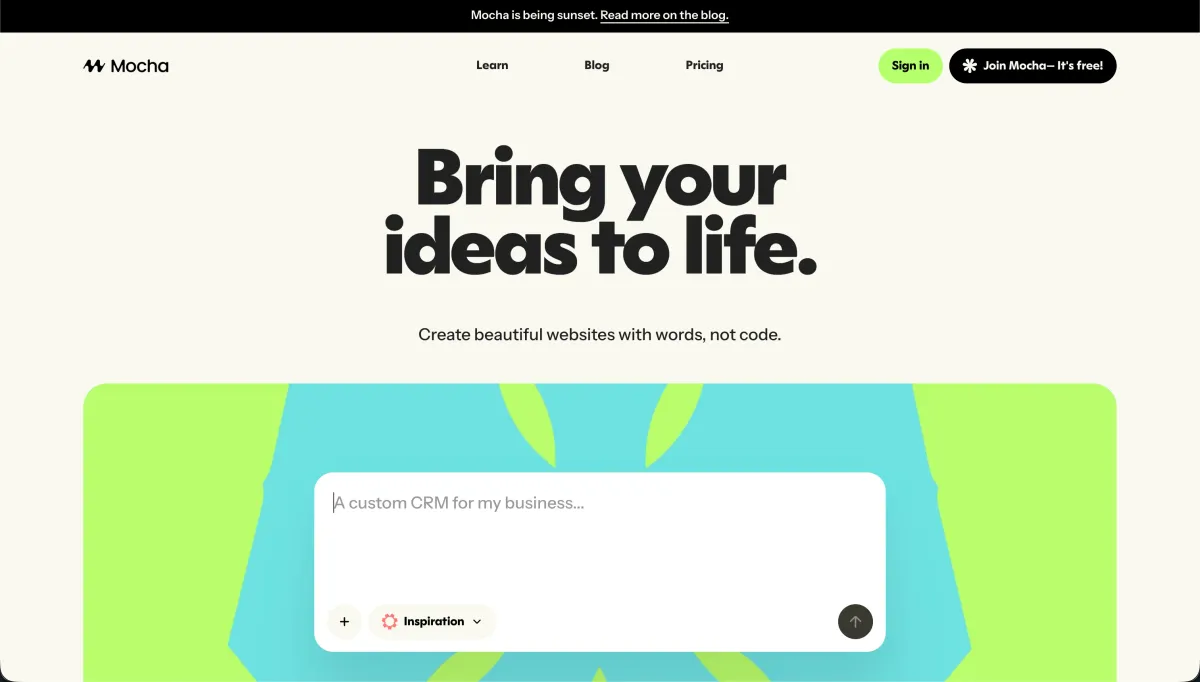
Lovable vs Mocha, on screen

lovable.dev
Lovable homepage
getmocha.com
Mocha homepage

The fairest way to compare Lovable and Mocha is to judge them on the canonical first database application: a business manager with user authentication, custom logins, and secure data rows. For a non-developer, this is the milestone where prototyping stops and production-grade security begins. The app needs to write data reliably, restrict who can edit what, and crucially, stay online to run the business.

This comparison is shaped around that exact milestone. While both tools promise to build custom web applications using conversational prompts, they diverge completely on underlying stability, database architecture, and lifetime viability. A comparison based on landing page generation ignores the reality of maintaining a living, evolving database app.

The audience

Who each one is for

Lovable

  • Non-technical founders wanting polished React frontends and rapid SaaS prototypes
  • Designers seeking to import Figma files and convert them to clean React code
  • Developers using conversational prompts to scaffold database structures before manual editing
  • Teams whose primary deliverable is a beautiful visual demo on a Supabase backend

Mocha

  • Early-stage builders looking for a zero-configuration SQLite database setup with Google login
  • Makers wanting to quickly establish simple web utility tools and directories without setup
  • Founders iterating on basic MVP concepts before coding them from scratch
  • Developers who want to download static raw React and backend source configurations

While Lovable targets builders who want to launch premium React applications, Mocha was designed for quick, lightweight web utilities. That distinction is now overshadowed by Mocha's impending shutdown.

The scope

What you'd build with it

Lovable

  • Fully functional multi-page web applications integrated with Supabase postgres databases
  • Visual SaaS MVPs and interactive pitch dashboards that match Figma layouts
  • Gated client portals requiring email, social, or multi-factor authentication
  • Complex long-term business databases that will eventually require professional developers to maintain

Mocha

  • Simple, single-purpose calculators, trackers, and local data utilities
  • Lightweight directory pages with basic Google-authenticated login paths
  • Small-scale internal tools displaying flat data arrays with simple logic
  • Production-grade business systems: what it produces is too fragile to sustain live enterprise data

The platform viability question

Under the hood, Lovable sets up a postgres database via Supabase. Data visibility and security are regulated using Supabase Row Level Security (RLS) policies. While Lovable generates these policies based on your natural language prompts and runs security scans to audit them, the non-developer is still forced to manage a highly technical database backend. If the AI structures a relationship incorrectly, resolving it down the road can create deep 'schema debt' that resists future prompt edits.

Mocha operates on a hosted SQLite database coupled with Node.js. It requires zero configuration to start, which makes first-day deployment fast. However, Mocha's entire hosting infrastructure and generator are shutting down on August 1, 2026. Running a business app on Mocha means your backend is sitting on an active expiration date, requiring a manual codebase migration or an absolute export to self-hosting before the platform turns off.

Strengths

Where each one is strong

Edge: Lovable

Lovable takes the category because it establishes a standardized, modern full-stack architecture that won't go offline in 2026.

Lovable

  • Polished visual interfaces that translate Figma variables cleanly into responsive Tailwind layouts
  • Managed database provisioning via Supabase, including automated postgres setups and email auth
  • Git-integrated code syncing, allowing updates to feed directly into a standard GitHub repository
  • Autonomous pre-publish security scans that inspect dependencies and search for vulnerable code structures

Mocha

  • Zero-setup dev environment that configures a local SQLite repository and hosting instantly
  • Automated compile debugging that automatically patches basic build errors during prompt cycles
  • Clean raw code export option that allows you to download the entire frontend and backend
  • Simple visual previewing that displays application iterations quickly within the browser window

Failure modes

Where each one breaks

Edge: Lovable

Mocha's total platform shutdown is an terminal failure mode, making Lovable's regression loops a minor issue by comparison.

Lovable

  • Regression loops where the agent re-introduces resolved bugs while attempting to fix new errors
  • Credit inflation: users report prompts consuming 3 to 4 credits compared to historic 1-credit averages
  • High complexity ceiling where multi-table databases run into build failures and broken relationships
  • Failing to handle visual and padding alignments correctly without manual CSS adjustments

Mocha

  • Total platform sunset scheduled for August 1, 2026, forcing a complete data migration off the platform
  • Severe resource depletion within compilation loops that consume credits in circles trying to resolve bugs
  • Incomplete access controls that require prompting the AI to secure basic backend tables manually
  • Extremely slow support and Discord-based resolution queues for billing and environment crashes

Iteration cost

The fix loop, priced

Edge: Lovable

Lovable's scaling tiers are expensive, but investing in an active platform is the only logical choice.

Lovable

  • Pro plan starts at 25€/month ($25) for 100 monthly base developer credits
  • Credit scaling is aggressive, reaching 480€/month if your loops require 2,000 monthly credits
  • Fixing complex authentication or schema drift under high credit inflation depletes limits quickly
  • Paid subscription tiers allow unused credits to roll over into the next monthly billing cycle

Mocha

  • Bronze plan starts at $20/month for a baseline of 1,500 app credits
  • Pricing tiers max out at $200/month for 25,000 credits on the Gold tier
  • Compiling or deployment failures frequently dump credits into infinite, automated patching loops
  • No credit longevity guarantees remain on any plan as the service heads toward full shutdown

Prompting an AI to patch code always incurs an iteration penalty. You must budget for the fix loop tax rather than looking only at the first draft cost.

Exit paths

The code you end up with

Edge: Lovable

Lovable's Supabase backend structure provides a real path to developer handoff, unlike Mocha's expiring runtime.

Lovable

  • Exports standard React and TypeScript code synced cleanly to a GitHub repository
  • Underlying database can suffer from severe database schema debt if designed strictly by AI
  • Proprietary visual elements and tracking tags are sometimes injected inside the exported packages
  • A standard codebase design that developers can easily import and run inside local editors

Mocha

  • Generates clean React code coupled with an integrated SQLite database configuration
  • Exported project files can be downloaded as a complete, self-contained zip file
  • Requires immediate transition configuration; you cannot rely on Mocha's hosting to run your code
  • The architecture is simple but not structured to easily support massive scale migrations

When neither wins

Here is the critical problem with choosing either tool for a business database or customer directory: both of these platforms are build engines that dump developers' code onto you. If you are not a developer, you are now the primary maintainer of thousands of lines of code. If an authentication flow leaks data, or a database query times out, you cannot visually inspect the code to patch it. You are locked in an expensive loop, prompting an AI agent and hoping the next version fixes the bug instead of introducing two more.

For a business app with real users, Softr bypasses this cycle entirely. Softr treats user authentication, secure directories, data permissions, and record filtering as standard platform infrastructure. You configure who sees what visually using toggle settings, and there is no generated code because Softr is a true no-code interface. The database runs on Softr Databases or your existing tools. It is the wrong choice if you want to export raw code or construct custom consumer-facing software, but it is the correct choice if you want utility without the engineering overhead.

Verdict

Lovable is the default winner of this specific matchup because it remains an active product, whereas Mocha will go offline permanently on August 1, 2026. If you must build with a prompt-to-app generator, Lovable establishes a standard Supabase backend, maintains visual design controls, and exports functional React code to GitHub that developers can actually inherit.

Mocha is only useful if you want to scaffold a quick utility, immediately download the zip folder of code, and self-host the application yourself. Prompting Mocha for a long-term business tool that runs on their hosted backend is a direct path to losing your database access when the shutdown deadline arrives.

For non-developers building operational software to run a real business, look past both. Building an app with database dependencies and secure user permissions shouldn't land you in a code-maintenance loop. Choosing Softr solves the structural security risks and ensures your app stays online without an AI-credit meter running every time you need to add a table.

Q & A

Frequently Asked Questions

Is Mocha shutting down?

Yes, Mocha announced that it is sunsetting all services and shutting down permanently on August 1, 2026. Users must migrate their databases and export their visual codebases before this date to prevent data loss.

Which is better for client portals, Lovable or Mocha?

Lovable is far better because it is a living platform that integrates directly with Supabase for user authentication. However, since both require you to manage generated code, non-developers should look at visual alternatives like Softr.

Can I export my code from Lovable?

Yes, Lovable supports full synchronization with GitHub, exporting standard React and TypeScript code. This ensures you can transition the project to a developer if the AI iteration limits become too difficult to manage.

How do Lovable and Mocha handle database hosting?

Lovable connects to your own Supabase instance which runs on a standard PostgreSQL database. Mocha provides an integrated SQLite database that runs on their hosted infrastructure, which will expire during their platform shutdown.