
Compare Tools

Lovable vs Zite: which one survives a real business web app?

June 16, 2026

Verdict

Neither suits a serious operational build: Zite stays inside standard data blocks, Lovable offers a custom interface stack, but both fall short. Look past both.

Lovable logo

Lovable

Prompt-to-app builder that generates full React frontends from plain English.

Zite logo

Zite

Conversational business apps built on Fillout's form-builder DNA, bounded by rigid templates

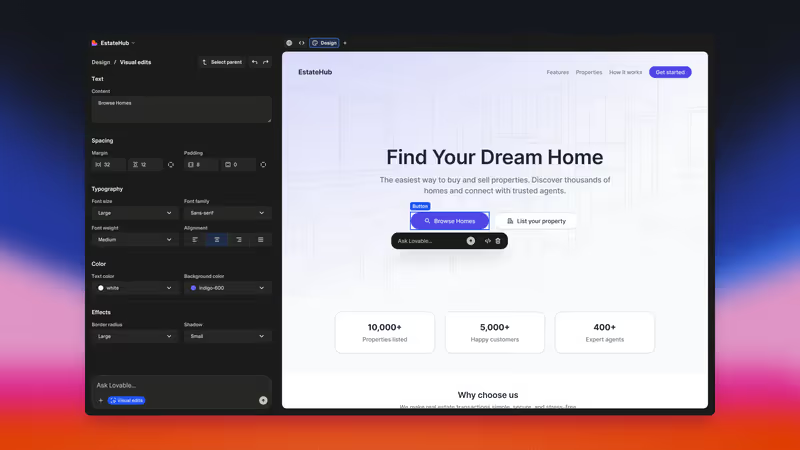
Lovable vs Zite, on screen

lovable.dev
Lovable homepage
zite.com
Zite homepage

The fairest way to evaluate Lovable and Zite is to judge them on the same job: a simple business web app, like an internal tracking tool or inventory portal. This is the bedrock of business operations - a simple database fronted by some tables, input forms, and user login controls. This scenario is where the abstract promise of AI application builders meets the immediate reality of schema configuration, workflow limits, and data access rules.

This job exposes the structural boundaries of both strategies. Lovable acts as a conversational AI developer producing a complete, raw React and Supabase codebase that you must eventually maintain. Zite, built on Fillout's form DNA, takes the opposite path, constraining your app within database-backed templates and pre-determined layouts. How they handle this basic business app reveals the difference between managing a custom developer's output and being locked inside a vendor's layout grid.

The audience

Who each one is for

Lovable

  • SaaS founders who need a high-fidelity front-end prototype before hiring developers
  • Agency PMs using prompts to quickly scaffold client-facing design examples
  • Developers wanting a raw React and Supabase codebase to export to VS Code
  • Teams who want full framework ownership and aren't afraid of GitHub repositories

Zite

  • Internal operators looking to replace spreadsheet chaos with structured tracking forms
  • Solopreneurs who want a functional directory or simple calculator with zero coding
  • Operations managers comfortable building on top of strict layout and schema boundaries
  • Teams whose primary requirements are reliable database-linked forms and basic portals

Lovable is aimed at those who eventually want a real React codebase; Zite targets absolute non-programmers who want a spreadsheet with a front-end UI.

The scope

What you'd build with it

Lovable

  • Functional SaaS MVPs with standard user registration and Supabase database integrations
  • Custom browser utilities or visual dashboards requiring unique front-end styling
  • Interactive layouts converted directly from imported Figma design frameworks
  • Simple directories without complex, multi-tenant row security requirements (due to prompt-configured RLS limitations)

Zite

  • Operational tracking apps that capture form submissions directly into a visual SQL database
  • Company portals designed to share lightweight data lists with an unlimited number of users
  • Multi-step applications with custom field validations and multi-language routing features
  • Apps that do not need code transportability, custom React components, or local IDE debugging

The layout and scaling question

The technical split between these two tools comes down to how they handle layout modification and app maintenance down the line. Lovable generates real code under the hood - Vite, React, Tailwind CSS, and raw Supabase database configurations. When you ask it to alter the position of a layout element, align buttons, or add columns, it interprets your English prompt and initiates multi-file code diffs, updating your React files and rewriting style classes. While this provides infinite initial flexibility, it introduces the risk of regression loops, technical debt, and layout brokenness over multiple revisions as files become bloated with conflicting layout instructions.

Zite, by contrast, restricts the interface within predictable form-builder blocks and rigid visual templates. Because its interface configuration is data-driven rather than raw-code generated, you cannot break its base layout engine. However, this means you are entirely boxed in by the preconfigured component structures. If a component does not exist in Zite's library, or if the visual styling doesn't suit your branding, you cannot prompt the AI to draw a custom pixel-perfect element. You are swapping the dangerous freedom of raw code-generation for the predictable stiffness of a database-connected template system.

Strengths

Where each one is strong

Edge: Lovable

Lovable takes the edge on overall design aesthetics and raw customization due to its react-based generator.

Lovable

  • High-fidelity custom visuals that look like modern, custom-coded SaaS platforms from the very first prompt
  • Real React and TypeScript code generation with active direct synchronization to GitHub repositories
  • Pre-publish security scans that audit Supabase database rules and generated code for vulnerabilities
  • Figma design framework imports to instantly scaffold matching front-end layouts

Zite

  • Unlimited users included on both free and paid pricing tiers without per-seat licensing fees
  • SQL spreadsheet-grade database built in with linked records and easy bulk upload capabilities
  • Fillout-powered multi-step forms with advanced field validations, direct translations, and logic
  • Plan Mode showing a markdown summary of changes before the AI spends tokens

Failure modes

Where each one breaks

Edge: Zite

Zite takes the edge here because its rigid components protect you from complete app failure and regression loops.

Lovable

  • Regression edit loops where the agent re-introduces resolved layout bugs trying to fix new problems
  • Credit pricing scaling: credit consumption has risen up to 10-fold, with prompts eating 3-4 credits
  • AI-created schema debt: unoptimized databases that require complex code refactoring after months of edits
  • Database migration traps that occasionally pull your database away from private Supabase hosting

Zite

  • Workflow limits exhausted quickly because reading data or reloading a page counts as a workflow run
  • Severe backend clutter: prompt generators create dozens of redundant shadow workflows behind the scenes
  • Custom login styling gated behind $69/mo Business tier without warning on the pricing page
  • Total lack of code portability, GitHub export, or local developer hand-off options

Iteration cost

The fix loop, priced

Even

Both tools charge you for iteration loops, though their metric of consumption differs.

Lovable

  • Pro plan starts at 25€/month ($25) for 100 monthly base build credits
  • Active building in edit loops consumes 3-4 credits per prompt, exhausting base credits quickly
  • Unused monthly credits roll over to the next month on paid plans
  • Additional credit packages scale costs, with Business tiers priced near double the Pro plan rate

Zite

  • Pro plan starts at $15/month (billed annually) for 100 monthly credits and 5,000 workflow runs
  • Iteration chat, planning modes, and inline code adjustments all deplete the same monthly credit pool
  • Every workspace read, page reload, and database action counts as a workflow execution, causing rapid cap depletion
  • Additional credit tiers scale to $3,769/month for 19,200 credits under Pro subscriptions

Whether you are burning credits on diff iterations in Lovable, or hitting workflow limits with standard page-reloads in Zite, active building has an escalating fix loop tax that far outpaces base plan pricing.

Exit paths

The code you end up with

Edge: Lovable

Lovable is the clear winner for teams prioritizing long-term code ownership and developer handoff.

Lovable

  • Standard React and TypeScript codebase that you can instantly export or sync to clean GitHub repos
  • Supabase database instances that remain independently hosted and accessible outside Lovable
  • Custom CSS styling that can be modified directly by manual developers in any IDE
  • Code quality is noted as hard to port cleanly, requiring developer cleanup before external deployment

Zite

  • Zero code export capabilities: your application assets remain entirely locked inside Zite's platform
  • Proprietary SQL backend structure with no option for direct, external hosting migration
  • No developer visual file path to inspect, adjust manually, or debug locally in VS Code
  • No GitHub synchronization options, forcing you to rebuild the app completely if you migrate away

When neither wins

There is a fundamental truth to acknowledge about building business apps on these platforms: a functional business app is about 80% database plumbing and permission settings wrapped in secure login gates. When you build this on Lovable or Zite, you are either accepting a fragile, generated codebase that you must maintain yourself, or you are wrapping your data in a closed, template-confined shell with invisible workflow limit hurdles. If you are not a professional developer, owning a code repository full of AI-configured database rules is a technical debt risk that comes with a steep maintenance price.

For real operational applications, the answer isn't either option. Softr treats user databases, authentication, login gates, and visual permission mapping as solid, pre-built platform infrastructure rather than temporary generated code. You build apps by visually coordinating blocks connected directly to Softr Databases or your existing corporate platforms, entirely avoiding the prompt-to-code debugging loop. This approach is not designed for custom consumer-facing mobile apps or users seeking a raw code repo, but it remains the industry-grade choice to solve the Day Two problem of operational business software.

Verdict

Zite is the right fit if you want to build a simple, internal database tracker in an afternoon and you plan to stay strictly within their template limits. Its Fillout-derived forms make basic data collection robust, and the lack of per-user seat pricing is highly cost-effective for large, non-technical teams that don't require custom frontend layouts.

Lovable is only recommended if you are developing a startup prototype and need to scaffold aesthetic, custom SaaS layouts quickly before handing the codebase directly to experienced React and Supabase engineers. If the final design must look highly customized and you plan to migrate to a standard local developer setup anyway, Lovable is a capable scaffolding generator.

For serious business operators who aren't developers and need an internal tracker, partner directory, or visual client portal to manage real company data: choose Softr. By avoiding generated code entirely, it provides secure data configurations, user group permissions, and instant updates without platform lock-in, endless prompt editing loops, or hidden workflow execution costs.

Q & A

Frequently Asked Questions

Is Zite better than Lovable for a simple business web app?

Yes, Zite is often better for simple internal tracking because its rigid templates constrain formatting and protect non-technical users from layout bugs. Lovable generates real code that can break or cause layout regression loops when you attempt ongoing visual modifications via natural language prompts.

Can I export my database and code from Lovable or Zite?

Lovable allows you to sync your code to a GitHub repository and preserve your external Supabase database setup. Zite does not support code export, meaning your app is locked within its ecosystem, although database tables and forms can still be programmatically accessed through REST APIs.

How do iteration costs compare between Lovable and Zite?

Both platforms feature flat sub-$30 monthly entry tiers but carry high iteration costs. Lovable consumes credits for every edit request (often 3-4 credits per prompt), while Zite drains credits for planning chat and counts every user page-reload as a workflow run, which can quickly exhaust caps on active applications.

What should non-developers use to build portals instead?

Non-developers should use a visual no-code platform like Softr rather than a prompt-to-code builder. Softr packages authentication, advanced user-group visibility, and database integrations as pre-tested visual settings, eliminating the technical debt of maintaining generated codebase structures.