Compare Tools

Lovable vs v0: which one handles a marketing-site-to-product graduation?

June 16, 2026

Verdict

v0 wins if you need design-to-code React UI components for an existing codebase; Lovable wins if you want to scaffold a full-stack database-driven product. If you're a non-developer, both are dangerous.

Lovable logo

Lovable

Prompt-to-app builder that generates full React frontends from plain English.

v0 logo

v0

Vercel's AI frontend generator: prompts to shadcn/ui React components.

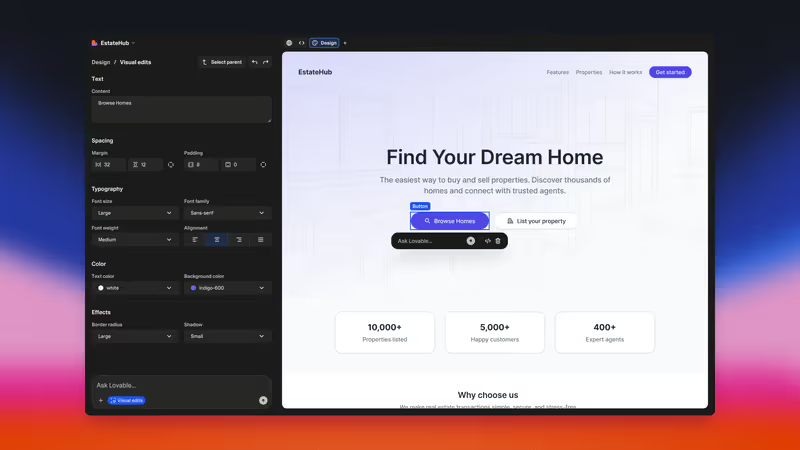
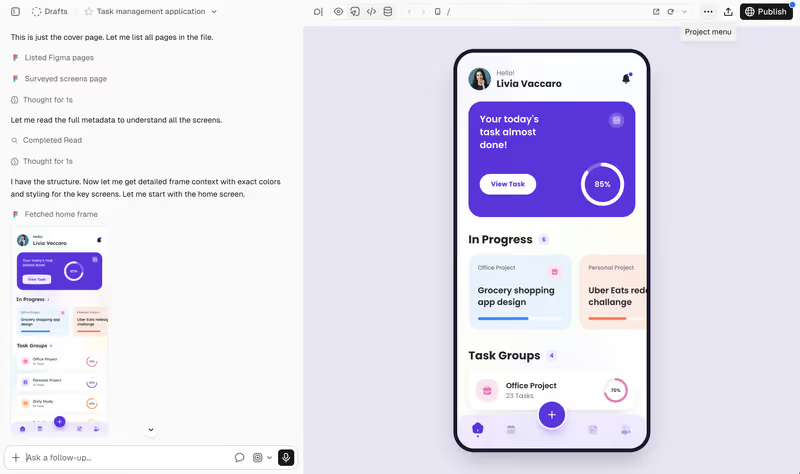
Lovable vs v0, on screen

lovable.dev
Lovable homepage
v0.dev
v0 homepage

The moment a marketing site stops being static and graduates to a functional product is the moment when design requirements collide with backend plumbing. In this matchup, we judge both tools on a canonical graduation project: transforming a clean, React-based SaaS landing page into a real dashboard where signed-in users can manage real transactions. v0 approaches this from the frontend out, generating isolated, visually polished React components with Tailwind CSS and shadcn/ui. Lovable targets the entire stack in one prompt, building the database schema, authentication layers, and UI routes in a unified system.

This transition exposes the deep structural differences between a component generator and an app builder. A comparison based on simple landing pages ignores the friction of the day-two problem: how these tools handle live database connections, schema debt, and user-facing security. Graduating to a real product requires more than responsive buttons; it requires backend data integrity and robust security policies.

The audience

Who each one is for

Lovable

  • Non-technical founders who need a working backend-and-frontend SaaS MVP in days, not weeks
  • Operations managers looking to stand up customized business databases without managing servers
  • Designers wanting to convert visual Figma mockups directly into multi-page React portals
  • Teams where the definition of done is a fully hosted, interactive database prototype

v0

  • Frontend developers who want to scaffold beautiful UI quickly and copy pure React components
  • Technical founders seeking to design complex, custom color themes and interfaces from prompts
  • Builders who already maintain an existing codebase and need standalone Tailwind assemblies
  • Teams looking to quickly turn hand-drawn sketches or screenshots into raw frontend files

Lovable is configured for builders who want the entire app built for them; v0 is built for programmers who want a smart frontend assistant.

The scope

What you'd build with it

Lovable

  • Full-stack SaaS MVPs featuring integrated user email/social logins and hosted relational databases
  • Custom internal portals where different visual lists display based on database attributes
  • Figma-to-React UI conversions synced automatically to a private GitHub repository
  • Avoid using for heavy real-time data streaming or complex native mobile applications

v0

  • Highly polished, custom frontend landing pages and responsive marketing layouts
  • Isolated, interactive UI blocks like complex tables, drop-downs, and settings panels
  • Next.js and Astro frontend scaffolds that connect clean design modules seamlessly
  • Avoid using as a standalone backend generator, as it has no native databases

The backend integration question

Lovable tackles the product graduation by deploying a turnkey, managed backend using Supabase. When you prompt Lovable to create a signup form or store transactional histories, the AI designs the relational PostgreSQL tables, maps the fields, and configures the API calls in a unified TypeScript framework. To protect customer transactions, Lovable relies on prompt-configured Supabase Row-Level Security (RLS) policies. This approach is highly autonomous, but it raises the stakes: if the AI misinterprets the data structure, it introduces silent data vulnerabilities or heavy schema debt that can break future visual regenerations.

v0 completely bypasses native backend infrastructure. When given a backend prompt, v0 generates standalone, stateless React modules with mock functions that developers must manually wire into real database environments, such as a private tRPC API, Prisma schema, or PostgreSQL server. There are no built-in database tables, custom role-security systems, or server-side session controls. This leaves 100% of the state management, host integration, and secure API architecture of the graduated product under the developer's manual control.

Strengths

Where each one is strong

Edge: Lovable

Lovable wins on strengths for full-stack graduation because it sets up the backend, whereas v0 stops at the frontend style.

Lovable

  • Turnkey full-stack application architecture: automatic database creation, user signups, and hosted routing layers
  • Pre-publish safety audits that scan generated React files and Supabase RLS policies for vulnerabilities
  • Direct Figma mapping to imports, ensuring design assets turn directly into deployable React assemblies
  • A clear, collaborative visual interface with multi-file edit views and native file trees

v0

  • Exceptional, designer-grade visual polish of generated buttons, tables, custom cards, and layout containers
  • Flawless, native integration with shadcn/ui components and modular Tailwind utility structures
  • In-depth design input mode that translates image uploads and UI wireframes directly into code
  • Standard deployment tools with single-click previews to Vercel's global CDN framework

Failure modes

Where each one breaks

Edge: v0

v0's failure modes are less damaging on this job because frontend styling bugs are easy to fix; Lovable’s regression and database traps can block progress entirely or lead to data leaks.

Lovable

  • Severe regression loops: the AI agent routinely introduces new bugs trying to fix previous errors on existing pages
  • Schema debt traps, where initial AI-designed database systems fight and break future feature requests by month six
  • Lock-in of database components, with community users reporting autonomous backend migrations without explicit user consent
  • Poor scalability beyond the initial prototype phase, making apps difficult to maintain after 18 months

v0

  • Drastic compilation degradation: code quality crumbles and becomes highly buggy once chat histories exceed 5 messages
  • Lacks any native authentication, requiring developers to manually build security, password resets, and session storage
  • Local setup friction, where exported files frequently throw dependency errors when you run npm install locally
  • No backend data layer, meaning all database actions must be manually wired up from the generated frontend scaffold

Iteration cost

The fix loop, priced

Even

Both platforms consume credits when the AI model makes mistakes, which causes debugging loops to become expensive fast on both sides.

Lovable

  • Pro plan starts at 25€/month ($25) for 100 monthly credits with rollover features
  • Real-world burn scales to 3-4 credits per prompt, making multi-turn debugging sessions highly expensive
  • AI agents occasionally exhaust entire monthly allowances on automated loops that run empty of visual changes
  • Unused credits roll over, but scaling to 10,000 monthly credits costs up to 2,250€/mo

v0

  • Team plan starts at $30/user/month, with custom credit limits or token consumption controls
  • Uses precise credit usage rates based on chosen models: v0 Mini, v0 Pro, v0 Max, or v0 Max Fast
  • Failed edits or broken UI generations still consume your credit allowance, making debug loops punitive
  • Includes $2 of free daily credits on login on paid plans, but users report running out of $20 credit pools in a single day

Graduating a product is a high-iteration job. When the AI fails to install a library or configures a form incorrectly, you must pay for those attempts. Learn more about how the iteration tax scales in the fix loop tax.

Exit paths

The code you end up with

Edge: v0

v0 outputs standard, clean React and Tailwind files with absolutely zero database backend lock-in.

Lovable

  • React and TypeScript generated assets synced cleanly into a private GitHub repository
  • Exported codebase often contains messy dependency arrays that make clean local editing difficult
  • Turnkey Supabase database can be hard to migrate out of once Lovable structures the database setup
  • Underlying architecture requires high development skill to clean and scale manually once exported

v0

  • Clean, modern React code built to be dropped directly into popular setups like NextJS
  • Standard dependency configurations making frontend components ready for custom repository porting
  • No backend variables, eliminating any risk of server, hosting, or database software lock-in
  • Output contains occasional bloated inline Tailwind styles, but components match modern web design standards

When neither wins

If your goal is to graduate a marketing site into a functional product, and you are not an experienced developer, both tools hand you a dangerous architecture. Loving your first-draft prototype is easy, but maintaining generated security rules, managing dependency version drift, and preventing client-side data leaks quickly becomes a nightmare. Once you launch, you are the final auditor of an advanced, security-critical codebase you did not write but must support.

For builders who do not want to manage code or debug database schema conflicts, Softr offers a secure path. It treats database links, visual page visibility, user directories, and multi-step forms as native platform infrastructure instead of raw, generated code. You build and maintain changes visually, with zero risk of silent security vulnerabilities. Because there is no generated code, there are no deployment regressions to fix. However, Softr is the wrong tool if you need to export full, raw React source code or require visual consumer-facing animations.

Verdict

v0 wins this matchup if your product graduation is handled by a frontend developer who needs visual assistance. Its strengths lie in component design and rapid mockup generation. You prompt v0 for the visual component, copy its clean React and Tailwind styling, and manually wire it into your own database and auth layers. This gives you complete control over your app's code quality and performance from day one.

Lovable is the better option only if you are looking to quickly build a full-stack, mock-up prototype of a SaaS idea. It handles the initial heavy lifting of backend setup, login logic, and hosted routing pathways faster than almost any other builder. But you must prepare to pay a high credit iteration cost to solve regression bugs, and have a clear exit path planned to move your app to professional hosting folders when it grows.

If you want custom, interactive features for a real business without the burden of maintaining code, you should avoid both. A visual application platform like Lovable vs Softr demonstrates why configuring pre-built components is a safer, faster route to production. Choose the platform that keeps the complex elements of your business operational, not delicate.

Q & A

Frequently Asked Questions

Is Lovable better than v0 for building full-stack products?

Yes, Lovable is better for full-stack products because it integrates frontend UI directly with hosted Supabase databases, backend schemas, and user authentication. v0 only outputs frontend React visual components, requiring you to manually build your own backend.

Can I export my code from Lovable and v0?

Both sync generated files to GitHub. v0 output is standard React/Tailwind code with zero lock-in, while Lovable output includes full backend configurations that can be more complex to migrate cleanly without developer assistance.

Which costs more to iterate on, Lovable or v0?

Both charge you for model testing and iteration edits. Lovable's rate of 3-4 credits per prompt on a 100-credit base plan can make debugging loops highly costly, while v0 usage-based pricing on Team or Pro tiers can quickly consume your monthly credits during complex design rounds.

What is the best way for non-developers to graduate to a real database product?

For non-developers, using a platform like Softr is much safer than running a generated code engine. Softr provides secure user authorization, role permissions, and database connections as built-in visual features, removing the risk of coding errors.