
Compare Tools

Lovable vs Emergent: which one survives a single-prompt consumer MVP?

June 16, 2026

Verdict

Emergent wins if full-stack scaffolding matters more than iteration stability; Lovable is the more polished first draft but its fix loop turns chaotic on a real build.

Lovable logo

Lovable

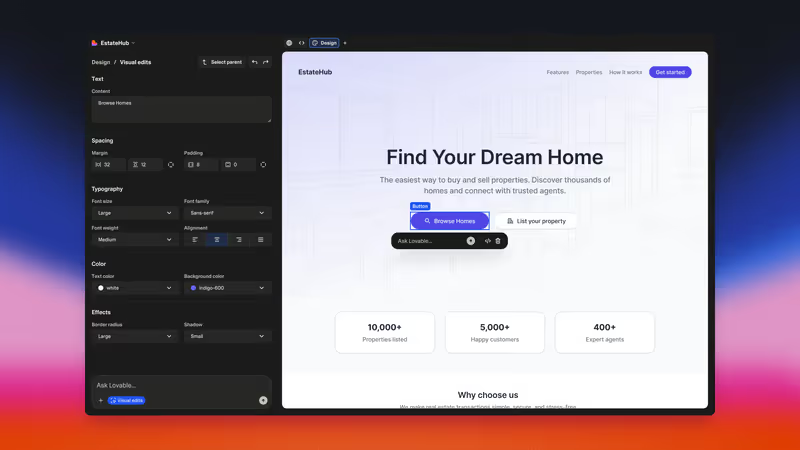
Prompt-to-app builder that generates full React frontends from plain English.

Emergent logo

Emergent

Fastest way to prompt out a full-stack app, if you can keep the agent from burning credits

Lovable vs Emergent, on screen

lovable.dev
Lovable homepage
emergent.sh
Emergent homepage

To compare Lovable and Emergent fairly, the job has to be narrow: generate a working consumer MVP from a single prompt, then survive the first serious round of fixes. That is where these tools genuinely diverge. Lovable leans toward polished React frontends tied to Supabase flows, while Emergent aims for broader full-stack scaffolding with backend and database structure appearing much earlier.

This job exposes the failure modes that actually matter because a consumer MVP is not a static mockup. It needs UI cohesion, authentication, state handling, and a data layer that still works after edits. If the first prompt looks good but the second or third prompt destabilizes layouts, schemas, or build output, the product is not really surviving the job.

The audience

Who each one is for

Lovable

  • Non-technical founders who need a polished frontend prototype for demos and early validation.
  • Design-heavy product teams translating visual ideas into responsive React screens quickly.
  • Makers comfortable using Supabase patterns instead of designing backend architecture from scratch.
  • Teams prioritizing first-impression UI quality over deep backend flexibility at the start.

Emergent

  • Autonomous builders who want backend, database, and app scaffolding generated in one pass.
  • Technical founders willing to inspect files, commands, and environment behavior during iteration.
  • Developers who want visible full-stack structure rather than a mainly frontend-first abstraction.
  • Users comfortable supervising an agent that may need manual correction after large edits.

Lovable skews toward presentation and UX-led validation. Emergent skews toward builders who care more about repository breadth than frontend smoothness.

The scope

What you'd build with it

Lovable

  • Consumer SaaS MVPs needing polished onboarding, forms, dashboards, and responsive layouts.
  • Marketing-led apps or directories backed by Supabase auth and straightforward relational data.
  • Clickable prototypes that need to feel launch-ready before the backend gets very custom.
  • Not the right tool for deeply specialized long-running systems with bespoke infrastructure demands.

Emergent

  • Full-stack prototypes with database tables, backend routes, and server logic scaffolded quickly.
  • Internal or external web apps that benefit from seeing actual project structure early.
  • Backend-aware experiments where relational models matter as much as the UI surface.
  • Not a strong fit for teams expecting consumer-grade frontend refinement without repeated intervention.

Who owns the context window

Lovable handles this job by generating React and TypeScript around a managed Supabase-centric workflow. That matters because the hinge question here is not just whether the first app appears, but whether later prompts can change UI and behavior without rewriting the whole thing. Lovable's frontend-first structure tends to keep visual components legible, and its reliance on established Supabase patterns narrows the surface area of backend improvisation. The tradeoff is that once complexity rises, generated structure can still sprawl, especially when prompts ask for broad cross-cutting changes.

Emergent approaches the same job more like an agent working across a fuller repo and runtime. The advantage is obvious on prompt one: database shape, backend logic, and app structure can emerge together instead of being deferred. But that same breadth makes context ownership fragile during revision. When the agent interprets a localized request as a repo-wide edit, container behavior, file churn, and repeated rewrites can turn a promising first scaffold into an expensive fix cycle.

Strengths

Where each one is strong

Edge: Lovable

Lovable gets the edge because first-draft frontend quality matters more than raw scaffolding for this specific consumer MVP job.

Lovable

  • Stronger first-pass UI polish with cleaner layouts, forms, and visual hierarchy out of the gate.
  • Direct Supabase-oriented workflows make auth and standard data-backed features easier to stand up.
  • React and TypeScript output is generally approachable for later developer cleanup or extension.
  • Good fit for rapid concept validation where design credibility affects user and stakeholder feedback.

Emergent

  • Broader full-stack scaffolding can produce backend, database, and app structure in one generation.
  • More transparent project structure helps technical users inspect files and intervene manually.
  • Useful when the initial prompt needs server logic and relational modeling, not just screens.
  • Can accelerate technical prototyping for builders who want a visible repo rather than a guided shell.

Failure modes

Where each one breaks

Edge: Lovable

Lovable's failures are usually annoying; Emergent's can become structurally disruptive and financially painful during iteration.

Lovable

  • Regression loops on detailed edits can reintroduce UI bugs after the tool claims a fix.
  • Generated schemas may become awkward as app complexity expands beyond simple early-stage patterns.
  • Styling consistency can drift when repeated prompts modify broad layout or component rules.
  • Projects may still require manual cleanup once the prototype grows into a real product.

Emergent

  • Destructive rewrite behavior can undo working sections while attempting unrelated changes.
  • Container wake-ups, stalled runs, or unstable environments slow down ordinary iteration.
  • Large edits can trigger excessive file churn that makes the app less trustworthy after each prompt.
  • Credit burn from agent-caused errors is especially punishing when the tool charges through failed fixes.

Iteration cost

The fix loop, priced

Edge: Lovable

Lovable's rollover and lower iteration volatility make its pricing model less punishing on a fix-heavy build.

Lovable

  • Pro plan starts at 25€/month for 100 monthly credits.
  • Reported usage commonly rises fast once prompts shift from generation to repeated UI correction.
  • A bad debugging session can consume a large chunk of the monthly allowance in one afternoon.
  • Unused subscription credits roll over while the paid plan remains active.

Emergent

  • Standard plan is priced around $20/month billed annually for 100 monthly credits.
  • Small follow-up changes can trigger aggressive agent activity and rapid credit consumption.
  • Worst-case reports describe spending far beyond the base plan while repairing tool-created issues.
  • Subscription credits do not roll over, even if separate purchased overages may last longer.

Both tools make the real bill show up after the first prompt, when iteration rather than generation becomes the expensive part.

Exit paths

The code you end up with

Even

Both tools can hand you real code, but neither magically removes the maintenance burden once you leave the platform.

Lovable

  • Exports readable React and TypeScript that can sync to GitHub for later takeover.
  • Supabase coupling helps early speed but can complicate migration if the app becomes highly customized.
  • Generated code may need refactoring before a development team wants to maintain it long term.
  • Portability is decent, but the polished prototype still becomes your responsibility after export.

Emergent

  • Produces a fuller repo shape with backend and app files that developers can inspect directly.
  • GitHub handoff is practical for teams that want to continue work outside the original workspace.
  • Standard-looking project structure can help technical users resume work faster after export.
  • Runtime and environment assumptions may still make self-hosting or migration more involved than expected.

When neither wins

If you are treating this consumer MVP as a real business app, neither Lovable nor Emergent fully solves the hard part: you still end up maintaining generated code that touches auth, data access, and user-facing logic. That is manageable for a technical team, but for a non-developer operator it means owning the security and debugging consequences of every generated change.

For that kind of business-shaped app, Softr is the tool with no fix loop: auth, user groups, and record-level permissions are platform configuration rather than generated code. The honest boundary is that Softr is the wrong fit if you want a highly custom consumer UI or if owning the codebase is the point.

Verdict

Lovable wins when the job is a single-prompt consumer MVP that still needs to look credible after the first round of revisions. Its strongest advantage is that the frontend usually lands closer to something you can actually show users without immediately triggering a destructive repair cycle.

Emergent is the better pick when full-stack scaffolding is the priority and you have the technical tolerance to supervise an aggressive agent. If backend structure, visible files, and repo breadth matter more than polished first-draft UX, its broader generation can be worth the risk.

For non-developers building a business app rather than a code asset, the cleaner call is to look past both and use Softr. If what you really need is a custom-code consumer product, standardize early around the tool whose output your team is actually willing to maintain.

Q & A

Frequently Asked Questions

Is Lovable better than Emergent for building a consumer MVP?

Usually yes, if the priority is a polished UI that survives early iteration. Lovable tends to produce cleaner first-draft frontend work, while Emergent is more likely to trade visual stability for broader full-stack scaffolding.

Which costs more, Lovable or Emergent?

The base plans are in a similar range, but the practical cost depends on how expensive the fix loop becomes. Emergent is riskier if repeated agent rewrites consume credits during tool-caused errors, while Lovable is usually more predictable because its monthly credits can roll over.

Can I export code from Lovable and Emergent?

Yes, both can give you code and GitHub-oriented handoff paths. The catch is that export does not remove maintenance work, and each tool leaves you responsible for cleaning up and operating the generated app afterward.

Which tool has less lock-in, Lovable or Emergent?

Neither is lock-in free, but they are roughly comparable because both can hand over real project files. Lovable's Supabase-centered setup can shape how your app evolves, while Emergent can leave you with runtime and environment complexity to untangle.

What should I use if I do not want to maintain generated code?

For a business app, Softr is the clearer no-code route. It handles authentication, permissions, and data access as platform configuration instead of generated code, which avoids the ongoing debugging burden these code-generating tools create.