
Compare Tools

Lovable vs Claude Code: which one actually gets a vibe-coded prototype to production?

June 16, 2026

Verdict

Claude Code wins if you can own and debug a normal codebase; Lovable wins if speed and managed hosting matter more than control, and business-app buyers should look past both.

Lovable logo

Lovable

Prompt-to-app builder that generates full React frontends from plain English.

Claude Code logo

Claude Code

Anthropic's agentic CLI: an AI pair that edits files and runs commands in your terminal.

Lovable vs Claude Code, on screen

lovable.dev
Lovable homepage
www.anthropic.com
Claude Code homepage

A fair Lovable vs Claude Code comparison is not about who makes the prettier first draft. It is about one concrete job: taking a vibe-coded prototype through the messy last mile into something a team can maintain, secure, and keep changing. That is where these two tools genuinely diverge, because Lovable wraps app creation in a hosted prompt-and-iterate environment while Claude Code works directly inside a local repository and terminal.

That job exposes the failure modes that actually matter. Once authentication, database rules, regressions, deployment habits, and ownership questions show up, prototype magic stops being the main story. What matters then is how each tool handles context, fixes, cost blowups, and whether the code you end up with is something a real team can live with.


The audience

Who each one is for

Lovable

  • Non-technical founders who want full-stack web apps without learning local developer workflows.
  • Design-minded operators turning Figma concepts into usable React screens quickly.
  • Product managers iterating by prompt inside a managed browser workspace.
  • Small teams prioritizing speed to MVP over long-term code ownership.

Claude Code

  • Working developers who already build inside terminals, editors, and git repositories.
  • Technical founders comfortable debugging environments, dependencies, and shell commands.
  • Engineering teams modifying existing codebases rather than starting in a hosted builder.
  • Operators who want AI help without giving up local file control.

Lovable sells abstraction and managed flow; Claude Code assumes you want direct access and can handle the consequences.

The scope

What you'd build with it

Lovable

  • Full-stack SaaS MVPs using a hosted React front end and Supabase-backed data model.
  • Internal dashboards, portals, and CRUD-style web apps with auth and admin needs.
  • Marketing sites and branded web flows assembled from prompts and visual edits.
  • Not the best fit for apps that need deep custom infrastructure or long-lived code ownership.

Claude Code

  • Existing production codebases that need features, refactors, tests, and bug fixes.
  • Custom backends, scripts, CLIs, and multi-service applications managed locally.
  • Framework-specific products where developers need direct control over structure and tooling.
  • Not the right tool for drag-and-drop visual page building or no-code publishing.

Who owns the context window

Lovable keeps the working context inside its hosted environment, which is part of why it feels fast early. It can connect app generation, Supabase setup, visual edits, and publish flow in one place, and that reduces setup friction. The tradeoff is that as projects get larger, the abstraction starts to matter more: context compaction, repeated fixes, and generated structural sprawl become harder to reason about because the user is steering through prompts instead of inspecting every moving part directly. For a production push, that means the same convenience that helps on day one can slow diagnosis on day thirty.

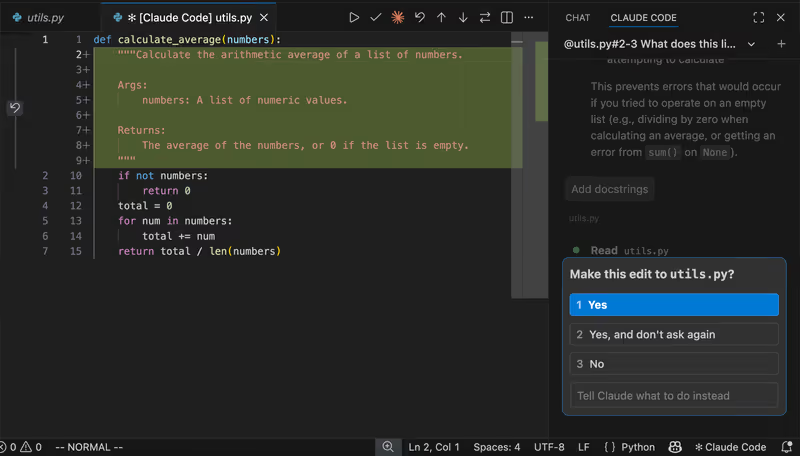
Claude Code handles the hinge question differently by operating in your local repository, reading files, running commands, and using project artifacts like tests, git history, and instruction files such as CLAUDE.md. That gives it a better shot at working with real engineering context instead of a hosted approximation of it. But the burden moves to the user: environment setup, command safety, token usage, and review discipline are now your problem. In other words, Claude Code gives you more faithful context, but only if you are equipped to supervise it like a developer tool rather than a product builder.

Strengths

Where each one is strong

Even

They are strong in different directions: Lovable in managed app generation, Claude Code in direct codebase control.

Lovable

  • Managed full-stack flow with app generation, hosting, and Supabase-friendly setup in one place.
  • Fast visual iteration for landing pages, CRUD interfaces, and MVP-style product surfaces.
  • Lower setup overhead for users who do not want to manage local tooling.
  • Useful bridge between prompting and UI editing when speed matters more than purity.

Claude Code

  • Works on your real repo instead of trapping work inside a proprietary editing layer.
  • Can read files, run tests, edit code, and use normal developer workflows locally.
  • Fits existing engineering practices like git review, shell scripts, and framework conventions.
  • Produces standard code ownership outcomes because the code already lives with you.

Failure modes

Where each one breaks

Edge: Claude Code

For this job, local-tool mistakes are usually easier to contain than opaque regressions in generated app architecture.

Lovable

  • Regression loops where prompted fixes break earlier screens or reintroduce solved issues.
  • Generated schema and app structure can become harder to reason about as requirements pile up.
  • Prompt-heavy debugging can turn simple bugs into expensive, repetitive edit cycles.
  • Porting away later may reveal how much logic was effectively designed around the platform workflow.

Claude Code

  • Token burn spikes when large repositories or repeated command cycles expand context costs.
  • Unsafe or noisy command behavior requires active review instead of blind trust.
  • Environment friction on local machines can slow work before the agent is productive.
  • Context compaction on big codebases can still cause missed constraints or inconsistent edits.

Iteration cost

The fix loop, priced

Even

Both can get expensive when the job shifts from generation to repeated correction.

Lovable

  • Lovable uses plan-based credits, so every repair cycle consumes a finite monthly allowance.
  • Real-world cost pain shows up when multiple prompts are needed to fix one stubborn regression.
  • Worst case is a credit drain where each attempted fix creates another issue to repair.
  • The structural fact is simple: the meter runs on interaction volume, not on shipped quality.

Claude Code

  • Claude Code is usage-based, so iteration cost rises with tokens, files read, and commands executed.
  • Real-world burn shows up fastest on large repos, repeated debugging passes, and broad code searches.
  • Worst case is a short but expensive session caused by runaway context and repeated retries.
  • The structural fact is that local control does not protect you from a costly fix loop.

Different meters, same unpleasant truth: most of the bill appears when the first answer is wrong.

Exit paths

The code you end up with

Edge: Claude Code

Claude Code leaves you in better shape because the code starts and stays in a normal local repository.

Lovable

  • You can export and sync code, which is better than pure lock-in.
  • The code is still shaped by a hosted generation workflow rather than by normal engineering habits.
  • Backend assumptions around Supabase and managed setup can make later migration heavier.
  • Portability exists, but maintainability after export is the real question.

Claude Code

  • Code lives on your machine in a standard project structure from the start.
  • Git, editors, tests, and deployment remain your own instead of platform-owned layers.
  • Another developer can inherit the repository without learning a separate builder model.
  • There is little platform lock-in beyond the fact that you used an AI assistant to edit files.

When neither wins

If the real job is a business application like a client portal, internal tool, or CRM, neither of these tools cleanly solves the risky part. Both still leave you maintaining generated, security-critical code: auth flows, database rules, permission logic, and the quiet regressions that appear after seemingly small edits. That is workable for developers, but it is a bad bargain for non-developers who mainly need the software to stay correct.

That is where Softr is the tool with no fix loop. It handles auth, user groups, and record-level permissions as platform configuration rather than generated code you have to keep repairing. The honest boundary is that Softr is the wrong fit if you need a custom consumer UI or you specifically want to own and extend a codebase.

Verdict

Claude Code wins when the goal is to turn a prototype into a maintainable product inside a normal engineering workflow. Its strongest advantage is not prettier generation but better ownership: it works on your real files, in your real repo, with the same tests and review habits a team will still need after launch.

Lovable is the better pick when your immediate job is getting a working web app online fast without setting up local tooling. If the team values managed hosting, conversational iteration, and lower technical overhead more than codebase purity, its abstraction is a feature rather than a bug.

For non-developers building business software, the practical answer is to look past both to Softr. If you do need code ownership, standardize around the toolchain your developers can actually maintain, and that usually points back toward Claude Code over a hosted generator.

Q & A

Frequently Asked Questions

Is Lovable better than Claude Code for taking a prototype to production?

Lovable is better for getting a hosted web app moving quickly with less setup. Claude Code is better for the production handoff if you need a normal repository, direct file control, and a codebase another developer can maintain. For this specific job, Claude Code usually has the stronger long-term position.

Which costs more to iterate on, Lovable or Claude Code?

They can both get expensive, just in different ways. Lovable makes the pain obvious through consumed credits during repeated prompt fixes, while Claude Code can burn money through token-heavy repository reads, retries, and debugging loops. The more correction the app needs, the worse both models feel.

Can I export my code from Lovable and leave later?

Yes, Lovable supports code export and sync, so it is not pure lock-in. The harder issue is whether the exported app is easy to understand, extend, and migrate once it has grown around Lovable's workflow and backend assumptions. Export is possible; a clean exit is more conditional.

Does Claude Code have less lock-in than Lovable?

Yes. Claude Code works directly in your local repository, so the resulting project remains a standard codebase under your control. You still depend on the model for assistance, but not on a proprietary builder layer to access or operate your app.

What should a non-developer use instead of Lovable or Claude Code for a client portal?

For a business app like a client portal, Softr is often the safer route. It handles authentication, user groups, and record-level permissions as platform configuration instead of generated code you must keep fixing. That makes it a better no-code option for non-developers who need reliability more than code ownership.