Compare Tools

Lovable vs VibeCode: which one survives a real creators' mobile application?

June 16, 2026

Verdict

VibeCode wins if the job demands a true native mobile app in the official app stores; Lovable wins if the creator audience is better served by a highly customized web MVP.

Lovable logo

Lovable

Prompt-to-app builder that generates full React frontends from plain English.

VibeCode logo

VibeCode

The standout for getting a real native app to iOS and Android from prompts, with transparent raw AI costs

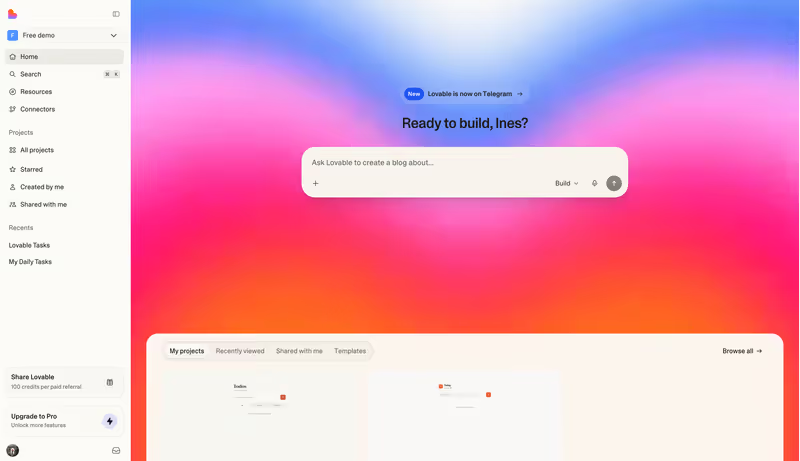
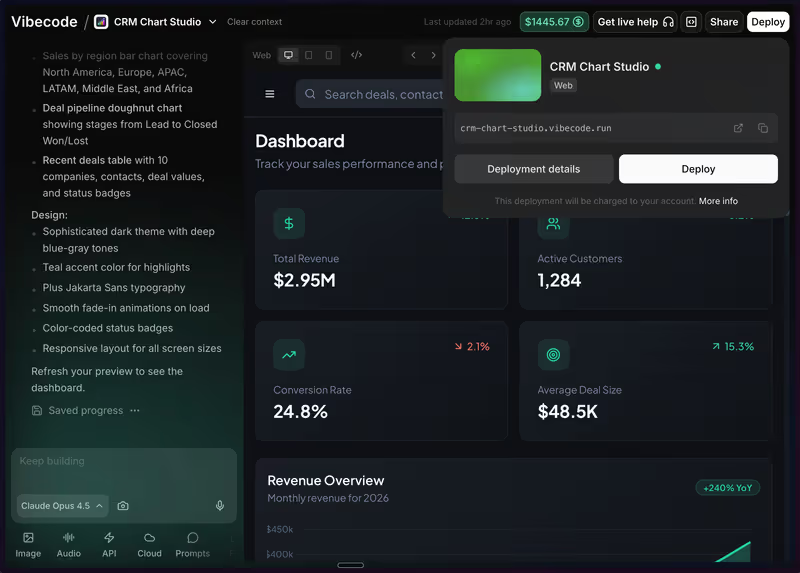
Lovable vs VibeCode, on screen

lovable.dev
Lovable homepage
www.vibecodeapp.com
VibeCode homepage

The fairest way to compare Lovable and VibeCode is on a mobile app built specifically for a creator audience - a platform where video creators upload clips, manage member tiers, and check tip earnings. To succeed here, the app needs premium design, media-friendly layouts, and a painless mobile user experience. The visible frontend is only half the battle; the key is how each tool delivers the app to creators who live entirely on their smartphones.

This job exposes the deep design and pipeline differences between these two builders. Lovable outputs a full React, TypeScript, and Supabase web-first stack that is highly interactive but requires manual styling to look passable on a phone screen, and packaging it as a native mobile app is left to you. VibeCode, by contrast, targets native mobile outputs from the first prompt, preparing real iOS and Android packages and letting you publish directly to the app stores. It is a choice between web-centered customization and native mobile utility.


The audience

Who each one is for

Lovable

  • Web-focused developers and founders who want an interactive SaaS MVP that runs in any browser
  • Designers who want to go from a polished Figma mockup to interactive React code with AI assistance
  • Visual builders needing a fast, customizable full-stack web workspace connected to a managed Supabase database
  • SaaS teams validating software products that will eventually move to an enterprise, custom code stack

VibeCode

  • Mobile app prototypers wanting to spin up native iOS and Android apps without coding in Swift
  • Creator-economy developers who need to package smartphone utilities, lightweight tools, or simple mobile games quickly
  • Non-technical founders aiming to launch a mobile MVP directly into the official App Store
  • Builders who want complete visibility into exact LLM token pricing without paying marked-up subscription taxes

Lovable targets builders who prioritize highly flexible full-stack web architectures; VibeCode targets creators whose final product must live on a smartphone's home screen.

The scope

What you'd build with it

Lovable

  • Branded creator backend platforms, desktop-friendly media dashboards, and visual SaaS portals
  • Supabase-connected web MVPs requiring granular custom user schemas, database triggers, and deep logic workflows
  • Interactive web apps with rich data visualization and rich layouts - but poor out-of-the-box mobile-native features
  • Production-grade mobile apps that must live past 24 months, which builders strongly advise against using Lovable for

VibeCode

  • Native mobile utility apps, simple mobile games, and smartphone-specific directories for creator channels
  • Mobile-first MVPs requiring local mobile device hardware access and lightweight, fast container performance on iPhones
  • Direct-to-store mobile apps with built-in basic user authentication and straight-forward data tables
  • Complex complex web apps, which VibeCode should explicitly not be used for due to its strict mobile-first design

The mobile packaging question

Under the hood, Lovable compiles standard React and TypeScript code on top of a Supabase backend. When you prompt it to build for mobile, it outputs a mobile-responsive web layout that runs seamlessly inside Chrome or Safari. However, if your creator audience demands an actual app to tap on their home screen, you face the developer overhead of wrapping Lovable’s exported React output inside a hybrid wrapper like Capacitor or Cordova yourself. You must manually manage native dependencies, hardware bridges, and compilation chains, which can quickly frustrate non-technical operators who thought vibe coding would skip the technical plumbing.

VibeCode approaches the exact same prompt from a native-first perspective. It compiles assets specifically for iOS and Android deployment right out of the box, avoiding web-container compromises on mobile screens. It handles the mobile-first layouts, local assets, and cloud configurations natively, meaning you do not have to struggle with build containers, responsive layout prompting fatigue, or Cordova compilation errors. VibeCode lets paid subscribers push builds directly to the Apple and Google Play stores, removing the developer packaging hurdles that plague standard web-focused AI code generators.

Strengths

Where each one is strong

Edge: Lovable

Lovable takes the edge on visual prototype polish and database flexibility, though VibeCode is unchallenged on true native app store packaging.

Lovable

  • Stunning first-draft visual generation, delivering elegant web designs that feel highly interactive
  • Turnkey Supabase integrations, automatically handling postgres databases and social auth
  • Figma design-to-component imports, making it easy to scaffold interfaces from existing designer mockups
  • Pre-publish security scans that audit generated codebase code and row-level security policies

VibeCode

  • True native mobile focus, optimizing the rendering pipeline specifically for Android and iOS mobile devices
  • Direct publishing pipelines to the Apple App Store and Google Play Store for paid accounts
  • No markup pricing, meaning you pay exactly what the LLMs charge for raw token usage
  • SSH developer backend access, letting advanced users inspect the output and edit code with local IDEs

Failure modes

Where each one breaks

Edge: VibeCode

VibeCode's limits are more predictable for mobile targets, whereas Lovable's regression loops can burn through expensive credits on simple layout edits.

Lovable

  • Severe regression loops, where the AI agent often breaks working features while attempting to resolve separate bugs
  • AI credit inflation, with community reports of credit consumption suddenly multiplying on simple prompts
  • Schema debt, where AI-designed databases become highly fragile and resist structural changes after several months
  • Unfinished deployment preview discrepancies, where elements running well inside the preview break on public deploys

VibeCode

  • Strict complexity walls, with the AI agent losing structural files context inside larger codebases
  • Strict platform lock-in on lower tiers, where code export requires expensive upgrades
  • Risk of silent logic hallucinations, making custom API integrations difficult to audit for non-developers
  • Weak performance on non-mobile layouts, failing entirely if you try to stretch it to a desktop application

Iteration cost

The fix loop, priced

Edge: VibeCode

VibeCode's transparent model doesn't mark up AI costs, making it cheaper to run long debugging chat loops.

Lovable

  • Pro plan starts at 25€/month for 100 base monthly credits, with scaled tiers for higher usage
  • Reports of simple edits consuming 3 to 4 credits per prompt, exhausting base allowances fast
  • Debugging cycles occasionally introduce new code bugs, forcing you to pay credits to patch the AI's own mistakes
  • Unused monthly credits roll over to the next month on all paid developer accounts

VibeCode

  • Plus plan is $20/month and includes $20 in direct LLM API token credits with no markup
  • Usage is mapped directly to raw API calls, with the platform offering a completely transparent billing model
  • Fixing complex code bugs burns raw developer API tokens directly, but avoids arbitrary credit inflation
  • Unused credits roll over to subsequent months up to a maximum two-month limit

Both builders will bill you for iterative AI mistakes. Chasing complex bugs inside code you cannot read quickly leads to an expensive fix loop tax that devours your monthly budget.

Exit paths

The code you end up with

Even

Lovable outputs cleaner full-stack web react repositories, but VibeCode is easier to download and run inside Cursor for mobile developers.

Lovable

  • Exports standard, readable React and TypeScript synchronized straight to your custom GitHub repository
  • Exported codebase files can be messy and hard to migrate cleanly without manual developer rewrites
  • Database backend is highly integrated, leading some builders to complain about a backend migration lock-in
  • Codebases are best used as design references or temporary skeletons, rather than production assets long-term

VibeCode

  • Compiles native mobile assets that can be extracted cleanly on Pro accounts
  • Offers full SSH developer access, making it direct to sync your workspace with editors like Cursor
  • Backend runs on VibeCode Cloud, meaning you have to host assets on their architecture to maintain database features
  • Source files can sometimes become unoptimized, but remain standard and free from proprietary blocks

When neither wins

If your creator application is actually an operational project - like a portal where members manage bookings, update directories, and sync with business calendars - neither of these tools is the optimal choice. Both VibeCode and Lovable generate custom raw application code that you are forced to audit, secure, and debug. If you are not a developer, you are essentially paying developers to inherit a fragile codebase you cannot maintain when the AI hits a day two context window limit.

If you are aiming to build operational apps, client portals, or member centers, Softr handles the entire stack differently. Instead of attempting to code authentication, databases, and permissions via natural language prompts, Softr serves user login, user groups, and record visibility as battle-tested platform configuration. In addition, its responsive layouts function beautifully as Progressive Web Apps (PWAs) that your users can install on their smartphones with a single tap, bypassing App Store review delays entirely. For business portals, it removes the fix loop tax entirely because you manage settings visually, not through code regenerations.

Verdict

VibeCode wins this comparison conditional on one major criteria: you must have a true native mobile app in the official Apple App Store or Google Play Store. It is the standout tool when smartphone-native performance, on-device operations, and mobile layout compiling are non-negotiable. If you want local mobile assets and transparent LLM costs, select VibeCode.

Choose Lovable instead if your developer team is building a web-first creator dashboard or interactive web MVP. Lovable outperforms VibeCode on initial visual generation, aesthetic presentation, and managed Supabase setup. It is the superior workspace if the final deliverable is an interactive web showcase that you eventually intend to migrate to a local developer workspace.

And if you are a non-technical creator building deep operational portals or membership hubs, look past both code-generators. The core plumbing of an operational business portal is exactly what no-code systems provide natively. Skip code-maintenance cycles and construct your platform on Softr to keep your development simple.

Q & A

Frequently Asked Questions

Is VibeCode better than Lovable for mobile apps?

Yes, VibeCode is superior if you need a true, native mobile app deployed to the Apple App Store or Google Play Store. Lovable is a web-first developer workspace that outputs responsive React code, which requires manual packaging to run natively on mobile devices.

Can I export code from Lovable and VibeCode?

Both options support code export. Lovable synchronized standard TypeScript and React react code to GitHub, though some developers report it is messy to migrate. VibeCode lets paid Pro plan users export their mobile compilations and connect via SSH to local IDEs like Cursor.

Which runs up a higher bill, Lovable or VibeCode?

Lovable's credit-based model can become highly expensive, as builders complain about consumption increasing to 3-4 credits per prompt during simple layout updates. VibeCode utilizes a transparent pricing model where credits represent exact raw LLM API usage with no platform markup.

What should non-technical creators use for portal apps instead?

Non-technical operators should look past raw code generators and use Softr. Softr packages login, database links, and user group permissions as stable platform configuration, letting you deploy custom, responsive web engines and mobile PWAs without maintaining fragile codebases.