Compare Tools

Lovable vs Softgen: which one survives a real client SaaS MVP?

June 16, 2026

Verdict

Softgen is cheaper for quick visual mockups but struggles to customize outside templates; Lovable offers full React ownership yet buries a non-technical owner in maintenance. If you are a freelancer shipping to a non-technical business owner, look past both.

Lovable logo

Lovable

Prompt-to-app builder that generates full React frontends from plain English.

Softgen logo

Softgen

Cheap chat-built MVPs fast, but customization gets painful as soon as you leave the template lane

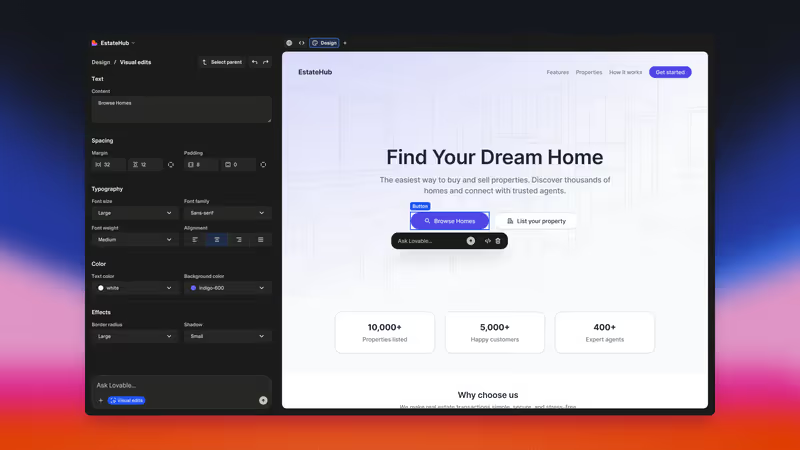
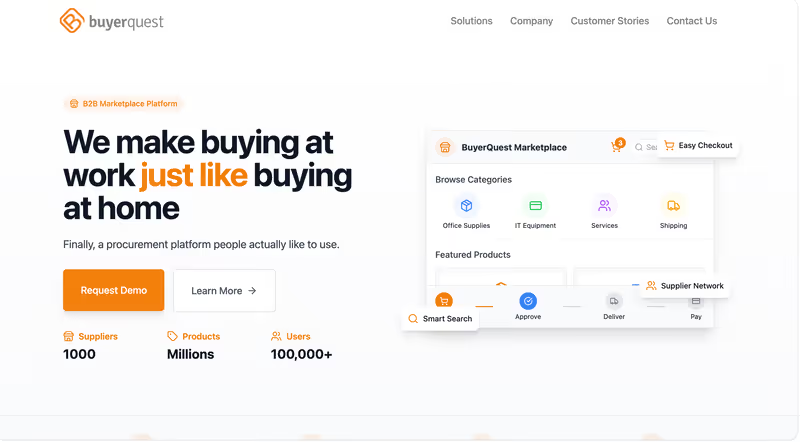
Lovable vs Softgen, on screen

lovable.dev
Lovable homepage
softgen.ai
Softgen homepage

The client wants a SaaS MVP and they want it quickly. For a freelancer, this is a dangerous brief. You need to deliver something that looks custom, handles user accounts, and stores data reliably. On paper, both Lovable and Softgen let you build a functional full-stack app by chatting with an AI. They both offer database schemas, user authentication, and landing pages, but past the initial generation, their architectures diverge entirely.

This comparison is judged on a concrete job: a freelancer shipping a business-shaped SaaS MVP to a paying, non-technical client. This job exposes the difference between prototype-level speed and production-grade maintenance. If the app breaks after the final invoice is paid, the client will call you, and some AI-led debugging loops are incredibly expensive to run when you are on a fixed freelance budget.

The audience

Who each one is for

Lovable

  • Freelancers and developers who need a clean, standard React codebase synced directly to GitHub.
  • Technical founders building an early-stage SaaS MVP aimed at raising venture capital.
  • Product managers who want an interactive, pixel-perfect design reference to hand to developers.
  • Agencies looking to deliver high-fidelity functional mockups within tight production deadlines.

Softgen

  • Indie hackers looking for the absolute cheapest entry point to test a basic directory.
  • Non-technical creators who want a conversational, guided setup to outline a basic website.
  • Makers comfortable with rigid template lanes who only need simple database listings.
  • Early-stage builders testing basic stripe payment integrations on highly bounded app scopes.

Lovable targets technical builders who eventually want to manage their own code repository; Softgen targets non-technical creators aiming for low-cost, template-constrained setups.

The scope

What you'd build with it

Lovable

  • Fully custom SaaS applications with relational database triggers and rich web layouts.
  • Interactive dashboards that require custom React components and third-party API wiring.
  • High-fidelity prototypes where custom Figma design tokens must map cleanly to front-end states.
  • Complex multi-user portals (though they struggle to scale past 18 to 24 months without a manual code rebuild).

Softgen

  • Basic directories and resource libraries that fit clean, predefined visual modules.
  • Simple landing pages featuring basic stripe checkouts and standard newsletter collection forms.
  • Early-stage SaaS MVPs that do not depart from standard, pre-built list and search layouts.
  • Interactive tools that do not require deep custom business logic or nested database relationships.

The customization ceiling

Lovable hooks your front end up to a Supabase backend. When you describe your database needs, Lovable's AI translates them into database schemas, tables, and Row-Level Security (RLS) policies. Once generated, this React, TypeScript, and Tailwind code is fully transparent and synced to GitHub. If the AI hits a wall during a complex update, a developer can clone the repository, open Cursor or VS Code, and write standard code to bypass the limitation. This is a critical safety valve when delivering to a client.

Softgen relies on its conversational Cascade AI Agent to write code inside its own ecosystem. It abstracts the visual frontend and SQL schemas away, which is easier for beginners but creates a rigid visual environment. Because there is no manual visual drag-and-drop editor and no local development loop, every minor layout change, spelling correction, or column alignment requires going back to the chat assistant. If the AI cannot interpret your layout request cleanly, you are stuck in a prompting loop with no clean way to fix the code directly in an IDE.

Strengths

Where each one is strong

Edge: Lovable

Lovable takes the edge on sheer software capability, code quality, and its high-tier Supabase infrastructure, which are mandatory for client-ready deliverables.

Lovable

  • The highest quality first-generation output in the prompt-to-app category, shipping standard React, TypeScript, and Tailwind.
  • Turnkey Supabase integration providing instant managed PostgreSQL, user authentication, and secure RLS policies.
  • GitHub integration that synchronizes your generative codebase with a standard, portable repository.
  • Built-in Figma import and pre-publish security scans that audit code and dependencies.

Softgen

  • Extremely cheap entry price of $33 per year for platform access, custom domains, and hosting.
  • Structured conversational outline helper that drafts database schemas before writing code.
  • Stripe payment setups and user login forms built cleanly into the assistant's standard templates.
  • Pay-as-you-go credit structure rather than expensive recurring monthly base subscriptions.

Failure modes

Where each one breaks

Edge: Lovable

Softgen's strict customization ceiling and lack of developer-friendly escape routes make it too risky for client work; Lovable is at least repairable.

Lovable

  • Severe regression loops where the agent re-breaks working components while attempting to fix minor UI bugs.
  • Lock-in of database backends where the AI has been reported to migrate schemas without developer consent.
  • Database schema debt where AI-generated structures become highly fragile and difficult to evolve by month six.
  • Credit inflation, with community reports of credit consumption rising up to ten-fold for simple prompts.

Softgen

  • Severe visual and design ceiling that makes customizing outside pre-packaged template lanes highly painful.
  • Total dependency on chat prompts for visual adjustments, with no drag-and-drop studio or visual layout panels.
  • Limited database options that make complex business workflows and nested relational rollups impossible to secure.
  • High risk of accumulating technical debt with no local IDE debugging loop to salvage client apps.

Iteration cost

The fix loop, priced

Even

Both tools operate as credit-consuming black boxes, meaning you write a check every time the AI makes a coding mistake.

Lovable

  • Pro plan starts at 25€ per month, which yields 100 base monthly credits.
  • Real-world burn is reported at 3 to 4 credits per prompt, which can exhaust a base plan in under 30 edits.
  • Worst-case scenarios involve paying for credit overages because of looping debugging loops.
  • Unused credits roll over on paid plans, which keeps the base cost predictable during downtime.

Softgen

  • Base platform costs $33 per year, which covers hosting and editing rights.
  • Usage credits are pay-as-you-go, requiring users to purchase credit packages separately.
  • Each layout adjustment forces you back to the prompt box, constantly draining pay-as-you-go balances.
  • The pricing model ensures you only pay for active iteration sessions, avoiding standard monthly overhead.

Whether you are paying for monthly rolling credits or pay-as-you-go packages, the economics of AI code-generation are fragile. One complex bug can burn through your budget in an afternoon, which is why the fix loop tax is the real price of vibe coding.

Exit paths

The code you end up with

Edge: Lovable

Lovable exports standard, developer-accepted React and TypeScript, while Softgen is highly proprietary and template-locked.

Lovable

  • Standard React, TypeScript, and Tailwind CSS code synced directly to GitHub.
  • The generated database schema depends entirely on how Supabase is configured via prompt.
  • Community reviews note the exported code can require significant manual refactoring to port cleanly.
  • Experienced builders advise moving off the platform after 18 to 24 months to avoid long-term schema limits.

Softgen

  • Exportable codebase options exist, but are heavily dependent on Softgen's layout modules.
  • The database is managed within Softgen's closed runtime, making backend migrations complex.
  • Developers are highly unlikely to welcome inheriting or maintaining native Softgen exports.
  • Customizing or scaling the application requires rebuilding the stack using local code libraries.

When neither wins

Here is the reality of building a SaaS MVP for a paying client: most of what you are actually building is authentication, user tier routing, databases, and secure record filters. If you use Lovable or Softgen, you are writing code for these security-critical layers via prompts. That means you, the freelancer, are fully responsible for auditing that code, testing it for vulnerabilities, and maintaining it when platform updates break the app months from now. For a non-technical client, this is a ticking clock of maintenance cost.

For business-shaped MVPs, client portals, and back-office pipelines, Softr handles the entire infrastructural stack without writing or generating a single line of raw code. Authentication, secure user groups, and record-level permissions are visual configurations on a secure platform. You co-build the data tables with an AI Co-Builder, and customize visually. There is no code to leak, and no platform regressions for you to fix on your own dime. It will not fit if you need custom consumer UI or require raw React codebase ownership to hand to an internal engineering department. But if the job is business operations, it removes the dangerous part of the freelance handoff.

Verdict

Lovable wins this comparison by a wide margin, but on one condition: you must be comfortable stepping into the code yourself when the AI hits its complexity wall. The ability to sync clean React and TypeScript to GitHub is the only real insurance policy a freelancer has. If a client-critical feature breaks, you can clone the repository, open an IDE like Cursor, and fix it manually. Softgen's template lane is too narrow to support client deliverables that require visual or logic deviations.

Softgen is the right pick only for low-budget personal experiments. If you are an indie hacker launching a basic directory or a static page with a simple stripe checkout, its $33 per year platform fee and pay-as-you-go pricing keep your upfront design costs at zero. But the moment you leave those template constraints, the conversational prompting loops will drain your budget and test your patience.

If you are a freelancer shipping this SaaS MVP to a business owner who has no idea what a React node module is, look past both. Building security-critical auth and data routing through AI-generated code is a payday loan of technical debt. Use a production no-code solution like Softr to configure the business logic visually, keep your databases secure, and protect yourself from lifelong unpaid maintenance requests.

Q & A

Frequently Asked Questions

Is Lovable better than Softgen for shipping client MVPs?

Yes, Lovable is much better for client work because it exports standard React and TypeScript code synced directly to GitHub. Softgen is templatebound and difficult to customize, which makes handling client feedback highly unpredictable.

Can I export my database and code from Lovable?

Yes. Lovable generates clean React and TypeScript synced to GitHub, and uses Supabase for the database layer. However, community builders note that the database setup can act as a lock-in trap if you try to migrate the backend later.

Which tool costs more to maintain, Lovable or Softgen?

Softgen has a cheaper base entry point at thirty-three dollars per year, but its prompt-only layout engine means you burn credits for every minor layout edit. Lovable requires monthly plans starting at twenty-five euros, and prompt consumption frequently rises to three or four credits per change.

What should a freelancer use for a business SaaS MVP instead?

If you are delivering a system like a portal or CRM to a non-technical client, choose Softr. It replaces code-generation with visual, secure infrastructure, ensuring there are no hidden data vulnerabilities or broken packages for you to maintain after launch.