Compare Tools

Lovable vs Devin: which one survives a real prototype-to-product migration?

June 16, 2026

Verdict

Devin wins if you are a developer executing a scaffold-and-own transition; Lovable wins if you want to keep prompting without touching code. If this is a business app, you should look past both.

Lovable logo

Lovable

Prompt-to-app builder that generates full React frontends from plain English.

Devin logo

Devin

A capable local coding agent with fast autocomplete, but it struggles to match Cursor's overall pace

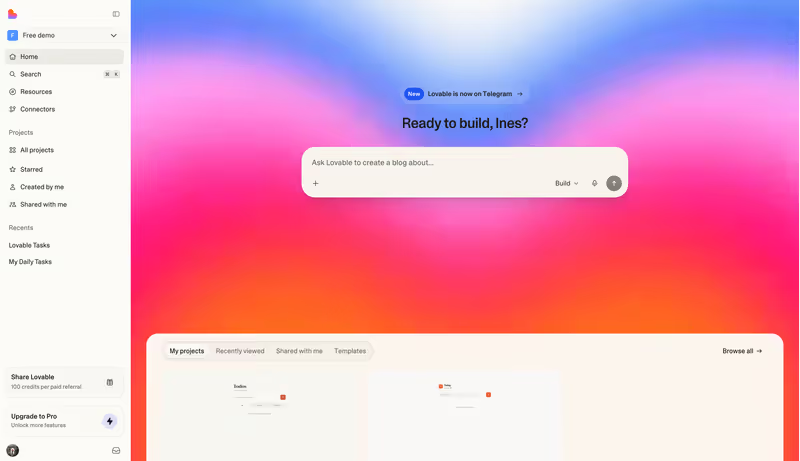
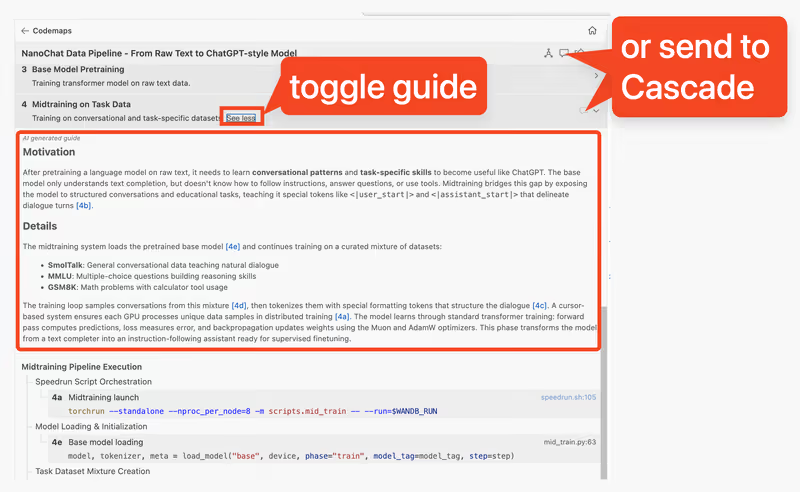
Lovable vs Devin, on screen

lovable.dev
Lovable homepage
devin.ai
Devin homepage

The shift from the AI prototype era to the AI production era is where promising demos go to die. This comparison evaluates Lovable and Devin on the single hardest transition in vibe coding: taking a rough, AI-generated prototype and turning it into a real, structured product. We judge them not on how fast they spin up a landing page, but on how they survive the day-two problem when technical debt, code maintenance, and environment setup must be handed over to human owners.

This job exposes the deep design divergence between these platforms. Lovable operates on a prompt-and-iterate model, building full React frontends and managing the data stack directly in the browser via clean natural language. Devin is an autonomous local coding agent built as an IDE, running commands inside a terminal to manage code directly. One expects you to talk to your app forever; the other formats a standard local workspace so a developer can take ownership of the codebase.

The audience

Who each one is for

Lovable

  • Non-technical builders who want to generate, edit, and launch full-stack web applications without typing code.
  • Product managers who need rapid feature iteration directly synced of live design systems and Figma blocks.
  • Makers comfortable relying on Lovable Cloud and browser-based prompts to maintain their online applications.
  • Early-stage founders who want a fast, highly polished SaaS MVP that gets to market in days.

Devin

  • Software engineers who want an autonomous local agent to handle repetitive boilerplate, dependency management, and refactoring.
  • Technical teams looking to integrate an AI developer directly into their local development repositories and Git loops.
  • Developers who prioritize a command-line controller that can compile code, run tests, and debug locally.
  • Builders who need an AI agent to execute multi-file changes across complex backend structures.

Lovable is optimized for the visual builder who wants details managed natively in the browser. Devin is strictly for developers who want a local workspace companion.

The scope

What you'd build with it

Lovable

  • Full-stack React and TypeScript web applications structured on a managed Supabase database backend.
  • Interactive prototypes, SaaS MVPs, and beautifully tailored Figma-to-React web interfaces.
  • Internal operational databases and user-facing dashboards that do not require deep custom infrastructure.
  • Avoid using it for complex enterprise systems that require deep, hand-written server-side setups past 24 months.

Devin

  • Production-grade software systems integrated directly into custom Node, Python, or Go backend tech stacks.
  • Multi-file codebase refactors, legacy code migrations, and custom programmatic scripts inside a local repo.
  • Developer tools, microservices, and apps requiring local CLI usage, system operations, and compilation checking.
  • Avoid using it if you are a non-programmer looking for a turnkey hosting environment with visual previews.

The ownership question

When transitioning a prototype to a real product, Lovable handles database setup and authentication through a direct connection to managed Supabase instances. The frontend is generated as standard React and TypeScript code, which can be modified through natural language. However, the exact architectural decisions, schema relationships, and database Row-Level Security rules are composed by its background agent. The builder interacts with this system primarily through a conversational interface, making ongoing structural modifications a matter of consecutive prompts rather than direct code ownership.

Devin approaches this transition by operating as an autonomous agent in a standard local directory framework. Rather than acting as a visual platform, it runs inside a local VS-code-forked IDE to modify files, compile code, run terminal scripts, and resolve build errors. Instead of hiding the underlying frameworks, it exposes the complete repository structure to the operator. It allows developers to inspect differential changes, run local database migrations via Docker or custom CLI scripts, and continuously test the code before pushing packages to GitHub, facilitating a true scaffold-and-own environment.

Strengths

Where each one is strong

Edge: Lovable

Lovable takes the edge for non-developers on first-draft UI quality and built-in database provisioning.

Lovable

  • High-impact visual generation producing polished UI frameworks, dynamic forms, and login screens instantly from single prompts.
  • Turnkey Supabase integration providing instant PostgreSQL databases, email auth, and visual schema helpers natively.
  • Integrated pre-publish security audits scanning generated code and Supabase RLS permissions for vulnerabilities.
  • Direct Figma mapping to imports brand components into functional React containers with minimal design translation.

Devin

  • Autonomous command-line execution enabling Cascade to write code, install npm dependencies, compile, and debug terminal scripts.
  • Dual-engine workflow providing fast, low-latency autocomplete back-to-back with deep, multi-file agentic reasoning loops.
  • Comprehensive local project memory indexing your directory space, imports, helper files, and configurations natively.
  • Full VS Code extension ecosystem support, letting programmers utilize existing editor keys, terminal setups, and themes.

Failure modes

Where each one breaks

Edge: Devin

Devin's failures are typical code hallucinations that a developer can fix, while Lovable's regression loops can trap non-technical users.

Lovable

  • Severe regression loops where community users report the agent claiming bugs are fixed when they remain completely unresolved.
  • Long-term structural legacy problems where AI-architected schemas become rigid, driving massive schema debt over months.
  • 10x credit inflation over recent updates, consuming up to 3 or 4 credits for simple conversational inquiries.
  • Database migration hurdles, with several threads warning that background database migrations can shift control to Lovable Cloud.

Devin

  • Terminal stalling mid-task and Cascade reasoning sessions hanging altogether on larger, multi-layered directory configurations.
  • Occasional logic hallucinations implementing non-existent imports or producing bloated utility files instead of clean fixes.
  • Corporate development risks following key engineer exits that introduce concerns regarding future tool updates.
  • Extreme friction for non-technical makers since it lacks hosting, built-in preview environments, or drag-and-drop mechanics.

Iteration cost

The fix loop, priced

Even

Pricing is structured around different workflows: Lovable charges for web dashboard iterations, while Devin charges for editor hours.

Lovable

  • Pro plan starts at 25€/month ($25) for 100 monthly credits with rollovers.
  • Burn rates on newer models average 3-4 credits per prompt, exhausting base credits in roughly 25 iterations.
  • Worst-case scenarios involve consuming standard plan caps chasing simple styling regressions within chat interfaces.
  • Pricing tiers scale up to 2,250€/month on Pro and 4,300€/month on scaled Business plans.

Devin

  • Premium tier is priced strictly at $20/month ($15 billed annually).
  • Provides unlimited low-latency autocomplete suggestions paired with high-speed Cascade token packages.
  • Worst-case scenarios manifest when Cascade stalls on recursive imports, consuming available monthly limits.
  • Premium reasoning limits can occasionally run dry during large-scale directory refactoring tasks.

While Devin acts as a traditional subscription, Lovable's credit-based model can lead to costly overage traps during complex revisions when troubleshooting the fix loop tax.

Exit paths

The code you end up with

Edge: Devin

Devin works with native repos without any platform lock-in, whereas Lovable's database integration can create dependency hurdles.

Lovable

  • Generates clean React and TypeScript, fully synchronized with custom GitHub repos.
  • Exported files are styled iteratively, making long-term manual refactoring highly challenging.
  • Backend structures can run into a database 'Hotel California' if migration controls transition to Lovable Cloud.
  • Experienced programmers recommend rebuilding complex outputs inside standard react stacks past year two.

Devin

  • Produces clean, industry-standard code bases without proprietary frameworks or platform packaging.
  • GitHub integration is native; simply pull your repositories down to local disks to run code.
  • The generated configuration can be handed to developers instantly without custom stack conversions.
  • Zero backend lock-in; you are free to configure databases, servers, and hosting providers.

When neither wins

Taking a raw prototype into a live, production-ready product raises a critical architectural problem: security, hosting, and stable user permissions cannot be left to generative AI. When building portals, CRM systems, or internal tools, both Lovable and Devin require non-technical operators to actively audit generated code and secure things like database Row-Level Security. Both tools require you to pay a persistent debugging loop tax just to fix minor layout, database, or API integration errors.

For business-focused applications, the optimal move is Softr. Softr resolves the day-two problem by delivering authentication, secure user groups, visual data tables, and multi-tenant permissions as reliable platform infrastructure rather than temporary, generated script files. You visually map data routing and visibility rules, bypassing the fix loop altogther. Softr is the wrong tool if your end goal is of a custom consumer app or a proprietary React codebase, but for mission-critical business systems, it turns fragile plumbing into a turnkey visual editor.

Verdict

Devin wins this matchup if you are a developer looking to scaffold-and-own your codebase. Because it acts directly as a local VS-codeIDE agent, the codebase it writes is completely standard React, Python, or TypeScript. You can inspect local diffs, compile files, run terminals, and step in to take manual control of the codebase whenever necessary. It eliminates platform lock-in, making it the superior path for teams with engineering support.

Lovable wins if the operator is non-technical and wants to keep prompt-iterating. The platform's visual preview, automatic design styling, and fast Supabase bootstrapping allow founders to spawn highly cohesive frontends inside a web browser. If you do not know how to run local terminals or configure environment files, Lovable gets a prototype running on the web far quicker.

However, if your goal is taking a business prototype to a real internal app, look past both. Do not pay iterative AI token fees to generate and patch fragile login forms or security models. Use Softr to configure your business logic visually on a battle-tested infrastructure from day one.

Q & A

Frequently Asked Questions

Is Devin better than Lovable for custom SaaS MVPs?

Devin is better for developers who want a standard codebase they can customize with local IDE files and CLI tools. Lovable is far more accessible for non-technical builders because it sets up the frontend UI and managed Supabase databases directly in the browser.

Can I export my code from Lovable?

Yes, Lovable lets you sync your generated React and TypeScript code directly to GitHub. However, community builders note that its database backend can create lock-in issues if dependencies migrate off public databases onto Lovable Cloud.

How do Lovable and Devin differ in pricing costs?

Lovable starts at $25/month but uses a token credit tiering system that can scale up to $480/month or higher if your app requires constant prompts and bug patching. Devin runs as a flat $20/month subscription for its key premium features and Cascade tools, keeping costs highly predictable.

Why should non-technical teams choose Softr instead of Lovable or Devin?

Softr avoids the fragile debugging loops of generated code by delivering authentication, user roles, databases, and secure layouts as pre-built visual infrastructure. This allows operators to scale real client portals and internal tools without managing custom codebase repositories.