
Compare Tools

Devin vs Same.new: which one survives taking a prototype to a real product?

June 16, 2026

Verdict

Same.new wins if you need a fast visual React prototype from an existing page; Devin wins if you need to turn that prototype into software you can actually ship and own.

Devin logo

Devin

A capable local coding agent with fast autocomplete, but it struggles to match Cursor's overall pace

Same.new logo

Same.new

Clone a live site's UI into editable React fast, if you stick to simple layouts

Devin vs Same.new, on screen

devin.ai
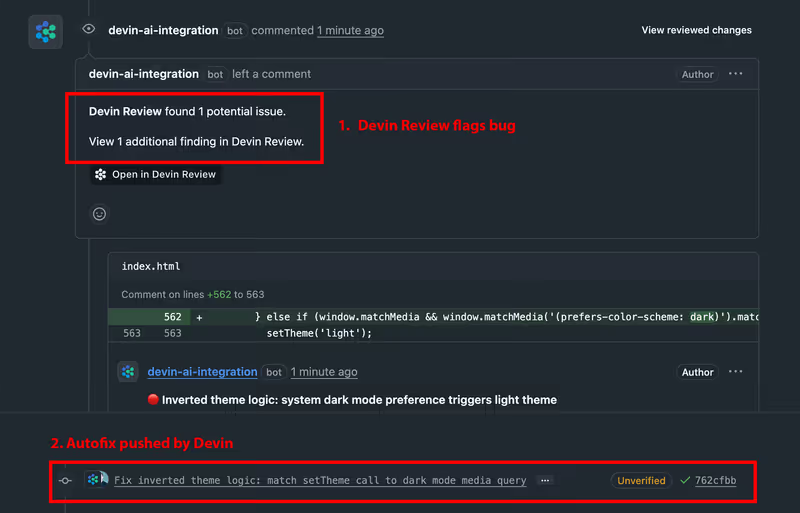
Devin homepage
same.new
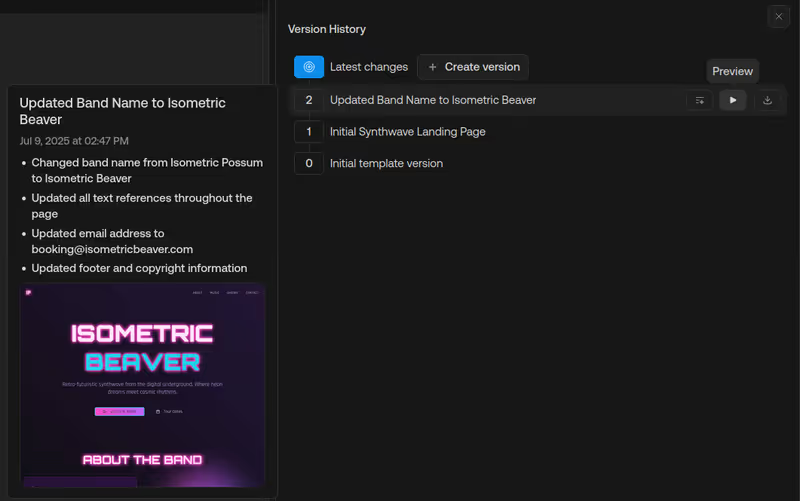
Same.new homepage

The most useful way to compare Devin and Same.new is on one concrete job: taking a vibe-coded prototype and pushing it toward a real product. They diverge sharply here because Same.new is optimized for cloning and editing frontend UI from a URL, while Devin is an AI coding environment that can work through files, terminals, and deployment-shaped tasks.

That job exposes the failure modes that matter. A nice-looking prototype is easy to fake, but production work forces decisions about backend logic, environment setup, debugging, and code ownership; that is exactly where a visual generator and a developer-first IDE stop looking remotely interchangeable.

The audience

Who each one is for

Devin

  • Working developers who want AI inside a real editor with terminal access.
  • Technical founders managing codebases, scripts, and deployment steps without leaving an IDE.
  • Engineers refactoring multi-file apps that need autocomplete plus agent-driven code changes.
  • Teams already standardized on VS Code habits, extensions, themes, and keyboard shortcuts.

Same.new

  • UI-first builders who want to clone a webpage into editable React quickly.
  • Designers and PMs iterating on layouts before handing implementation details to engineers.
  • Non-technical creators adjusting spacing, sections, and styling through chat-driven edits.
  • Marketing or frontend teams needing rapid mockups rather than backend-heavy application logic.

Devin assumes someone is prepared to own a software project. Same.new assumes someone mainly wants to reshape a frontend without becoming that project's maintainer.

The scope

What you'd build with it

Devin

  • Full-stack web apps that need terminal commands, package management, and real debugging loops.
  • Products with backend APIs, scripts, environment variables, and deployment tasks beyond the browser.
  • Existing repositories that need broad refactors across components, config files, and dependencies.
  • Not the right choice for a no-code business team that needs guardrails instead of code ownership.

Same.new

  • Frontend prototypes, landing pages, and React layouts cloned from an existing live URL.
  • Tailwind-styled component shells for demos, design exploration, and handoff to developers.
  • Clickable mockups where visual fidelity matters more than backend correctness or data modeling.
  • Not a strong fit for complex transactional apps with real server logic and persistent state.

Who owns the context window

Devin handles this job like an IDE-native coding agent. Its value is not just code generation but working across a local project with editor context, terminal execution, file edits, and compile-feedback loops, so the prototype-to-product transition can include package installs, command runs, refactors, and debugging inside the repository you actually plan to keep.

Same.new handles the same job like a frontend scaffolder. It can turn an existing page into React and Tailwind, then let you iterate visually through chat, but that context is mostly the rendered UI and generated component structure; once the work shifts to environment variables, backend endpoints, auth flows, or production-safe application behavior, the missing terminal and repo-level execution become the real constraint.

Strengths

Where each one is strong

Edge: Devin

For surviving the jump from prototype to product, Devin has the broader and more durable toolkit.

Devin

  • IDE-native workflow with file editing, agent help, and terminal-driven development in one place.
  • Can work across multi-file projects instead of staying trapped inside a single visual canvas.
  • Fits standard developer habits such as repository ownership, local saves, and git-based iteration.
  • Better aligned with debugging, refactoring, and deployment-shaped tasks that prototypes eventually hit.

Same.new

  • Fast visual cloning from a live URL into editable React components.
  • Useful for quickly recreating layouts without manually rebuilding structure and styling from scratch.
  • Chat-based UI iteration is accessible for non-engineers adjusting sections, spacing, and presentation.
  • Exports a frontend starting point that developers can later clean up and integrate elsewhere.

Failure modes

Where each one breaks

Edge: Devin

Devin's problems are usually ordinary coding problems inside an owned repo; Same.new's problems become more damaging once the app needs reliable behavior beyond the UI.

Devin

  • Developer-only ergonomics mean non-programmers can hit a wall immediately.
  • Agent suggestions can still introduce bad imports, weak patterns, or framework-misaligned code.
  • Long debugging sessions can turn into expensive iteration if the agent misses the root cause.
  • You still inherit responsibility for reviewing, testing, and securing everything that gets generated.

Same.new

  • Visual regression risk means a simple prompt can reshape working UI in unwanted ways.
  • Complex layouts and interactions are more likely to produce brittle or cleanup-heavy output.
  • Backend wiring, secure state handling, and production logic remain manual work outside the tool.
  • The more the project depends on consistency across iterations, the more fragile the generated frontend can feel.

Iteration cost

The fix loop, priced

Even

Both can get expensive in different ways once you start paying repeatedly to correct generated work.

Devin

  • Paid access starts around $15 per month billed annually, or about $20 month-to-month.
  • The practical spend is tied to how often you rely on agent help during refactors and debugging.
  • Worst case, you burn time and allowance chasing code that still needs manual developer review.
  • The structural upside is that the repo stays yours, so fixes can continue outside the tool.

Same.new

  • Pro pricing starts at $10 per month with a platform-token allowance attached.
  • Extra generation usage is billed beyond that base allowance, so iteration volume matters quickly.
  • Worst case, repeated visual corrections consume tokens while still leaving cleanup for a developer.
  • The structural limit is that the bill tracks prompt-heavy revision loops more than durable engineering progress.

Both products can look cheap until you count how many paid turns it takes to get from almost right to actually usable.

Exit paths

The code you end up with

Edge: Devin

Devin leaves you closer to a normal software project, which matters when you want out.

Devin

  • Works in a conventional codebase that can be stored, versioned, and maintained independently.
  • Your files, git flow, and local environment are not trapped behind a visual export step.
  • A developer can continue iterating without needing Devin to host or preserve the project structure.
  • Lock-in is lower because the end state is an ordinary repository rather than a specialized builder runtime.

Same.new

  • You can export React and Tailwind-style frontend output for use in another environment.
  • The exported result is useful as a starting UI layer rather than a complete application foundation.
  • Developers often still need to clean structure, deduplicate styles, and connect real data flows.
  • Portability exists, but the practical handoff cost rises as soon as the project needs real product logic.

When neither wins

If the real job is a business app such as a portal, internal tool, or client workspace, neither Devin nor Same.new really wins. Both leave you maintaining generated, security-critical code for auth, permissions, and data access, which means the burden shifts to you to review login flows, protect records, and keep the app safe as requirements change.

For non-developers, Softr is the tool with no fix loop: auth, user groups, and record-level permissions are platform configuration, not generated code. That makes it a better fit for secure business software, though it is the wrong fit if you need a custom consumer UI or want to own and shape a codebase directly.

Verdict

Devin wins when the prototype is supposed to become a real product, because it is built around repository ownership, terminal execution, and the messy debugging work that shipping software actually requires. If the job includes backend logic, deployment steps, or sustained iteration after the first draft, that developer-first foundation matters more than a fast visual start.

Same.new is the better pick when the real goal is speed on the frontend. If you want to clone a page, reshape a React UI quickly, and hand the result to an engineer later, its visual workflow is more direct and less intimidating than starting inside a coding environment.

For non-developers building business software, the smarter call is to look past both and use Softr instead of maintaining generated security-sensitive code. If you do need code ownership and product-grade flexibility, standardize on the tool that leaves you with a normal repo: Devin.

Q & A

Frequently Asked Questions

Is Devin better than Same.new for launching a real web app?

Yes, if the app needs to move past frontend prototyping into owned product development. Devin is the stronger fit because it works like a real coding environment with repository and terminal-oriented workflows, while Same.new is better suited to generating and iterating on the UI layer.

Can I export my code from Same.new and Devin?

Yes. Devin leaves you working in a normal codebase you can keep and maintain independently, while Same.new lets you export frontend code such as React components and styling. The difference is that Devin's output is closer to an ongoing software project, while Same.new's output is more often a handoff starting point.

Which costs more for heavy iteration, Devin or Same.new?

It depends on what kind of iteration you are doing. Same.new can become expensive when visual revisions repeatedly consume tokens, while Devin becomes costly when you spend many agent-assisted cycles debugging and refactoring. In both cases, the real expense shows up when generated output needs multiple paid correction rounds.

Is Same.new good enough to turn a cloned page into a production product?

Usually not by itself. It is effective for producing a visual frontend starting point, but production work still requires backend logic, security decisions, environment setup, and developer cleanup outside the tool. That makes it stronger for prototyping than for owning the full path to launch.

What should a non-developer use instead of Devin or Same.new for a secure business portal?

Softr is the better no-code route for that use case. It handles authentication, user groups, and record-level permissions as platform features instead of leaving you to maintain generated security-critical code. That is a much safer model for non-developers building internal tools or client portals.