
Compare Tools

Claude Code vs Same.new: which one survives a real product launch?

June 16, 2026

Verdict

Claude Code wins if you want to scaffold and own a real React repository from the terminal; Same.new wins only for cloning static visual drafts. If you're a non-developer building a business tool, look past both.

Claude Code logo

Claude Code

Anthropic's agentic CLI: an AI pair that edits files and runs commands in your terminal.

Same.new logo

Same.new

Clone a live site's UI into editable React fast, if you stick to simple layouts

Claude Code vs Same.new, on screen

www.anthropic.com
Claude Code homepage
same.new
Same.new homepage

The road from an initial, prompt-generated demo to a stable, production-ready product is paved with broken layouts and endless debugging loops. For developers and teams aiming to graduate from standard prototypes, the choice between Claude Code and Same.new represents two opposing software engineering workflows. One is a headless terminal agent designed to read, analyze, and execute changes within a local folder; the other is a browser-based layout cloner that clones visually similar frontends from a URL, then relies on iterative prompts to add basic React features.

Taking a prototype to production is more than just stacking interactive elements on top of mock data. The transition requires setting up robust system state, managing external API hooks, and executing predictable builds. This matchup judges Claude Code and Same.new on how they handle that transition. We dissect the tools not on their initial speed, but on the mechanical realities of the code you inherit when you actually change something.


The audience

Who each one is for

Claude Code

  • Technical founders and developers who demand local repository access and direct terminal execution.
  • Software engineers wanting an agentic terminal pal to run tests and analyze bugs headlessly.
  • Builders tired of heavy IDE overlays who prefer raw shell integration and manual git control.
  • Teams migrating legacy projects who need to quickly execute localized refactors across many directories.

Same.new

  • Designers and front-end PMs looking to clone visual styles of existing layout structures.
  • Makers seeking to quickly scaffold visual-heavy landing patterns without any initial setup steps.
  • Iterators who prefer visual chat builders over local development folders or terminal setups.
  • Product teams whose principal objective is a visual draft rather than a maintainable code workspace.

Claude Code assumes you live in a Bash or Zsh terminal and manage local dependencies. Same.new assumes you want a visual playground that shields you from the file system entirely.

The scope

What you'd build with it

Claude Code

  • Production-grade backends, API hooks, and complex data logic wired within local environments.
  • Complex client-server applications that require terminal testing pipelines and continuous repository integration.
  • Refactoring patches applied directly across large existing repositories without code formatting loss.
  • Headless CLI tools or localized tasks that do not require visual canvas previews.

Same.new

  • Visual replicas of live mockups, layout structures, and simple dashboards taken from existing URLs.
  • Static page prototypes showcasing basic responsive HTML blocks with elementary state changes.
  • Clickable marketing frontends deployed fast for user onboarding or quick design validations.
  • Visual-only interfaces; do not use it for applications requiring secure DB storage, workflows, or backends.

Who owns the context window

Claude Code operates as an agentic CLI directly in your local directory, editing files locally. It is designed to run testing scripts, read system outputs, stage git changes, and parse localized files to execute complex alterations. Its background context compaction algorithm maintains awareness of system configurations up to large file limits, though users report it can occasionally compact context too early. Because it runs directly on your machine, it has unlimited access to configuration files, allowing it to adapt to whatever bundler or dependency changes are needed as the prototype scales.

Same.new handles context inside a closed browser container. Its core feature is cloning existing pages from a URL into editable React code. However, because it lacks systemic awareness of deep environment states, its prompt-to-iterate visual agent is heavily subject to visual bugs and code loss during refactors. Changes inside its visual dashboard are processed via an generative API loop that frequently edits files wholesale rather than applying isolated structural updates, risking code debt and layout corruption on larger components.

Strengths

Where each one is strong

Edge: Claude Code

Claude Code wins on structural flexibility. Having local control over the codebase is a requirement for production work.

Claude Code

  • Deep terminal integration allowing Claude to search repositories, run build commands, and evaluate test suites.
  • No IDE or container bottlenecks, working natively within your local Bash, Zsh, or terminal configuration.
  • Explicit version control integration that automatically stages files, generates commits, and drafts PR descriptions.
  • Direct edits to your local codebase without uploading raw projects to slow third-party servers.

Same.new

  • Fast layout replication from live URLs that instantly outputs scaffolding styled with visual frameworks.
  • Conversational UI adjustments allowing non-developers to edit simple visual layouts directly.
  • Clean, visual previews that let you test responsive styles without configuring localhost engines.
  • Easy React and Tailwind CSS scaffolding export to accelerate early front-end prototyping.

Failure modes

Where each one breaks

Edge: Claude Code

Claude Code's failures are performance-based and cost-driven. Same.new can silently overwrite entire system screens.

Claude Code

  • Unpredictable token burn that can exhaust twenty dollars of API credits in minutes of debugging loops.
  • High latency when processing large search indices, making complex commands slow to execute local refactors.
  • WSL file system overhead under Windows platforms that regularly times out and stalls local executions.
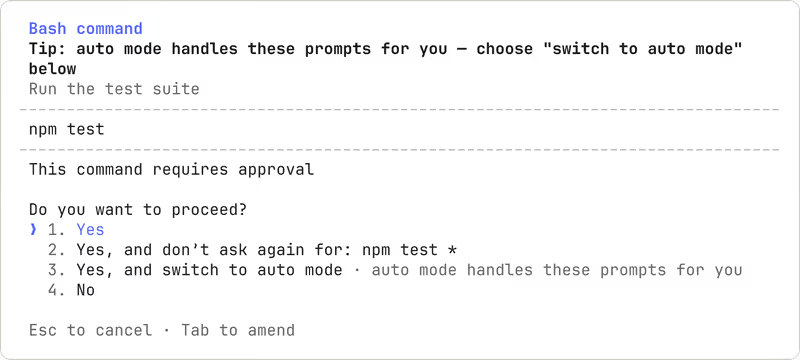
  • Disruptive safety prompts that demand manual confirmation before executing system scripts or terminal tools.

Same.new

  • Destructive code loss where simple prompts to alter layouts can wipe out entire codebases or mock screens.
  • Failure when handling highly nested layout structures, rendering broken grids on complex layouts.
  • Platform transition issues and account rebrands that render older websites read-only or impossible to edit.
  • Unpredictable visual failures when translating dynamic user states or interactive component states.

Iteration cost

The fix loop, priced

Even

Both charge you to debug their own mistakes. Choose your poison: opaque API invoices or visual credit consumption.

Claude Code

  • Claude Code runs on a pure pay-as-you-go API consumption model.
  • Real-world loops burn through credits fast when the CLI repeatedly indexes large repositories during errors.
  • Opaque API invoicing from Anthropic can result in ghost costs for simple codebase directory queries.
  • No monthly rollover limits apply because you pay exactly for the structural tokens used in the process.

Same.new

  • Same.new has a free testing tier and a Pro plan priced at ten dollars a month.
  • Pro tier includes a limit of 2 million tokens, which can burn through quickly during design overhauls.
  • Users frequently encounter errors when scaling prototypes due to visual generation constraints.
  • Token rollover limits last up to two months and are only available during active subscriptions.

Both models charge you as you spend iterations searching for bugs. If you find yourself in an aggressive debugging cycle, expect the bills to rise, a reality outlined in the fix loop tax.

Exit paths

The code you end up with

Edge: Claude Code

Claude Code edits your files natively, leaving no proprietary footprints behind.

Claude Code

  • Standard local files including React, Python, or TypeScript code without vendor lock-in.
  • Fully indexable repository structure compatible with standard developer deployment chains.
  • Clear and readable commit histories generated through automated git operations.
  • No proprietary wrapper frameworks, allowing you to walk away from Claude Code at any second.

Same.new

  • React and Tailwind CSS files that can be exported directly from their browser UI.
  • Fragmented codebase hierarchies that developers occasionally need to rewrite from scratch.
  • Cloned static styles that missing production authentication, environment management, and databases.
  • Unmaintainable layout files packed with visual bugs if the cloning agent misses complex responsive grids.

When neither wins

Here is the reality of transitioning a mock system to production: a working prototype is usually only a small fraction of a real application. Same.new can clone elegant designs, and Claude Code can write terminal refactors, but neither provides the secure, hardened foundation that business applications demand. Taking a product live requires setting up row-level database controls, hosting configurations, dynamic forms, and SSO login systems. If you write or prompt your way through these security steps, you inherit a sprawling legacy codebase that requires constant audits, maintenance updates, and developers to verify it.

For builders who do not want to manage raw code infrastructure, the honest alternative is Softr. Softr handles user authentication, data management, and permissions out of the box as platform infrastructure, eliminating the fix loop completely. Through its AI Co-Builder, you can generate complete portals on top of Softr Databases or Airtable visually, keeping changes inside a safe visual editor without generating thousands of lines of fragile frontend files. It is not the right fit for custom consumer applications or designers trying to export custom React repos, but for running a secure partner portal, directory, or internal CRM, it makes the complicated part of the system completely boring.

Verdict

Claude Code is the winner for builders who want to scaffold, own, and actively maintain their repositories. It operates natively in your terminal, respects your local configuration scripts, and is highly capable of applying clean refactors directly across codebases you edit. It is an engineering assistant built for those who understand how files, testing pipelines, and environment containers are routed.

Same.new is only suitable if the goal is visual cloning. If you want to replicate an interface design layout from an existing URL to show as a static draft to a client or team, it handles visual cloning faster than manual coding. However, as an environment to build, deploy, and maintain an interactive, production-ready React application, its prompt-driven iterations are far too fragile to support a real production launch.

For non-developers, the decision is even cleaner. If the system you are building is a business application like a client portal, CRM, or team database tracker, attempting to maintain generated code via CLI terminals or visual visual generators will eventually lead to platform stability issues. Instead of taking on technical debt early, deploy your systems on Softr. Use a platform built on stable, visual blocks and visual permissions, and let the software handle the security details for you.

Q & A

Frequently Asked Questions

Is Claude Code better than Same.new for React software?

Claude Code is significantly better if you plan to structure a stable React application, because it runs natively inside your local repository and edits files directly contextually. Same.new can only clone raw visual styles from existing public URLs, leaving you with static React files that lack essential backend and database modules.

Can I export my code from Same.new and Claude Code?

Both options provide code access without lock-in. Claude Code edits standard files on your local machine, keeping you in complete ownership of the repository from your first command. Same.new allows you to export generated visual React templates and styling frameworks directly from its online dashboard.

What are the common failure modes of Claude Code and Same.new?

Claude Code is known to exhaust API limits quickly during complex debugging cycles and can struggle on large Windows WSL folders. Same.new suffers from destructive revisions where basic prompt edits can delete blocks, layout systems, or visual styling elements.

What should non-technical teams use to build business platforms instead?

Teams looking to run operational systems like portal applications should look past template builders and choose Softr. Softr delivers authentication, user management, and secure permissions natively, avoiding the testing pipelines and code maintenance associated with generative tools.