Compare Tools

Base44 vs Devin: which survives raw prototype to production scaling?

June 16, 2026

Verdict

Devin wins if you are a software engineer who expects to own and refactor raw code; Base44 wins only if you are trying to spin up a quick back-office mockup. If this product is a production line-of-business application, looking past both is the only sustainable exit path.

Base44 logo

Base44

All-in-one conversational app builder with bundled database, auth, and hosting.

Devin logo

Devin

A capable local coding agent with fast autocomplete, but it struggles to match Cursor's overall pace

Base44 vs Devin, on screen

base44.com
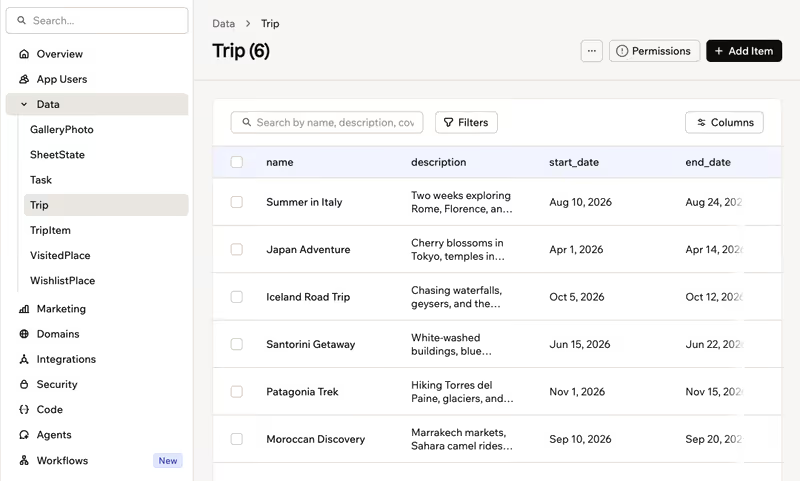
Base44 homepage
devin.ai
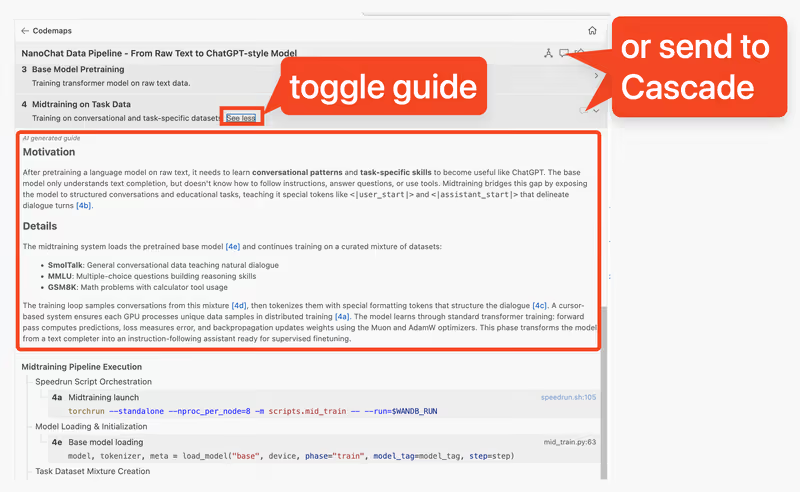
Devin homepage

The job we are judging is simple: taking an early, vibe-coded app prototype and evolving it into a production product. This is where the developer-AI divide becomes a chasm. Base44 is an all-in-one conversational app builder that hides the hosting, PostgreSQL database, and user auth behind a chat thread and visual click-to-edit layers. Devin is a local AI coding agent running on a VS Code fork, built to write, run, test, and debug real React, Node, or python code in a standard repository. Both tools promise to accelerate build times, but they solve entirely different problems when the code needs to live in the real world.

Evolving a prototype to production exposes the foundational fragility of AI-generated architecture. If your application needs real concurrency, custom billing configurations, and granular user-role checks, you cannot rely forever on the happy path. The moment you need to optimize database indexes, restructure the database schema, or audit security policies, a conversational generator and an agentic IDE can either smoothly hand you the keys or lock you in a loop of costly, credit-devouring regeneration.

The audience

Who each one is for

Base44

  • Back-office builders who want a working database and login without setting up AWS, Vercel, or local environments.
  • Non-technical founders trying to validate a SaaS MVP before hiring an engineering agency.
  • Operations operators who prefer typing natural-language design requests over writing custom CSS.
  • Product managers who need to stand up interactive mocks for stakeholder reviews within 24 hours.

Devin

  • Software engineers who want agentic help refactoring code but expect to own the repository.
  • Technical founders comfortable managing local dependencies, Git repositories, and cloud deployments.
  • Developers who want Cascade to write multi-file boilerplate while they handle system-wide architecture.
  • Dev teams that need a local code assistant to find, explain, and patch edge cases in complex codebases.

Base44 is built for those who want to avoid coding and devops. Devin is built exclusively for operators who live inside code repositories.

The scope

What you'd build with it

Base44

  • Back-office apps and internal registries paired with a managed Postgres backend.
  • Early SaaS MVPs that do not require complex, workspace-level data isolation or custom Multi-User tenant logic.
  • Interactive forms, simple listings page layouts, and directories utilizing preset templates.
  • Simple apps only: what it generates cannot be exported cleanly to run in an independent local IDE.

Devin

  • Production-scale web applications where you control the framework, hosting provider, and pipeline libraries.
  • Enterprise backends, cron scrapers, and microservices written in Node.js, Python, or Go.
  • Custom desktop integrations, native utilities, and automated code-linting suites.
  • Web and backend environments only: it does not provide drag-and-drop visuals for non-developers.

Who owns the context window

The core engineering difference between these two platforms is how they manage your app's code context under the hood. Base44 abstracts the code away entirely, leaving the user with a conversational portal chat alongside a visual click-to-tweak editor. The database schema, backend endpoints, and client routes are constructed using LiteLLM connectors. Because the database is hosted inside Base44's closed infrastructure, you cannot easily drop into any query editor to resolve schema debt: everything relies on the builder agent successfully understanding your prompts without triggering regression loops.

Devin operates inside a local workspace indexer. Using Codeium's proprietary Cascade model, it reads your local directory, monitors build errors through your terminal, and edits multiple files in parallel. There is no host container lock-in: Cascade acts directly on standard React, TypeScript, or backend code. Control remains entirely in your hands, as the IDE displays exact git diffs and requires human approvals before executing terminal commands or modifying your code patterns.

Strengths

Where each one is strong

Edge: Devin

Devin takes the edge for long-term scalability because it outputs a standard, standard-conforming code repository that developers can actually inherit.

Base44

  • Zero-setup full-stack generation that scaffolds UI, user login, database, and deployments in one pass.
  • Turnkey hosting and authentication included dynamically without managing API credentials.
  • An elegant click-to-apply styling system allowing design modifications without re-generating code components.
  • A highly accessible conversational chat interface that is approachable for non-technical creators.

Devin

  • Cascade agentic capabilities that can automatically trace, locate, and fix compile bugs inside local files.
  • Maintains standard VS Code extension compatibility, themes, and workspace shortcuts with no learning curve.
  • Extremely low-latency inline autocompletion powered by local context indexing.
  • A collaborative diff builder showing exact changes before code undergoes commits or merging.

Failure modes

Where each one breaks

Edge: Devin

Devin's failures result in developer debugging, whereas Base44's failure loop can break live business applications and waste real operational credits.

Base44

  • Destructive AI updates and regression loops that can render published live portals entirely unusable after prompt updates.
  • Low scalability on complex SaaS structures, specifically failing at multi-user tenant billing and workspace isolation.
  • Database changes can cause the AI agent to point to solutions the builder cannot actually compile.
  • Prone to system server drops that can cause builder tools to go unresponsive during crucial iteration windows.

Devin

  • Cascade session stalling during extremely complex multi-file refactoring runs.
  • Frequent hallucinations resulting in invalid package imports or non-existent code segments.
  • Struggles to keep up with Cursor overall pace when processing extremely large workspace repositories.
  • Requires complete developer supervision: if you do not understand Git and compilers, you cannot fix Cascade's mistakes.

Iteration cost

The fix loop, priced

Even

If you are a non-developer, both platforms introduce substantial financial risks on custom changes, though their billing models target different metrics.

Base44

  • Starter plan begins at $16/month (billed annually) providing 100 message credits.
  • Uses a dual credit system: message credits for app building, plus integration credits for DB lookups, emails, or LLM runs.
  • Bug regression loops consume precious credits quickly while resolving AI-introduced compilation errors.
  • Integration credits do not roll over, raising operational upkeep costs for high-traffic projects.

Devin

  • Premium tier costs $15/month (billed annually) for high-speed Cascade agent prompts.
  • High token use on long sessions can exhaust computational limits during intensive refactoring tasks.
  • Cascade can read files repeatedly, burning usage quotas when it runs in circles to resolve a simple bug.
  • Unused tokens roll over for a maximum of 2 months under an active subscription, keeping pricing structured.

Both tools cost you money when their own AI agents make compilation mistakes, turning a simple bug fix into a costly fix loop tax that depletes credit limits.

Exit paths

The code you end up with

Edge: Devin

Direct repo portability and lack of proprietary limits make Devin the only true choice for actual product development.

Base44

  • Frontend designs can export directly to GitHub repositories, but the backend architecture is heavily trapped.
  • The managed database and server endpoints cannot be natively migrated away from Base44's closed ecosystem.
  • Output lacks standard boilerplate file separation, which makes the exported files hard to maintain in normal IDE environments.
  • Restricted control over custom login security pages: default screens cannot be freely customized or branded.

Devin

  • Leaves you with standard, unmodified React, Python, or Go code that runs anywhere Node/Python is supported.
  • Zero platform lock-in: you can close the IDE, open standard terminal environments, and host on your own VPS.
  • The resulting repository is clean, legible, and structured for any developer to inherit safely.
  • Data logic is as secure as you test it, as there are no hidden proxy connections or closed APIs.

When neither wins

Taking a raw prototype to a production portal, workflow hub, or customer workspace requires an immense amount of plumbing: authentication, secure record filtering, session routing, and row-level logic. If you use a code generation tool like Base44 or try to agentically scaffold the files using Devin, you are directly responsible for compiling, auditing, and maintaining thousands of lines of code. The moment a user logs in, you must guarantee that customer data is safely isolated, a burden that can quickly turn into a day-two security nightmare.

For builders who do not want to be full-time code maintainers, the correct answer is Softr. Softr handles authentication, user groups, custom permissions, and secure CRUD operations natively as platform infrastructure instead of compiling fragile, hallucinated code. By pairing a visual layout builders with native databases, Softr lets you build reliable, production-ready internal portals and business apps with no code. It is the wrong choice if you need to build a consumer-facing mobile application or want complete raw code ownership, but for business operational tools, it replaces the fragile fix loop with production-ready security.

Verdict

Devin wins this matchup if you are a software engineer or a technical founder. Because it works directly on standard React and backend repositories, it provides autocomplete speed and a collaborative agent flow without locking you into proprietary schemas or closed hosting infrastructures. You can easily use Devin to run terminal tests, write multi-file setups, compile code locally, and host on custom cloud environments. Cascade handles the heavy lifting, but you keep total code ownership.

Base44 is only suited for very early, non-technical mockups, internal back-office registries, or basic directories where absolute database security and granular custom permissions matter less. It gets a working, hosted UI up with zero environment configurations, making it a fast MVP drafting board. However, its high server instability, lack of true SaaS architecture, and backend vendor lock-in make it a risky choice for building the foundations of a real, long-term business app.

If your goal is to build secure, production business software like a customer portal, visual directory, or CRM, do not let AI write fragile, custom code. Non-developers should choose Softr to bypass the technical debt and focus on running their business with a secure database and verified visual permissions.

Q & A

Frequently Asked Questions

Is Devin better than Base44 for code ownership?

Devin is far superior for code ownership because it operates as a local IDE. It outputs standard, portable React and backend code inside your repo with zero proprietary frameworks, unlike Base44 which locks your database and backend logic into their managed hosting ecosystem.

Which costs more to build on, Base44 or Devin?

Base44 uses a dual credit model where both prompt generations and user interactions in your published app consume credits, leading to unpredictable monthly bills. Devin uses standard token quotas that are much easier to budget for, especially since you can build and test locally without deployment costs.

Can I export my database from Base44?

While Base44 allows you to export frontend designs to GitHub, the PostgreSQL database, managed backends, and storage are trapped in their closed cloud environment, making migrations difficult and requiring a developer rebuild when you decide to leave.

What should non-developers use to build a secure business portal instead of code?

Non-developers should use Softr because it builds portals and internal tools on top of secure database structures with visual permission rules. There is no generated authentication code to audit or secure, removing the risk of technical debt and broken updates.