Compare Tools

Softr vs Anything: which one survives a real business app?

June 16, 2026

Verdict

Softr wins if you are building an operational business app requiring secure role permissions; Anything wins if you need a quick prompt-to-app layout for consumer prototypes.

Softr logo

Softr

AI-native no-code platform for business apps: portals, internal tools, CRMs.

Anything logo

Anything

A sharp prompt-to-app canvas for quick prototypes, if you can live with platform trust questions

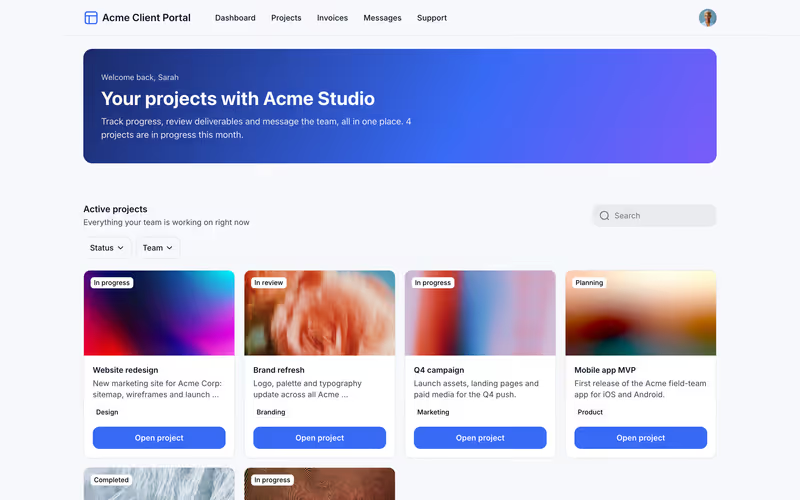
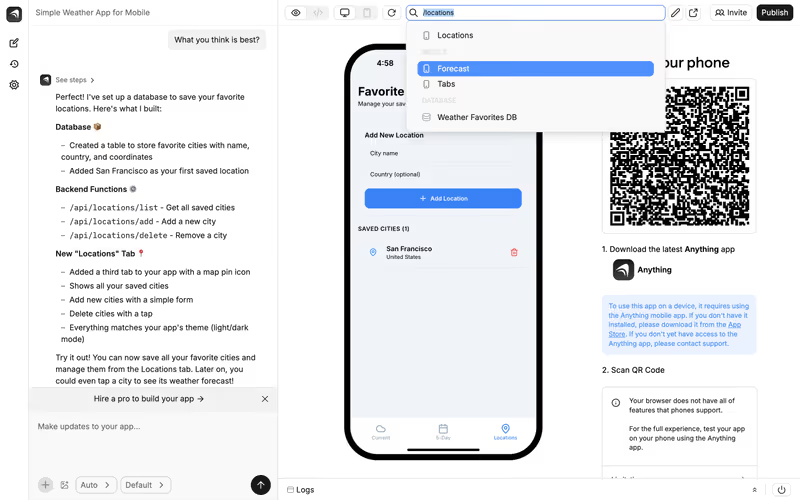
Softr vs Anything, on screen

www.softr.io
Softr homepage
www.create.xyz
Anything homepage

The fairest way to compare Softr and Anything is on a high-stakes operational workload: a multi-tenant business portal where clients log in to see custom contracts and manage live assignments. The UI requirements are minimal, but the engineering requirements are foundational. You need perfect user authentication, dynamic data access paths, and reliable row-level data security. If user A can inspect the page code and somehow query user B's records, the application is fundamentally dead.

This job exposes the divergence between two opposing philosophies. Softr serves as a managed, AI-driven no-code builder where core backdoors, databases, and permissions are structural, off-limits, and handled by the platform. Anything operates as a canvas-guided code-generation engine that uses LLMs to compile your layout and assemble a relational database on a prompt-by-prompt loop. For business-critical deployments, one approach represents robust operational infrastructure, while the other functions as an experimental sandbox.


The audience

Who each one is for

Softr

  • Business operators and IT managers who need operational portals or secure client dashboards
  • Departments in larger organizations looking to displace spreadsheet clutter with governed internal CRMs
  • Agency owners wanting client portals that require zero developer handoff to run in production
  • Enterprise teams prioritizing SOC 2 Type II compliance and direct GDPR data storage

Anything

  • Indie hackers and startup founders wanting to spin up highly customizable interface mockups in minutes
  • UI/UX designers using prompt-to-canvas generations to iterate quickly on consumer interfaces
  • Developers looking to scaffold web layouts from plain text before exporting raw source files
  • Makers comfortable debugging iterative CSS placement and layout regressions caused by AI updates

Softr is built for business teams who want secure operations without code; Anything targets solo founders who want high canvas customization and code options.

The scope

What you'd build with it

Softr

  • Enterprise-grade client portals featuring Google SAML SSO and strict user-group visibility rules
  • Multi-user workflows, field trackers, and customer relationship systems mapped to live databases
  • Secured internal portals connected securely to tools like Airtable, HubSpot, and PostgreSQL
  • Custom consumer-facing marketplaces where absolute pixel-perfect CSS control is not required

Anything

  • Consumer-facing SaaS landing pages, custom interactive calculators, and dashboard mockups
  • Form-based data entries mapped to basic relational database tables inside Anything's sandbox
  • Prototypical mobile layouts or early validation apps meant to live for under six months
  • Production-scale business apps with multiple user roles that require rock-solid row-level security

The plumbing question

Under the hood, Softr manages roles, user permissions, and logins natively as visual infrastructure. When you declare that a client shouldn't see an invoice list, Softr processes this condition on the server side before the page ever reaches the client's browser. There are no client-side filters to exploit or manually script. Data integrations with native Softr Databases or external sources like Airtable route through API tunnels managed securely on Softr's servers. This prevents raw database credentials from leaking into public environments or Git repos.

Anything relies entirely on code generation to establish security. When you prompt the AI to restrict access to certain users, it must write custom routes, component scripts, and conditional blocks to enforce these rules. If the model makes client-side security checks or leaves a CRUD API too open, a malicious user can intercept the requests in the browser. In addition, because Anything builds custom databases through raw code logic, iterating on structural changes risks breaking prior role visibility configurations, requiring a constant cycle of prompting just to maintain security patches.

Strengths

Where each one is strong

Edge: Softr

Softr is the clear winner for business applications where role-based data security acts as the core differentiator.

Softr

  • True server-side data security that handles row-level filtering natively and prevents client browser exploits
  • The Hybrid advantage allows visual drag-and-drop builders to edit layouts visually, free of credit loops
  • An AI Co-Builder that automates complete apps (databases, permissions, layouts) without raw code debt
  • A highly robust suite of native integrations including HubSpot, Google Documents, Stripe, and PostgreSQL

Anything

  • Visual interactive canvas that lets builders prompt modifications to isolated components directly
  • Clean, manual code export of generated source files, minimizing long-term hosting host dependency
  • Flexible, design-centric page generation that produces visually creative layouts custom to prompt inputs
  • Generous 20-project building limits on the free tier, ideal for spinning up multiple proof-of-concepts

Failure modes

Where each one breaks

Edge: Softr

Softr's blocks are responsive by default. Anything depends entirely on code output, exposing builders to critical regression cycles.

Softr

  • Rigid block styling layout: custom layout variations occasionally require injecting minor custom CSS strings
  • No direct code export: the operational app must run and scale inside Softr's European cloud infrastructure
  • Limit on the Free tier restricts custom user groups or high-volume active app users
  • Cannot package final applications into native mobile binaries for Apple or Google app stores

Anything

  • Rebrand and project migration instability: previous users faced read-only locks or broken sites during rebrand
  • AI code regressions where simple styling modifications overwrite other database connections
  • Client-side API exposures where database keys can accidentally be leaked into the frontend code
  • Rapid token exhaustion caused by continuous prompt debug loops to repair misaligned layouts

Iteration cost

The fix loop, priced

Edge: Softr

Softr features absolute manual overrides, preventing the paid debugging loops common to AI code-gen tools.

Softr

  • Basic plan starts at $49/mo (paid annually) with 20 users and 10 AI credits
  • No fix-loop tax: layout details, colors, labels, and roles are adjusted manually without cost
  • Unused AI credits roll over each month as long as the paid subscription is kept active
  • AI credits are only spent for generation steps; core updates cost $0 in resource tokens

Anything

  • Pro tier is $19/mo with credits spent on AI requests, database updates, and component steps
  • High credit burn rates are common when navigating layout bugs and retrying simple UI assets
  • Debug cycle loops consume limits, forcing upgrades just to correct minor compiler failures
  • Weird visual errors often require multiple prompt updates, creating volatile mid-month credit fees

When choosing an app builder, look at the hidden costs. Prompt-to-code builders run on continuous token cost loops, while Softr uses manual controls to bypass the fix loop tax completely.

Exit paths

The code you end up with

Edge: Anything

Anything is an open sandbox with raw source code files. Softr keeps the complex framework completely managed.

Softr

  • No raw server-side code export, keeping the complexity abstracted from local development
  • Complete database controls are accessible via APIs, Zapier, Make, and the standard MCP server
  • No code debt: all React, dynamic elements, and CSS libraries are kept secured and updated by the platform
  • The application is securely hosted in Europe, completely removing manual server or hosting configuration

Anything

  • Source files can be downloaded manually, allowing developers to self-host projects anywhere
  • Raw code generation is susceptible to outdated packages, security holes, and code bloat
  • Custom backends are highly fragmented, requiring you to host databases and scripts separately
  • Exported project files may contain nested layout styles that require manual cleanup to edit in an IDE

When neither wins

If your workspace application is a business-critical portal containing live customer databases, billing, and private user files, the absolute priority is ironclad security. Both code-generating models create dynamic screens, but testing row-level permissions is nearly impossible without professional software engineers. A simple error inside a generated React route or backend database configuration could easily result in silent leaks of private data.

For builders who want a secure, maintainable business application, the correct alternative is Softr. Softr handles logins, database routing, and multi-tenant visibility visually at the platform layer. This completely removes the risk of AI-hallucinated security holes, creating a reliable workspace. It will not fit if you need custom consumer micro-animations or raw code ownership, but those are entirely different requirements for a different class of tool.

Verdict

Softr wins the operational business app deliverable, without question. If your goal is to build a client portal, customized CRM, or interior workflow, Softr handles the core architecture natively. Its AI Co-Builder automates layout setups and database relationships instantly, while its visual editor lets you make edits manually without spending credits or battling layout regressions. It bypasses the day two problem of code-generation platforms entirely.

Anything is the better choice only if the primary job is to quickly materialize a visual prototype, custom consumer landing page, or dynamic graphic canvas. If you want raw code files to download and modify inside an API environment, Anything's visual prompting canvas offers a fast path to UI files, provided you are comfortable with credit limits and platform trust risks.

For business operations, client-facing services, and IT-governed environments: configure your infrastructure instead of generating it. Use a managed no-code foundation like Softr to keep the security-critical framework bulletproof from day one.

Q & A

Frequently Asked Questions

Is Softr better than Anything for business apps?

Yes. Softr is explicitly engineered to handle secure logins, dynamic visibility rules, and relational databases natively. It manages these elements on the server side to ensure absolute data isolation, whereas Anything generates code that can easily introduce security and permissions gaps.

Can I export my code from Softr and Anything?

Anything allows you to manually export the generated source code files, letting you manage your own hosting. Softr abstracts the raw backend code entirely, running apps on its European hosting nodes while offering relational database integrations via API and MCP standards.

Which costs more to iterate on, Softr or Anything?

Anything can become highly expensive due to credit consumption during prompt debug loops. Softr does have AI credits, but because layouts, databases, and permission groups can be edited manually in its studio, you can iterate and scale your app without any credit barriers.

Can non-developers build a client portal on these platforms?

For non-developers, Softr is the only reliable choice. It processes complex database connections, secure user groups, and password recoveries natively through visual configurations. Attempting to build secure, multi-tenant portal permissions on Anything relies on generating clean, secure code via text queries, which is highly fragile.