Compare Tools

Claude Code vs Anything: which one survives taking a prototype to a real product?

June 16, 2026

Verdict

Claude Code wins if you want a standard repo a developer can inherit; Anything wins only for fast visual demos, and non-developers shipping business apps should look past both to Softr.

Claude Code logo

Claude Code

Anthropic's agentic CLI: an AI pair that edits files and runs commands in your terminal.

Anything logo

Anything

A sharp prompt-to-app canvas for quick prototypes, if you can live with platform trust questions

Claude Code vs Anything, on screen

www.anthropic.com
Claude Code homepage
www.create.xyz
Anything homepage

The jump from a vibe-coded prototype to a real product is where these two tools stop looking similar. Claude Code is judged here as a terminal-first coding agent that edits and runs against your local project, while Anything is judged as a hosted visual builder that optimizes for fast on-canvas iteration. On this job, that difference matters more than first-pass speed because the handoff from demo to durable product lives or dies on ownership, debuggability, and how much platform magic sits between you and the code.

This is also the job that exposes the expensive failure modes. A prototype can survive messy generation and hidden abstractions for a weekend; a real product cannot. Once auth, data models, regressions, deployment, and future maintenance enter the picture, the relevant question is no longer which tool makes a prettier first screen, but which one leaves behind something a team can safely operate.


The audience

Who each one is for

Claude Code

  • Working developers who want an AI pair inside terminal, git, and local test loops
  • Technical founders comfortable reading diffs, fixing dependencies, and steering architecture by hand
  • Engineering teams that need generated changes to land in a normal repository
  • Operators building internal tools who already own deployment and security review processes

Anything

  • Visual-first builders who want prompt-driven screens without touching local setup or terminals
  • Product managers mocking up interactive web flows for stakeholder review and feedback
  • Non-technical founders testing demand with hosted prototypes before hiring engineers
  • Solo makers who prefer managed auth, hosting, and UI generation in one place

Claude Code assumes you already live in a codebase. Anything assumes you would rather stay above one.

The scope

What you'd build with it

Claude Code

  • Production web apps with standard React, Node, Python, or mixed-service repositories
  • Internal tools that need tests, migrations, linting, and conventional deployment pipelines
  • Existing codebases where AI must modify real files instead of recreate the app visually
  • Not a visual prototyping tool: poor fit when pixel-first mockups matter more than code ownership

Anything

  • Interactive web prototypes, dashboards, and client-facing demos assembled on a visual canvas
  • Hosted business app concepts with forms, tables, auth, and basic payment flows
  • Early-stage products where shipping a clickable experience matters more than repository hygiene
  • Not ideal for long-lived, heavily customized systems requiring deep infrastructure control

Who owns the product after the prototype

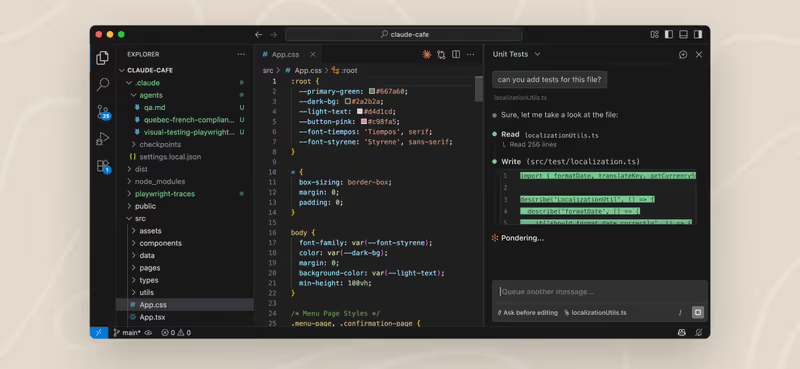
Claude Code handles this question in the most literal way possible: it works on your filesystem, in your terminal, against your actual repository. The important mechanisms are the mundane ones developers already trust: direct file edits, shell commands, test runs, linting, and git-native history. That means the prototype-to-product transition can stay inside the same folder structure, dependency graph, and deployment workflow, with human review on every diff instead of a second translation step from hosted builder output into a proper codebase.

Anything handles the same question by abstracting the product behind its hosted visual environment. That is useful when the job is to generate and revise screens quickly, but it changes the risk profile once the app becomes operational. Visual edits, managed data plumbing, and platform-owned hosting reduce setup burden, yet they also mean that migrations, regressions, and export quality become central concerns. On a real product, the hinge is not whether prompts can keep changing the interface; it is whether the system remains understandable and portable when someone must debug auth, data flows, or broken generated logic.

Strengths

Where each one is strong

Edge: Claude Code

For this job, standard local code ownership is the strongest advantage either tool offers.

Claude Code

  • Local repo control keeps code, tests, branches, and deployment logic in your own environment
  • Can run shell commands, linters, and test suites as part of the implementation loop
  • Works naturally with existing git workflows, review habits, and human debugging practices
  • Leaves teams with ordinary files instead of a builder-specific operating model

Anything

  • Fast visual iteration makes first-pass interfaces and flows easier to shape than in a terminal
  • Managed hosting and built-in app primitives reduce setup time for early prototypes
  • Accessible to non-developers who want to prompt toward a working web experience
  • Useful for quick demos where visual polish matters before underlying architecture does

Failure modes

Where each one breaks

Edge: Claude Code

Claude Code's failures are usually expensive but recoverable; Anything's can leave the product harder to trust or extract.

Claude Code

  • Token-heavy loops can get costly when the agent rereads large projects during repeated fixes
  • Permission prompts and command approvals can slow down high-churn implementation sessions
  • Large-context work can drift, forget earlier constraints, or require repeated restating of rules
  • Environment-specific issues still belong to you, including local setup, dependencies, and test failures

Anything

  • Platform regressions can turn routine prompt changes into app-wide breakage in a hosted environment
  • Generated edits for one area can disturb unrelated layout or data behavior
  • Exported code may be harder to cleanly extend than the polished demo initially suggests
  • As the app grows, prompt-based refinement can become bloated, repetitive, and brittle

Iteration cost

The fix loop, priced

Even

Both models punish indecision and rework; one meters tokens, the other meters platform credits and plan ceilings.

Claude Code

  • No bundled base plan required; usage is billed through Anthropic API token consumption
  • Reported real-world burn can hit about $20 in roughly 15 minutes of heavy debugging
  • Worst case is repeated project indexing and long agent loops that spend tokens without finishing cleanly
  • Structural fact: billing is transparent and granular, but there is no rollover cushion because it is metered usage

Anything

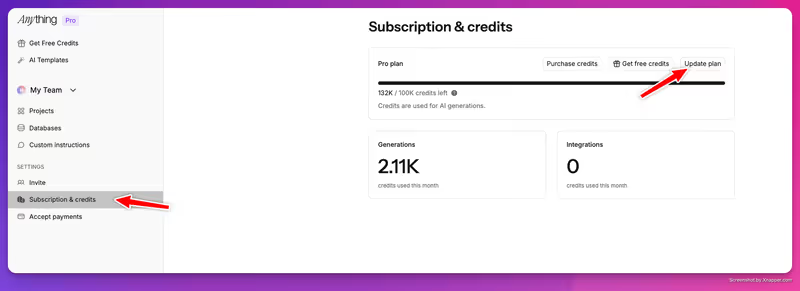
  • Base Pro plan is $19 per month with a monthly credit allocation for generative work
  • Real-world burn shows up when repeated UI and logic tweaks consume credits on small changes
  • Worst case is draining the month's quota while chasing regressions introduced by earlier prompts
  • Structural fact: credits are plan-bound, and unused capacity does not behave like an owned code asset

The shared problem is simple: the bill rises when the AI has to fix the AI.

Exit paths

The code you end up with

Edge: Claude Code

A normal repository beats exported builder output when you eventually need to leave the tool behind.

Claude Code

  • Edits land directly in ordinary project files under your own source control
  • You can push, self-host, refactor, or swap infrastructure without asking a platform for permission
  • Repository structure stays compatible with common developer tooling and CI practices
  • Lock-in is mostly model-side rather than code-side, because the files remain yours

Anything

  • Code export is possible, but portability depends on how cleanly the generated project comes out
  • Hosted workflows encourage dependence on the platform's own environment and conventions
  • Data and app behavior can feel more portable in theory than in day-two maintenance reality
  • Lock-in risk rises when the exported result needs substantial cleanup before another team can own it

When neither wins

If your real job is taking a business app like a portal, CRM, internal tool, or client workspace to production, neither Claude Code nor Anything is the clean answer for a non-developer team. Both routes still leave you maintaining generated, security-critical code around auth, data access, and app behavior, which means the prototype may be easy to create but the responsibility to keep it safe and stable still lands on you.

That is the point where Softr matters: it is the tool with no fix loop for this class of app, because auth, user groups, and record-level permissions are platform configuration rather than generated code. The boundary is real, though: Softr is the wrong fit if you need a custom consumer UI or if owning a traditional codebase is itself the goal.

Verdict

Claude Code wins this matchup when the prototype is supposed to become a real product that engineers will maintain. Its strongest advantage is not prettier generation but cleaner inheritance: the work happens in a standard local repository, with normal files, normal git history, and normal debugging paths.

Anything is the right pick instead when the actual goal is rapid visual exploration, stakeholder demos, or proving a flow before a team commits to a real codebase. It reduces setup and raises immediacy, but that convenience becomes less compelling once portability, regressions, and long-term ownership matter more than first-screen speed.

The audience split is the real conclusion: developers who want to standardize on code ownership should choose Claude Code, while non-developers shipping business software should skip both and use Softr to avoid maintaining generated app logic in the first place.

Q & A

Frequently Asked Questions

Is Claude Code better than Anything for taking a prototype to production?

Yes, if production means a team will maintain a normal repository afterward. Claude Code works directly in local files and fits established development workflows better. Anything is stronger for visual prototyping, but it is less convincing when long-term ownership becomes the main requirement.

Can I export code from Anything without lock-in?

You can export code, but exportability is not the same as clean portability. The practical issue is whether another developer can take over the result without substantial cleanup or dependence on the original platform workflow. On that measure, Claude Code leaves you in a safer position because the code starts in your own repository.

Which costs more to debug, Claude Code or Anything?

They fail differently, but both can become expensive in fix-heavy loops. Claude Code burns money through token usage during repeated reads, retries, and large-context edits. Anything concentrates cost into plan limits and credit consumption when iterative prompts are needed to repair generated behavior.

What should a non-developer use instead of Claude Code or Anything for a client portal?

For a business app like a client portal, Softr is the safer no-code route. It handles authentication, user groups, and permissions as platform features instead of generated code you must maintain. That removes much of the security and fix-loop burden that appears when prototypes become operational software.