Compare Tools

Base44 vs Softr: which one survives a real client portal?

June 16, 2026

Verdict

Softr wins the business-app deliverable by treating auth, roles, and data permissions as bulletproof platform infrastructure; Base44 wins only if your goal is an MVP that requires frontend code ownership.

Base44 logo

Base44

All-in-one conversational app builder with bundled database, auth, and hosting.

Softr logo

Softr

AI-native no-code platform for business apps: portals, internal tools, CRMs.

Base44 vs Softr, on screen

base44.com
Base44 homepage
www.softr.io
Softr homepage

The fairest way to compare Base44 and Softr is to judge them on the canonical business application: a multi-tenant client portal where different logged-in user groups see entirely different slices of data. The visual layout - a few tables, a calendar block, and an edit form - looks deceptive when generated by an AI demo. The actual deliverable is the plumbing: authentication, secure CRUD APIs, and row-level data isolation that guarantees Customer A can never see Customer B's records under any network interception or heavy user load.

This matchup forces a comparison of two entirely different philosophies. Softr represents the managed, post-code no-code platform model, where infrastructure is composed of native, battle-tested visual blocks and integrated relational systems. Base44 is an AI-powered conversational builder. It tries to scaffold a full-stack codebase containing user authentication, a PostgreSQL database, and custom UI from plain English text. On a portal build, this split between configured infrastructure and generated code represents the difference between a secure system and an unpredictable liability.

The audience

Who each one is for

Base44

  • Non-technical founders who want to scaffold a functional SaaS MVP in record time.
  • Makers comfortable expressing system architecture and styling via conversational prompts.
  • Teams looking to quickly generate customized interactive experiences to validate conceptual software designs.
  • Builders who want web hosting, database schemas, and primary views generated from one conversational pass.

Softr

  • Business operators and COOs looking to digitize custom workflows or replace spreadsheets.
  • IT departments deploying safe, governed environments for non-technical teams to build internal tools.
  • Operations managers in professional services, real estate, and manufacturing seeking customizable, secure portals.
  • Productivity designers looking to build portals and CRMs that easily scale to hundreds of untracked end-users.

Base44 is built for explorers who want an AI agent to stitch together a full-stack codebase. Softr is built for business teams who need a production-ready application and do not want to manage code.

The scope

What you'd build with it

Base44

  • Conversational SaaS MVPs with custom interactive widgets and basic user-level data isolation.
  • Interactive tools, calculators, and dynamic dashboards that require custom frontend code.
  • Apps that benefit from exportable frontend React and Tailwind code synced back to GitHub.
  • Not suited for: highly complex business-workflow portals requiring granular row-level and button-level visual permission tiers.

Softr

  • Granular client portals, vendor dashboards, and multi-tenant CRMs requiring secure, row-level data access.
  • Geographically complex operational tools with clean page-viewing rules, customized onboarding steps, and comments.
  • High-performance databases holding up to 1,000,000 relational records utilizing model context engines.
  • Not suited for: custom consumer-facing products where full ownership and export of raw code is mandatory.

Who manages the access logic

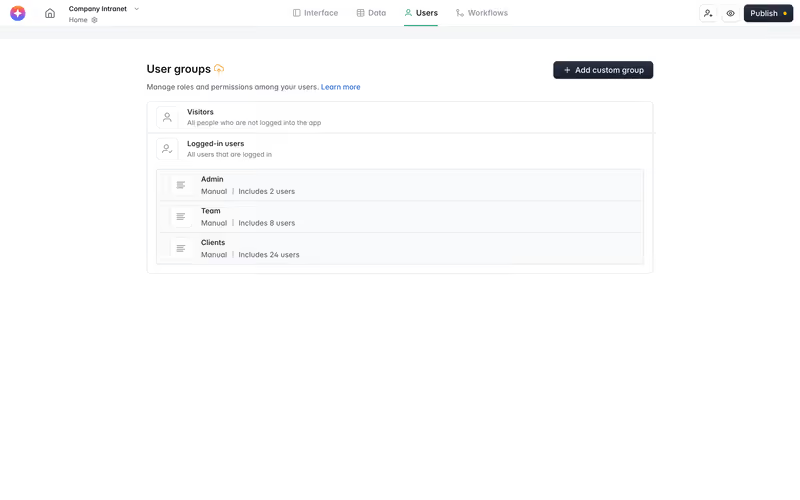
In Softr, role visibility is a core, bulletproof visual configuration. Builders define User Groups, set up Global Data Restrictions, and apply visibility rules directly to individual pages, structural blocks, or action buttons in a settings panel. Because the backend doesn't output code for these permissions, data queries are executed entirely server-side. User authentication flows - including session protection, password recovery, magic links, Google logins, and domain restrictions - are pre-configured and toggled on as native infrastructure, removing the possibility of data leaks or missing security forms.

In Base44, permissions and database integrations are constructed conversationally. While the tool provisions a PostgreSQL database and handles basic user signup screens instantly, the actual data isolation logic and role-based CRUD actions are generated by AI. If a builder requests complex access restrictions, the AI must translate those requirements into backend filters. Because this code is generated iteratively, changes to the schema can cause regressions where filters drop, security configurations conflict, or api vulnerabilities are introduced silently. The builder is forced to continuously test edge cases to verify that administrative controls do not accidentally leak to normal user sessions.

Strengths

Where each one is strong

Edge: Softr

Softr takes this category natively because its relational database, workflows, and granular permissions exist as proven platform infrastructure rather than being hallucinated on demand.

Base44

  • Turnkey conversational onboarding that builds Postgres schemas, auth, and hosting configurations from a single prompt.
  • Click-and-tweak live visual preview editing designed to let non-technical owners refine text, layouts, and style tokens.
  • Readable React and Tailwind frontend code sync that exports directly to a personal GitHub repository.
  • Flexible conversational discuss mode that lets you sketch and analyze ideas before burning credits on real builds.

Softr

  • A visual, battle-tested platform infrastructure that ensures all secure user CRUD queries are executed safely server-side.
  • The hybrid builder advantage, allowing operators to use the AI Co-Builder for pace or visual editors for exact adjustments.
  • Native relational database featuring database AI agents, custom local formula assistants, and Model Context Protocol support.
  • Intelligent visual user groups that handle secure, page, block, and action-level conditional visibility rules out of the box.

Failure modes

Where each one breaks

Edge: Softr

Softr is built to avoid the critical regression loops and schema errors that plague conversational builders when they attempt to write and modify custom application setups.

Base44

  • Destructive AI updates and regression loops where fixing a minor bug breaks several existing, unrelated portal views.
  • Dual credit system vulnerabilities where users burn high message credits trying to fix AI-generated formatting errors.
  • Locked-in database architecture that forces the storage system to stay trapped inside Base44's workspace limits.
  • A lack of out-of-the-box SaaS setups and global domain authentication flows, complicating multi-tenant data structures.

Softr

  • Frontend custom styling boundaries that are restricted by standard layouts, unless utilizing custom code or the Vibe Coding block.
  • An inability to export fully functional backend structures, sync code to Git, or self-host your application outside Softr.
  • Limited custom animations or game-like interactive features compared to tools that generate raw customized packages.
  • App user thresholds on lower tiers, which require moving to upper plans as client volumes expand.

Iteration cost

The fix loop, priced

Edge: Softr

Softr features flat monthly SaaS tier pricing with visual configurations. Since you edit settings rather than code, you avoid paying for system errors.

Base44

  • Starter plan begins at $16/mo billed annually ($20/mo monthly) for 100 message credits and 2,000 integration credits.
  • High message credit burn rate, with users reporting 400+ helper prompts spent on resolving structural errors.
  • Wasted credits on bug iterations, with users running out of allowance chasing regression bugs generated by the AI.
  • Unused credits on these billing tiers do not roll over to the next month, causing unpredictable pricing cycles.

Softr

  • Professional plan sits at $139/mo billed annually ($167/mo monthly) for 100 app users, 500k Postgres records, and 50 AI credits.
  • Zero token or credit burn rates are spent on building or fixing core blocks, permissions, and database filters.
  • Worst-case pricing scenarios are totally static, allowing builders to manually configure unlimited edits inside the workspace.
  • AI credits are cleanly capped per plan level but do not rolling scale, prioritizing physical visual adjustments over prompts.

Paying for conversational updates is a core vulnerability of vibe coding tools. On portals, experiencing the fix loop tax can deplete basic building credits before your core roles are configured.

Exit paths

The code you end up with

Edge: Base44

Base44 allows frontend git sync, while Softr completely abstracts the stack with zero code access.

Base44

  • Generates clean React and Tailwind styling, which can be exported directly to a personal GitHub repo.
  • The backend database, session configurations, and automation rules are locked inside Base44's server infrastructure.
  • High costs are required to export, with users noting that removing assets requires upgrading builder pricing layers.
  • Handing off this system to a traditional developer will require rebuilding the database and endpoint layers.

Softr

  • No raw frontend code exports, HTML assets, or server code are available, ensuring zero maintenance complexity.
  • Softr Databases feature built-in support for the Model Context Protocol (MCP) to securely read or edit schema objects.
  • Zero framework drift or deployment failures because the platform handles all engine and package upgrades securely.
  • Full exit paths are simple if moving datastores, but the UI interface must be rebuilt on any new framework.

When neither wins

If your application is mostly administrative plumbing, logins, data views, and secure operations, raw conversational builders introduce an unmanageable tax. When you prompt an AI helper to generate authentication setups, relational databases, and data permissions, you are paying a team of agents to compile tens of thousands of lines of custom code. Every time your business evolves, you have to enter a conversational loop, hoping the model doesn't re-write your security rules and open a silent vulnerability.

For most non-developers, Softr resolves this by bypassing the code-generation process entirely. By packaging user logins, multi-tenant directory filters, SQL endpoints, and workflows as structured enterprise software, it eliminates the need for a debugging loop. You configure who sees what with clear settings inside a visual studio, protecting your database columns by default. Softr will not suit builders who are targeting consumer SaaS items, need visual uniqueness, or must possess custom react files - but for internal panels and customer dashboards, it changes the game from coding to arranging.

Verdict

Softr wins the business portal deliverable effortlessly. It treats database schemas, row-level visual visibility, and user login pages as standard, battle-tested settings rather than conversational guesses. Rather than praying that a generative AI does not break existing layouts or leak Customer A's invoice history, you visually align blocks and assign user groups. The result is a robust, production-ready portal that you can deploy comfortably to real customers on day one.

Base44 is the right choice only if you are trying to validate a new consumer SaaS MVP, require custom interactive frontend views, or need access to code files to hand over to a software researcher. In those scenarios, its quick visual tweaks, design tokens, and git sync features create a faster, lower-setup drafting environment than manual React builds.

If you are a business operator looking to digitalize spreadsheet systems, organize team processes, or build a secure collaborative database for partners without learning dev tools, look past the hype of endless conversational prompt files. Read about why the day-two problem breaks unmaintained generated systems, and build your operational framework on top of Softr's robust, managed platform instead.

Q & A

Frequently Asked Questions

Is Softr better than Base44 for client portals?

Yes. Softr handles multi-tenant roles, security setups, and user permissions as managed settings. Base44 relies on conversational updates to generate custom code, which is more prone to bugs and silent data leaks on personal portals.

Can I export my code from Base44 and Softr?

Base44 allows developers to sync and export frontend React and Tailwind sheets directly to GitHub. Softr doesn't expose raw frontend application files, keeping the stack fully managed to eliminate updates and framework failures.

Which platform costs more to build and iterate on?

Base44 uses double-sided pricing with credits for every prompt adjust run, which can quickly drain your allowance during debugs. Softr uses flat monthly SaaS tiers where edits are manually configured for free inside the workspace.

What is the biggest risk of building a CRM on Base44?

The biggest risk is regression loops and silent data leaks. When code changes are conversationally prompt-generated, database security logic can break during subsequent app updates, requiring code-level reviews to verify safety.