Compare Tools

Base44 vs Anything: which one survives a real business app with user accounts?

June 16, 2026

Verdict

Anything wins if you only need a quick interactive canvas prototype; Base44 wins if you need a fully pre-configured Postgres database and auth on day one. If this is a real business app with real clients, you should look past both.

Base44 logo

Base44

All-in-one conversational app builder with bundled database, auth, and hosting.

Anything logo

Anything

A sharp prompt-to-app canvas for quick prototypes, if you can live with platform trust questions

Base44 vs Anything, on screen

base44.com
Base44 homepage
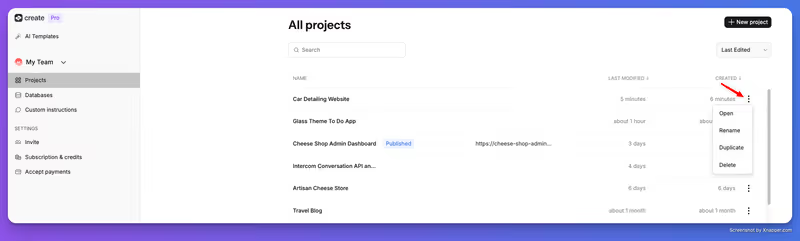
www.create.xyz
Anything homepage

The fairest way to compare Base44 and Anything (formerly Create.xyz) is to judge them on the same job. This comparison evaluates them on a classic business application: a no-code founder's first software app with secure user accounts where clients log in to view their own records. The visible interface - showing lists, tables, and buttons - can be designed in an hour. But the structural logic underneath (database design, robust session variables, dynamic record-level access) is what keeps a business running without leaking customer data.

This specific job of custom databases and secure utility flows is where prompt-to-app tools diverge. While they promise to turn basic English descriptions into live web systems, they struggle with the technical realities of multi-user authentication and database isolation. A layout prototype is easy to build, but a secure operational backend exposes the real limits of generative software.


The audience

Who each one is for

Base44

  • Non-technical founders wanting an all-in-one setup with user authentication and database management pre-configured
  • Operations managers looking to prompt simple CRUD tools without configuring external database hosting themselves
  • Makers seeking to generate front-to-back MVPs from a single conversational workspace
  • Teams whose priority is having database schemas automatically constructed by an AI builder

Anything

  • UI-focused designers who want to edit complex interactive web layouts by clicking specific canvas elements
  • Product managers who need to rapidly spin up and validate functional mockups and forms
  • Founders looking to embed specific external API connections and payments into a visual frame
  • Hobbyists who value building up to 20 diverse experimental projects on a free plan tier

Base44 focuses on founders who want a completely managed database and auth system configured on Day One. Anything targets builders who prioritize a canvas-based design workspace where they can visually prompt individual frontend components.

The scope

What you'd build with it

Base44

  • Internal staff portals with basic record listing, creation, and editing flows
  • SaaS Minimum Viable Products requiring managed user registration and lightweight database storage
  • Simple administrative trackers that manage and show lists of tasks or company projects
  • What it should NOT be used for: large-scale enterprise services with fine-grained security protocols

Anything

  • Highly interactive landing pages with complex visual elements that require fast custom tweaks
  • Basic administrative directories and forms that feed into simple relational tables
  • Early-stage product demos featuring Stripe integrations to test public willingness to pay
  • What it should NOT be used for: long-term, high-consequence production business operations with multi-tenant data

The database and authentication architecture

Base44 handles infrastructure by automatically provisioning a PostgreSQL database and a native user authentication layer behind a unified prompt interface. When you describe your business app concept, Base44 builds the tables, sets up schema relationships, and deploys default registration and login views. This approach reduces initial setup friction because there are no environment variable interfaces to manually map. However, you are dependent on Base44's automated backend logic to secure user data; you must trust that the AI constructed solid row-level validation patterns without introducing silent authentication bypasses.

Anything (formerly Create.xyz) relies on an interactive canvas combined with built-in relational table structures. It generates dynamic pages and maps visual elements directly to its internal database fields, utilizing simple user login screens to establish basic session validation. While this provides a visual environment for editing layouts, managing strict user roles or multi-user workspace isolation is not native. Instead, builders find themselves trying to prompt the rendering engine to write custom data boundaries in code, which frequently leads to logic errors or insecure configurations.

Strengths

Where each one is strong

Edge: Base44

Base44 takes the edge for transactional business apps because it bundles a real managed Postgres DB and built-in user authentication out of the box.

Base44

  • Built-in full-stack scaffolding that handles Postgres databases, user sessions, and hosting instantly with zero pre-build configuration
  • A conversational "Discuss Mode" that lets you design and optimize database structures before burning credits
  • Design tokens that instantly format complex interactive themes from single-word prompt requests
  • Direct frontend source code export to GitHub repositories to free the visual layer from platform lock-in

Anything

  • An interactive design canvas that lets you click on specific blocks and prompt changes strictly to that element
  • A generous free tier that tolerates up to 20 individual project workspaces for trial purposes
  • Fast custom API integrations and Stripe options to quickly monetize basic layouts and landing pages
  • Full source file code exports that let developers easily step in and download the layout

Failure modes

Where each one breaks

Edge: Base44

Base44 handles changes to complex apps with fewer layout regressions, whereas Anything suffered project access issues during its historical rebrand.

Base44

  • Regression loops during edits: community reviews highlight instances where fixing one database bug breaks multiple unrelated frontend pages
  • Severe platform locks which trap your raw database, backend processes, and file storage on Base44's closed servers
  • API speed latency when running automated functions or handling larger datasets through LiteLLM connections
  • Destructive AI updates that can occasionally cause an active, styled page to fail or revert to default layouts

Anything

  • Historical rebrand project instability: user feedback outlines active customer websites breaking or becoming read-only after the Create.xyz transition
  • Rapid token and credit exhaustion when trying to fix tiny layout bugs or misaligned elements through prompts
  • Fragile database rules that fail to provide secure multi-tenant isolation, exposing user records on the client side
  • Friction with specific assets like images and styled custom forms that often require multiple retries to display correctly

Iteration cost

The fix loop, priced

Even

Both tools operate on consumption-based models that charge you for errors and prompt revisions, making iterative development costly.

Base44

  • Starter plan matches custom requirements for $20/month with 100 message credits and 2,000 integration credits
  • Message credits are consumed each time you prompt the AI logic to fix, update, or tweak a page
  • Integration credits are consumed in production whenever your users trigger database queries, APIs, or emails
  • Wasted credits on regression loops can quickly deplete monthly quotas when fixing iterative bugs

Anything

  • Pro plan costs $19/month billed monthly, offering access to advanced layout models and integrations
  • Consumption quotas are consumed anytime the AI engine rewrites a component or runs a database logic update
  • Layout styling errors often force repeated formatting prompts that rapidly drain your visual credit allowance
  • Custom APIs and database logic setups frequently require multiple iterations that inflate billable credits

Because both systems charge you when the AI makes errors, resolving interactive bugs can trigger a costly design cycle. Users regularly burn through their plan balances trying to fix visual issues, which is a major factor of the fix loop tax.

Exit paths

The code you end up with

Even

Both platforms export frontend components but trap database architecture on their hosted servers, creating persistent backend lock-in.

Base44

  • Exports front-end HTML, CSS, and basic scripts directly to GitHub repositories for developer review
  • The Postgres database and complex business rules remain natively tied to Base44's proprietary cloud servers
  • High cost barriers apply: users must purchase higher plans to retrieve and run front-end code assets
  • The generated backend code is difficult to port to external hosting setups without extensive developer intervention

Anything

  • Generates clean web elements that can be downloaded locally and run outside the browser workspace
  • The structured data schema and logic variables remain locked within Anything's infrastructure
  • Handovers can be complex because developers must manually rebuild database connections in a standard stack
  • Community reviews indicate that exporting pages to standard hosts requires significant architectural cleanup

When neither wins

Here is the uncomfortable reality for a no-code founder building their first business application: a transactional portal requiring user accounts is roughly 80% security plumbing wrapped around a data table. When you use tools like Base44 or Anything, that sensitive architecture is constructed as generated code. This leaves the technical burden of auditing database queries, row-level access rules, and session variables entirely on your shoulders. If you cannot read or debug the generated codebase, you are running an live application with silent vulnerabilities and no visual way to verify that customer data is secure.

For a non-technical builder, the logical path is to remove generated code from the infrastructure entirely. Softr treats authentication, user groups, and data permissions as robust, pre-built platform infrastructure. Instead of prompts, you visually configure who sees what using visual settings, ensuring there is no generated code to audit because there is no code to begin with. It allows you to build secure, production-grade portals on top of a native, scalable database with no complex fix loops. Softr is the wrong fit if you want to export React repositories or require complex custom consumer layouts, but for a secure business app, it makes the dangerous parts boring.

Verdict

Base44 wins this matchup if you need to quickly launch a transactional prototype with automatic Postgres database provisioning and basic user routing. By handling the server setup, database logic, and email architecture behind the scenes, it manages the initial full-stack plumbing with less friction than canvas-centric builders. You must budget for credit consumption in the editing loop and monitor database stability as your user counts grow.

Anything is the better pick if your project prioritizes visual layout fidelity over database security. Its canvas workspace allows you to target prompts at individual blocks, making it a fast way to generate and tweak highly custom landing pages, Stripe checkout forms, and interactive visual concepts. It is an effective sandbox for designers to prototype ideas, provided long-term backend reliability and data-level security are not your primary objectives.

However, if you are a non-technical founder deploying an application for a real business with real client data, neither tool is a stable option. Trying to curate security, authentication, and database permissions by prompting an AI agent to write invisible code is a high-risk approach. For professional portals and operational systems, utilizing a visual platform like Softr ensures your system is safe, stable, and easily maintained without code regressions or platform trust questions.

Q & A

Frequently Asked Questions

Is Base44 better than Anything for a business app with logins?

Yes, Base44 is better because it automatically scaffolds a PostgreSQL database and user authentication out of the box. Anything is highly design-focused but lacks a solid backend framework for multi-user security, which can leave data vulnerable on transactional apps.

Can I export my code from Base44 and Anything?

Both tools let you export front-end layout files, and Base44 offers direct sync to GitHub. However, the database engines and backend business logic for both platforms are permanently locked into their visual hosting clouds and cannot be easily migrated.

Which costs more to iterate on, Base44 or Anything?

Both use credit models that charge you whenever the AI updates code or layout. Base44 relies on a dual-credit model that charges for both edits and user integration activities, while Anything's prompt-and-fix canvas can quickly exhaust your monthly limits during minor design-heavy updates.

What is the safest alternative for a founder building a portal?

A dedicated no-code platform like Softr is the safest option. Softr handles registration, user logins, and record permissions as visually managed platform infrastructure, removing the risks and credit costs of having an AI agent write custom code.