Compare Tools

Bolt vs Anything: which one survives a small business web app?

June 16, 2026

Verdict

Bolt wins if you can read and verify generated code; Anything wins only for fast visual prototypes, and business teams should look past both tools.

Bolt logo

Bolt

In-browser AI dev environment that scaffolds and runs full-stack apps.

Anything logo

Anything

A sharp prompt-to-app canvas for quick prototypes, if you can live with platform trust questions

Bolt vs Anything, on screen

bolt.new
Bolt homepage
www.create.xyz
Anything homepage

The useful way to judge Bolt and Anything is on one concrete job: a small business web app where users log in and see only their own records. That job forces a real split between the products. Bolt behaves like an AI-assisted coding workspace that emits a normal codebase, while Anything leans into a visual canvas with managed app primitives and more platform-shaped abstractions.

This job exposes the failures that actually matter because pretty UI is not the hard part. The hard part is auth, query boundaries, data isolation, and what happens when the first generated version is wrong and you have to fix it without creating a security hole or trapping yourself inside a brittle platform.


The audience

Who each one is for

Bolt

  • Technical founders who want AI speed but still expect to inspect code and configs
  • Frontend developers building React web apps with custom packages and normal deployment targets
  • Small teams planning an eventual GitHub handoff to contractors or in-house engineers
  • Builders comfortable debugging auth flows, environment variables, and broken dependency installs

Anything

  • Visual-first founders who want to prompt layouts instead of reading folders and files
  • Product designers mocking workflows and screens before any serious engineering handoff happens
  • Non-technical teams validating an MVP concept with lightweight forms and simple app states
  • Startups treating the first build as disposable if the idea proves worth rebuilding later

Bolt assumes some code fluency sooner or later. Anything is for people optimizing for speed of visual iteration, not long-term software stewardship.

The scope

What you'd build with it

Bolt

  • React and Vite business apps that may later move into a normal developer workflow
  • Internal dashboards, admin panels, and client portals with custom API integrations
  • Web apps needing npm packages, terminal commands, and conventional repo structure
  • Not the right tool for shipping native iOS or Android apps from the same generated project

Anything

  • Clickable prototypes, simple data-entry tools, and fast visual MVP demos
  • Lightweight apps with basic auth, simple relational data, and template-driven screens
  • Investor demos or concept validation where polish matters more than code portability
  • A risky choice for long-lived production business apps with security-critical logic and migrations

The data boundary question

For Bolt, the hinge question is whether the generated app enforces user boundaries in standard code you can actually inspect. Bolt builds conventional app structure, so auth flows, API handlers, database calls, and client logic live in recognizable files. That is an advantage only if someone checks them. If the generator wires a permission check in the wrong place, trusts client state too much, or misses a server-side validation step, the remedy is possible because the mechanism is visible in the repo, but the burden is also yours.

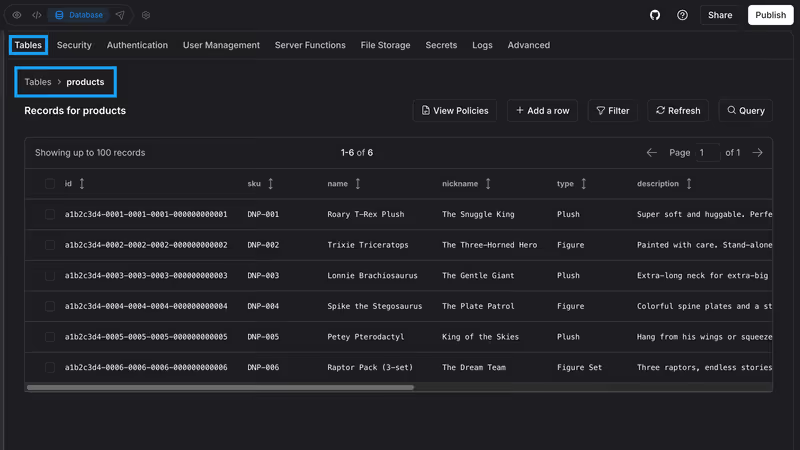
Anything handles the same problem through a more managed, prompt-driven surface. That makes setup feel easier, especially for non-developers, but it weakens auditability on the exact question this job hinges on: how records are isolated and enforced per user under the hood. A visual database and canvas workflow can speed up first-pass app assembly, yet it is harder to reason about edge cases, migration behavior, and whether a generated access rule is truly robust when you do not own a normal backend implementation.

Strengths

Where each one is strong

Edge: Bolt

Bolt has the stronger ceiling because it produces a normal web app stack you can keep using after the AI stops being helpful.

Bolt

  • Standard code output in a recognizable React/Vite-style project structure with real files
  • GitHub-friendly workflow that supports export, versioning, and later human maintenance
  • Terminal and package-install flexibility for adding libraries beyond a closed template set
  • Better long-term survivability when a project grows past the initial prompt-and-fix phase

Anything

  • Visual editing speed with promptable layout changes directly on the canvas
  • Lower intimidation for non-technical users who do not want to navigate source files
  • Fast assembly of screens, forms, and simple app flows for demos and MVP validation
  • Good fit when the primary goal is showing a concept quickly rather than owning the stack

Failure modes

Where each one breaks

Edge: Bolt

Bolt's failures are painful but usually recoverable inside a normal codebase; Anything's failures are worse when trust, migration, or platform dependence become the problem.

Bolt

  • Fix-loop token burn can get expensive when the model rewrites large files to solve small bugs
  • Browser-container limits can cause slowdowns, crashes, or trouble on larger projects
  • Generated auth and data logic still needs manual review to avoid silent security mistakes
  • Context drift during debugging can introduce regressions while repairing an unrelated issue

Anything

  • Platform trust risk is higher when critical app behavior lives behind a proprietary canvas workflow
  • Visual edits can create iterative layout regressions that consume credits without improving stability
  • Portability gets murky when app structure and data setup depend on platform-specific internals
  • Business-critical apps become fragile if future migration or deeper backend control is needed

Iteration cost

The fix loop, priced

Even

Both models hurt in fix-heavy builds because you pay again while correcting the system's own mistakes.

Bolt

  • Paid usage is token-metered, so debugging long files or repeated rewrites increases cost quickly
  • Real burn tends to spike during auth, integration, and deployment troubleshooting rather than first drafts
  • Worst case is an unresolved loop where each attempted fix consumes more tokens and adds regressions
  • The structural issue is that cost tracks generation volume, not whether the change was actually correct

Anything

  • Paid usage is credit-like and tied to continued generations and visual revisions
  • Real burn shows up when small UI or workflow adjustments require multiple prompt attempts
  • Worst case is spending credits refining a prototype that still is not trustworthy enough to ship
  • The structural issue is similar: iteration is billable even when the platform creates the rework

The shared problem is simple: the real bill lives in repeated corrections, not the first draft, which is the classic fix loop tax.

Exit paths

The code you end up with

Edge: Bolt

Bolt leaves you in better shape because the exit path is a conventional repo rather than a platform-shaped artifact.

Bolt

  • Exports as ordinary web app code that developers can inspect, edit, and deploy elsewhere
  • Fits normal Git workflows instead of requiring permanent dependence on a proprietary runtime
  • Makes contractor or team handoff realistic because the files are legible outside the product
  • Lock-in risk is lower even if the generated code still needs cleanup and hardening

Anything

  • Frontend export may be possible, but the overall app experience remains more platform-tied
  • Database and auth behavior are less portable when they rely on managed internal abstractions
  • Visual convenience up front can translate into awkward cleanup when leaving the platform later
  • Lock-in risk is higher for any app whose value depends on more than static screens

When neither wins

For a small business app with logins and private records, neither Bolt nor Anything fully solves the dangerous part of the job: both leave you maintaining generated, security-critical behavior. Even if one gives you cleaner files and the other gives you a friendlier canvas, you still own the consequences if auth checks, data filters, or record access rules are wrong in production.

If you are a non-developer building a portal, internal tool, or client app, look at Softr, the tool with no fix loop: auth, user groups, and record-level permissions are platform configuration rather than generated code you must audit. That is the safer business shape, with one honest boundary: Softr is the wrong fit if you need a custom consumer UI or want to own and self-direct a full codebase.

Verdict

Bolt wins when the job is a real small business web app and someone on the team can inspect the generated code. The strongest reason is not that it is magically more secure by default, but that it gives you a conventional codebase you can audit, export, and continue maintaining when the AI's first answer is incomplete.

Anything is the right pick instead when the real goal is rapid visual prototyping, stakeholder feedback, or MVP concept validation. If the build is likely to be thrown away or rebuilt properly later, its canvas-driven workflow can be the faster route to a convincing first version.

For non-technical business builders, the cleaner call is often to skip both and use Softr for portals and internal apps, because it handles permissions as product configuration instead of generated code. If you do need code ownership, standardization, and a normal repo, Bolt is the better side of this comparison.

Q & A

Frequently Asked Questions

Is Bolt better than Anything for a business web app with logins?

Usually yes, if someone on the team can review and maintain the generated code. Bolt is easier to trust long term because it produces a conventional codebase you can inspect and move elsewhere. Anything is better suited to prototype speed than to security-critical business logic.

Which costs more to maintain, Bolt or Anything?

Neither is reliably cheap once you enter a heavy fix loop. Bolt burns value through repeated token-heavy rewrites, while Anything burns value through repeated visual and workflow generations. The more the first draft is wrong, the less friendly both pricing models feel.

Can I export my app from Bolt and Anything without lock-in?

Bolt offers the cleaner exit because the app lives as normal web code that can continue outside the platform. Anything is more limited in practice because the useful parts of the app can remain tied to its managed environment and abstractions. So export is not the same as full portability.

What should a non-technical team use instead of Bolt or Anything?

For business portals, internal tools, and client-facing apps with permissions, Softr is the safer no-code route. It handles authentication, user groups, and record-level access as platform features instead of generated code. That removes much of the security and maintenance burden that makes both AI builders risky.