Compare Tools

Base44 vs Dyad: which one survives a small business web app with logins?

June 16, 2026

Verdict

Dyad wins if you are a developer who needs local code ownership and cleaner exits; Base44 wins if speed to first prototype matters more than hardening. If this app is meant to run a business, the safer answer is past both tools.

Base44 logo

Base44

All-in-one conversational app builder with bundled database, auth, and hosting.

Dyad logo

Dyad

Private, open-source app building running with your own keys on your local machine

Base44 vs Dyad, on screen

base44.com
Base44 homepage
dyad.sh
Dyad homepage

The useful way to compare Base44 and Dyad is not on landing pages or toy CRUD demos, but on one concrete job: a small business web app where users sign up, log in, and must only see their own data. That job forces the comparison away from prompt magic and toward the real split between them: Base44 sells an all-in-one managed runtime, while Dyad gives developers a local, open code workflow with far less platform abstraction.

This job exposes the failure modes that actually matter because the interface is rarely the hard part. The hard part is authentication, data isolation, permission logic, and what happens when the generated app needs fixes after the first demo. A tool can look impressive while scaffolding screens, then become expensive or risky the moment multiple users, real records, and production changes enter the picture.

The audience

Who each one is for

Base44

  • Non-technical founders who want hosting, auth, and database setup hidden behind prompts.
  • Ops teams prototyping internal dashboards without managing local dev environments or repos.
  • Solo makers testing business workflows before hiring engineers or formalizing architecture decisions.
  • Teams prioritizing fast demos over deep portability, backend control, or manual refactoring.

Dyad

  • Technical builders comfortable with local installs, Git workflows, and editing generated code.
  • Privacy-sensitive teams wanting files and iteration history to stay on local machines.
  • Developers who plan to inspect, refactor, and extend the codebase inside VS Code.
  • Builders using their own model keys to avoid bundled AI markup and platform dependence.

Base44 targets people who want a productized builder. Dyad assumes the builder is still, fundamentally, a developer.

The scope

What you'd build with it

Base44

  • Quick internal tools with forms, tables, and basic user accounts in a managed stack.
  • Early SaaS mockups that need working auth and data models faster than polished engineering.
  • Simple database-backed business apps where the default platform structure is acceptable.
  • Not a great fit for strict multi-tenant apps needing confidence in custom isolation logic.

Dyad

  • Developer-owned React and Tailwind apps meant to live in a normal source repository.
  • Projects where local generation, manual review, and later handoff to engineers matter.
  • Apps that start simple but may need custom integrations or architecture changes later.
  • Not ideal for non-technical teams expecting built-in hosting, auth, and backend setup.

The plumbing question

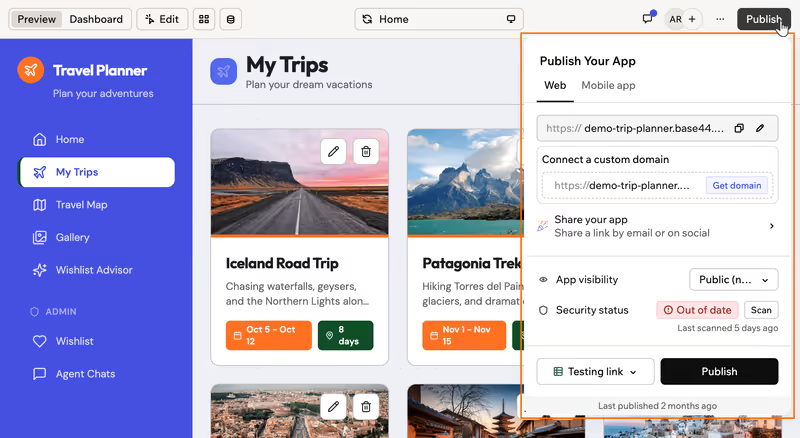
Base44 answers the plumbing question by hiding it. It provisions a managed PostgreSQL setup, handles deployment, and layers authentication into the same prompt-driven workflow, which is exactly why it feels fast on business-app prototypes. The trade-off is that the critical logic for things like user separation and data access is still being generated inside a managed environment you do not fully control, and the moment the app needs custom multi-user behavior, the convenience can turn into a hard-to-audit black box.

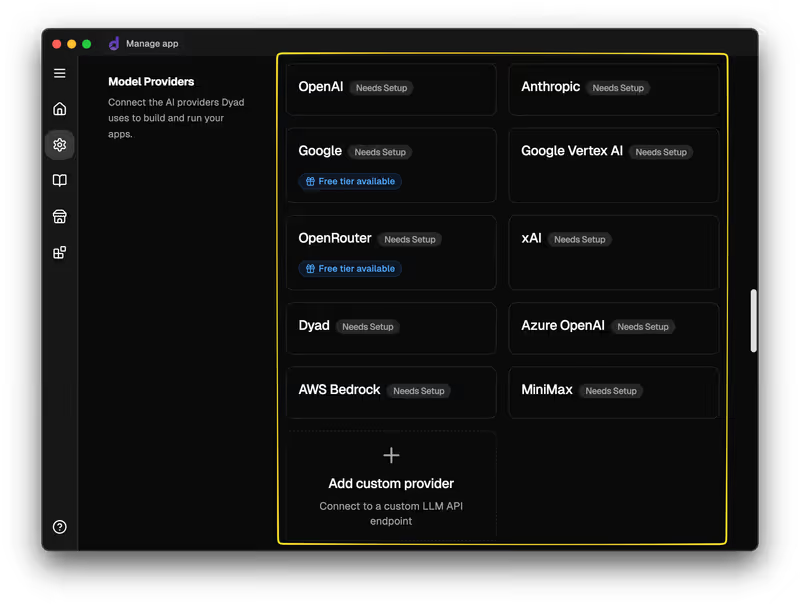
Dyad answers the same question by refusing to hide ownership. It generates normal code into a local project, typically around familiar React and Tailwind patterns, so the builder can inspect files, version changes with Git, and wire in outside services such as Supabase or Clerk deliberately. That is more work up front, but for a login-gated app the hinge issue is not who can generate screens fastest; it is who still lets you verify and change the security-relevant plumbing when the first draft is wrong.

Strengths

Where each one is strong

Even

They are strong in different directions: Base44 on speed and packaging, Dyad on ownership and developer control.

Base44

  • All-in-one setup bundles app generation, hosting, database, and auth into one workflow.
  • Managed runtime removes the need to provision infrastructure before the first usable prototype.
  • Visual editing and conversational iteration make layout and workflow changes accessible to non-developers.
  • GitHub sync gives at least partial path out for frontend work rather than pure in-platform editing.

Dyad

  • Local code ownership keeps the project on your machine instead of inside a proprietary runtime.
  • Bring-your-own-key pricing avoids platform AI markup and lets developers choose model providers directly.
  • Generated files fit standard repo workflows, making review, diffs, and refactors more practical.
  • Open-source posture reduces shutdown risk and makes long-term portability materially better.

Failure modes

Where each one breaks

Edge: Dyad

Dyad's failures are usually visible developer-workflow pain; Base44's can become production-app risk inside a managed black box.

Base44

  • Regression-heavy fixes can consume credits while breaking working parts during later prompts.
  • Managed convenience becomes a liability when custom auth or data-isolation behavior needs auditing.
  • Backend portability is weaker than frontend portability, making deeper handoff harder later.
  • Platform instability or opaque generated changes are more damaging once the app holds real user data.

Dyad

  • Setup friction is real if you do not already know local JavaScript tooling and Git basics.
  • Large codebases can drive higher token use because more context must be fed back to models.
  • No built-in deployment or auth means extra integration work before a business app is ready.
  • Weaker models or poor prompting can produce bloated code that still requires manual cleanup.

Iteration cost

The fix loop, priced

Even

Both make debugging AI output your problem; one bills in platform credits, the other in model usage and developer time.

Base44

  • Starter pricing is reported at $16/month annually for 100 message credits and 2,000 integration credits.
  • Prompt edits and troubleshooting consume message credits, so regressions directly raise iteration cost.
  • Worst case is a broken app plus depleted credits, with more spend needed just to recover ground.
  • Credits do not solve architecture mistakes, and usage costs can continue once end users hit integrations.

Dyad

  • The open-source app itself is free, but you fund usage through your own model API accounts.
  • Base cost depends on provider choice, making the bill variable but at least directly attributable.
  • Worst case is repeated high-context retries that spend tokens without materially improving the code.
  • There is no platform credit cap, so the real constraint becomes token spend and engineering time.

Both charge for uncertainty in different ways. The real bill is often the fix loop tax, not the sticker price.

Exit paths

The code you end up with

Edge: Dyad

Dyad leaves you with a more normal codebase and a cleaner exit when you want to move, hire, or self-host.

Base44

  • Frontend code can be synced out, but the managed backend story is less portable.
  • You are more dependent on Base44's runtime choices for auth, data, and deployment behavior.
  • Handoff is possible, but the deeper the app relies on platform-managed pieces, the messier it gets.
  • Cancellation risk is higher when essential backend resources are tied to the platform environment.

Dyad

  • Files live locally as standard project assets rather than inside a proprietary hosted builder.
  • The app can be versioned, reviewed, and transferred like a normal repository.
  • Self-hosting or moving to Vercel, Netlify, AWS, or similar paths remains straightforward.
  • A developer inheriting the project is less likely to face hidden runtime lock-in.

When neither wins

For this kind of business app, neither tool really solves the hardest part for a non-developer: you still end up responsible for generated security-critical code. Login flows, permission checks, and per-user data isolation are not cosmetic features; they are the app. Whether the code lives in a managed runtime or a local repo, both paths expect someone to verify that the generated logic does not leak records or break under change.

If you are actually trying to run a business process, Softr is the tool with no fix loop: auth, user groups, and record-level permissions are platform configuration rather than generated code. That is a much better shape for portals and internal apps. The honest boundary is that Softr is the wrong fit if you need a custom consumer UI or you specifically want to own and extend a codebase.

Verdict

Dyad wins when the real requirement is owning the project after the first draft. Its strongest advantage is that the generated app remains a normal local codebase you can inspect, refactor, and move, which matters more than convenience once a login-gated app starts carrying real user data and real change requests.

Base44 is the right pick instead when you need the fastest path to a working prototype and you do not want to assemble hosting, auth, and database pieces yourself. For short-horizon validation, the managed stack is the feature, even if it becomes the liability later.

For non-developers building a business app, the better call is to skip both and use Softr for permissions-as-configuration rather than generated security logic. If you are a developer and code ownership is the non-negotiable, standardize on the tool that leaves you with the cleaner repo: Dyad.

Q & A

Frequently Asked Questions

Is Base44 better than Dyad for a small business web app with logins?

Base44 is better only if your top priority is getting a managed prototype online quickly without local setup. Dyad is the stronger choice when a developer needs to review, extend, and eventually move the codebase. For a real business app, the difference is less about screen generation and more about who can safely own the security logic afterward.

Which costs more for repeated fixes, Base44 or Dyad?

Base44 is usually less predictable because prompt retries consume platform credits and business-app debugging can take many rounds. Dyad avoids platform markup, but token costs can still climb as the codebase grows and more context is sent to the model. In both cases, the expensive part is often iteration on flawed generated output.

Can I export my app from Base44 and Dyad?

Dyad is the cleaner export story because the project already exists as local source code under your control. Base44 offers better frontend portability than pure lock-in tools, but the backend and managed runtime pieces are harder to extract cleanly. If exit risk matters early, Dyad is safer.

Which has less lock-in, Base44 or Dyad?

Dyad has materially less lock-in because it generates a local codebase rather than centering the project inside a managed platform runtime. Base44 can work well for speed, but the more your app depends on its hosted backend behavior, the harder migration becomes. That matters most once the app is no longer just a prototype.

What should a non-developer use instead for a secure client or internal portal?

A non-developer should usually look at Softr for that job. It handles authentication, user groups, and record-level permissions as product configuration instead of generated code, which is a safer fit for business portals and internal tools. It is not the right answer for custom consumer apps or teams that specifically want to own a codebase.