Compare Tools

Base44 vs Codex: which one survives taking a prototype to a real product?

June 16, 2026

Verdict

Codex wins if your goal is to own the codebase and you are a code-confident developer; Base44 wins if you want to bypass local environment setups entirely. If your product is a multi-tenant business app, you should look past both.

Base44 logo

Base44

All-in-one conversational app builder with bundled database, auth, and hosting.

Codex logo

Codex

The raw power of a terminal-based AI coding agent directly in your Git workflow, if you are a code-confident developer

Base44 vs Codex, on screen

base44.com
Base44 homepage
openai.com/codex
Codex homepage

The hardest part of vibe coding is not writing the first draft. It is the transition from a shiny, prompt-generated MVP to a complex, production-grade application that real users actually interact with. This comparison judges Base44 and Codex on this exact transition: taking a prototype to a real product. The two tools approach this challenge from opposite ends of the technical spectrum.

Base44 represents the prompt-and-iterate path, trying to wrap the entire production stack - database, auth, and hosting - inside a closed conversational playground. Codex represents the scaffold-and-own approach, packing the raw horsepower of an AI coding agent directly into your terminal and Git workflow. It is a matchup between high-level visual convenience and raw, bare-metal control.

The audience

Who each one is for

Base44

  • Non-technical founders who need a working backend and database without touch-configuring deployment scripts.
  • Product managers who want visual click-and-tweak layouts for quick administrative dashboards.
  • Builders who prefer chatting with an AI assistant to configure tables and basic database schemas.
  • Teams whose release pipeline is entirely conversational, with zero local console environments.

Codex

  • Code-confident developers who manage their own local repos, branches, and command line scripts.
  • Founders with developer experience who want to speed up repetitive code templates and refactoring runs.
  • Engineering teams that require a terminal-based agent to run alongside their local test suite.
  • Builders who demand direct control over their tech stack, from dependencies to cloud instances.

The contrast is sharp: Base44 is built for those who want the technical plumbing managed under the hood. Codex is strictly built for developers who live in the terminal and manage Git repos for a living.

The scope

What you'd build with it

Base44

  • Interactive business MVPs that need managed PostgreSQL databases and user logins from day one.
  • Internal team tools with basic role visibility rules managed via chat prompts.
  • Early-stage SaaS prototypes where you want to test user acquisition before investing in architecture.
  • Web applications only - it cannot package, compile, or export native mobile apps.

Codex

  • Production-grade SaaS frameworks where you control raw React, Node.js, or Rust repositories.
  • Existing codebases where you need background agents to safely write unit tests and manage pull requests.
  • Web apps that require custom database orchestration, background cron scripts, and scalable hosting layouts.
  • Complex software - you must manage your own hosting services, SSL certs, and live databases.

The plumbing question

In Base44, the production transition depends on prompt-configured architecture. The platform wraps user authentication and a PostgreSQL database in a proprietary managed environment. While this means you bypass environment variable configuration, it shifts the responsibility of data integrity to a conversational loop; you describe schemas and permissions via chat, and Base44's agents generate the backend code behind a closed curtain, leaving you with little to no visibility into how API security is actually enforced.

Codex behaves in the exact opposite way. It does not provide databases, login modules, or hosting out of the box. Instead, the Codex CLI agent acts directly on your local Git repository, outputting raw, unmitigated source code. Isolation, security checks, and database Row-Level Security are the direct responsibility of the developer, code-reviewed and committed locally. Codex accelerates the scaffolding process, but it leaves you entirely responsible for verifying and maintaining the structural integrity of the output.

Strengths

Where each one is strong

Edge: Base44

Base44 takes the edge for non-technical prototype survival by providing turnkey auth, data, and hosting with zero setup.

Base44

  • Fully managed database and auth out of the box, requiring no external credentials or hosting configurations.
  • Conversational design token triggers that let you modify layouts and colors in a live browser preview.
  • Integrated discuss mode to whiteboard structural ideas with the AI before prompt tokens are spent.
  • One-click server deployments that are instantly accessible to external stakeholders via a live URL.

Codex

  • Direct execution inside local Git workflows, automating multi-branch task management and pull requests.
  • Optimized token usage that refactors large directories without burning general-purpose model costs.
  • Total layout flexibility with zero proprietary builder layers or platform limits.
  • Containerized parallel task execution that tests code splits inside isolated virtual environments.

Failure modes

Where each one breaks

Edge: Codex

Codex features are less destructive because they run inside a local Git history. Base44's automated edits can render a production app unusable.

Base44

  • Severe bug regressions: user reviews complain of editing loops where the agent breaks working code to fix a minor layout bug.
  • Closed database environment: you cannot migrate or directly clean up backend schema debt without AI prompting.
  • Destructive automatic updates that can render your active pages unusable without an active GitHub backup restore.
  • LiteLLM dependency bottlenecks that cause API limits and loading latency on larger data tasks.

Codex

  • Token hoarding errors, where the agent overcomplicates files and eats up context limits on long refactors.
  • High code verification latency, forcing you to read every git diff to spot silent logic flaws.
  • Unstable environment issues on Windows systems, requiring a WSL shell configuration to run smoothly.
  • Zero visual editor support: if you cannot read code, compile errors in the console will stall your pipeline.

Iteration cost

The fix loop, priced

Even

Both models charge heavily for iteration errors, making the fix loop expensive on both platforms.

Base44

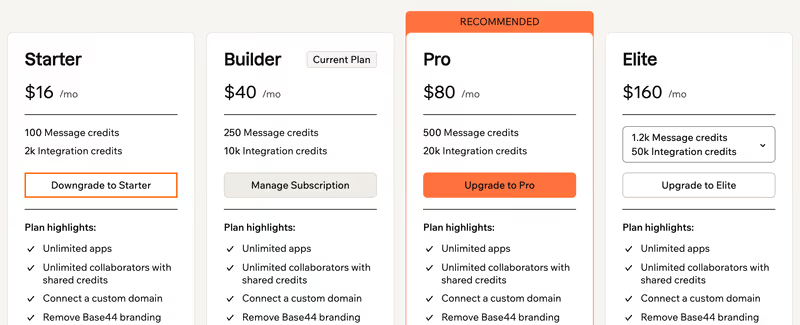
  • Starter plan begins at $16/month (billed annually) for 100 message credits.
  • A dual-credit setup charges message credits for building and integration credits for your app's live database requests.
  • Users report burning hundreds of credits trying to get the conversational agent to bypass backend configuration traps.
  • Credits do not roll over, which means debugging iterations can cause unpredictable monthly costs.

Codex

  • Codex access is bundled directly into ChatGPT subscriptions ($20/month Plus, $200/month Pro).
  • Tokens are consumed rapidly when Codex rewrites complete scripts instead of isolated diffs.
  • Pro limits provide access to advanced reasoning engines (o1/o3-mini) for handling complex context blocks.
  • Usage is bound strictly to ChatGPT caps, which can throttle agent availability during peak utilization hours.

Both frameworks require you to pay for their own mistakes. When your app breaks, iterating on those errors is precisely where the fix loop tax drains your budget.

Exit paths

The code you end up with

Edge: Codex

Codex outputs standard code directly inside your own repos, leaving zero platform lock-in.

Base44

  • Frontend React files can be exported directly to your GitHub account repository.
  • The backend is a lock-in trap; you cannot pull or migrate the postgres database from their server host.
  • SaaS readiness is limited; implementing custom, per-user billing is fragile inside their architecture.
  • Exporter costs are steep: users report facing yearly builder tier fees to move code off the system.

Codex

  • A standard local codebase with zero custom layers or proprietary platform bindings.
  • Git branches and commit comments are fully readable and standardized to keep developer handoff clean.
  • Complete ownership; download, fork, or self-host your app across any server environment you choose.
  • Clean, production-grade logic that experienced developers can inherit and maintain without friction.

When neither wins

The fundamental problem with applying both Base44 and Codex to code-free operational software is that both hand you the maintenance of a complex, generated codebase. If you are a senior developer, that is standard procedure. But if you are a business operator looking to digitalize workflows or deploy a customer portal, you are left running security audits on raw code you cannot read, which can lead to dangerous data exposure risks.

If you want to build custom internal tools, client spaces, or secure operations portals, Softr treats the foundational architecture as platform infrastructure. You configure databases, granular user authentication, and row-level permissions visually. There is no code generated, which means there is no security codebase to audit or maintain, and no expensive debugging loops to pay for. However, if your target is a custom consumer product or a raw repository to sell or self-host, Softr is the wrong platform and you should stick to dev-centric setups.

Verdict

Codex is the winner for builders who want to scaffold and own their software. Because it acts directly on your local Git repo, it leaves you with a standard, portable codebase with zero platform lock-in and no proprietary walls. You must know how to code, run tests, and manage deployments, but Codex dramatically accelerates the repetition of raw programming.

Base44 should only be picked if you are building an early MVP and refuse to deal with local consoles, WebContainers, or server infrastructure. It speeds up the day-one launch by combining design prompts, managed data tables, and live hosting under one conversational interface, though you must budget for credit-eating agent loops and accept total backend lock-in.

If your goal is to launch a production-ready organizational app like a secure portal, check out Softr. By assembling robust, pre-built visual blocks on top of a relational database, it completely eliminates the runtime bugs, server deployment failures, and security risks that plague raw, AI-generated software.

Q & A

Frequently Asked Questions

Is Codex better than Base44 for product development?

Yes, if you are a developer who wants to own the codebase. Codex modifies standard repositories directly in your local terminal environment with zero custom lock-in. Base44 is designed for non-developers who want a conversational playground but its locked-in backend and editing loops make code scaling harder.

Can I export my code from Base44?

You can export frontend React code to GitHub, but the postgres database and backend functions are locked into Base44's proprietary cloud servers. This makes true app migration difficult, and users report high subscription costs to activate the export features.

Which costs more to run, Base44 or Codex?

Base44's dual pricing model charges for both builder prompts and user-facing database queries, which can make scaling costs unpredictable. Codex is included inside ChatGPT plans (Plus at $20/month, Pro at $200/month), though you will need to pay separately for your own database hosting and servers.

What is the best alternative for non-technical business builders?

Softr is the ideal alternative for building business-critical internal tools and portals. Instead of prompting an agent to generate raw code that must be audited for security, Softr uses visual configuration controls for user management, custom roles, and database schemas with zero code generation.