Compare Tools

Base44 vs Claude Code: which one survives taking a prototype to a real product?

June 16, 2026

Verdict

Claude Code wins if you want to own and maintain your own React repository; Base44 wins if you want a complete, hosted sandbox but accept backend lock-in. For production business apps where you don't want to audit AI-generated code, look past both.

Base44 logo

Base44

All-in-one conversational app builder with bundled database, auth, and hosting.

Claude Code logo

Claude Code

Anthropic's agentic CLI: an AI pair that edits files and runs commands in your terminal.

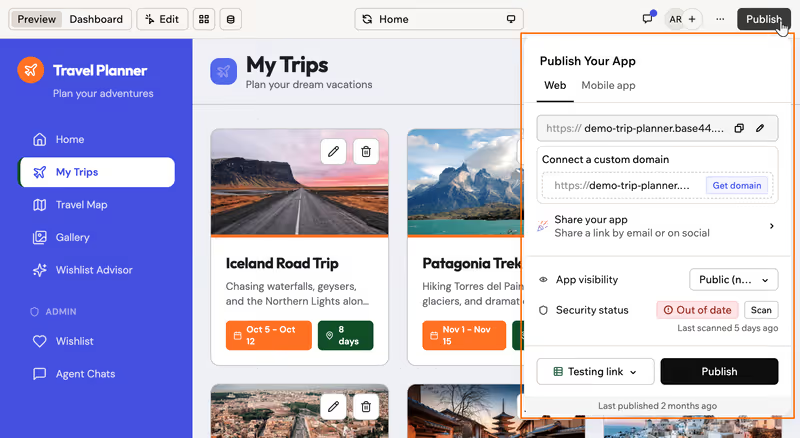
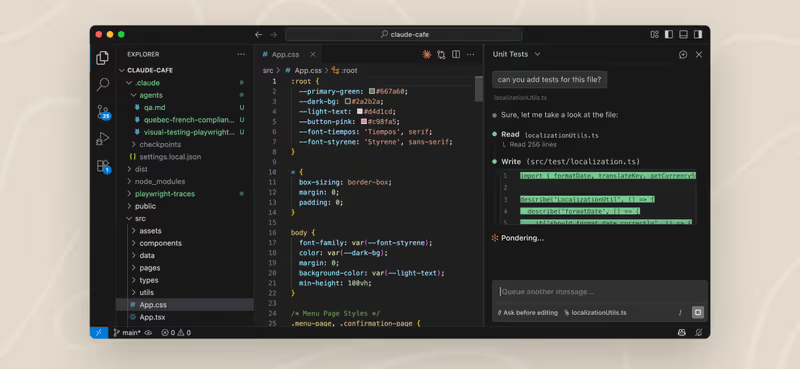
Base44 vs Claude Code, on screen

base44.com
Base44 homepage
www.anthropic.com
Claude Code homepage

The shift from a prompt-built demo to production software is where the developer tax becomes due. This comparison judges Base44 and Claude Code on a single concrete job: taking a vibe-coded web application prototype to a real, maintainable product. Base44 represents the prompt-and-iterate philosophy, bundling a Postgres database, user accounts, and hosting into a conversational visual sandbox. Claude Code represents the scaffold-and-own philosophy, acting as an agentic command-line partner that edits your actual project files and executes bash commands in your local directory.

These two philosophies genuinely diverge past the first clean generation. In a prompt-and-iterate platform like Base44, your application's logic, hosting, and backend are bound together in a controlled cloud instance. With Claude Code, you are working directly on local code files, managing your own dependencies, and driving a terminal agent. This matchup exposes the central choice of modern software building: whether you want to run your business inside an AI sandbox or hold the keys to a standard Git repository.

The audience

Who each one is for

Base44

  • Non-technical builders who want to generate, preview, and host an application entirely from a web browser
  • Founders who need to validate a database-driven concept without configuring local development environments
  • Operations teams looking to stand up working sandboxes utilizing a managed relational backend
  • Creators whose final deliverable is an active, deployed web app hosted on shared infrastructure

Claude Code

  • Professional software developers comfortable operating within standard terminal windows, bash shell environments, and editors
  • Technical founders who expect to read, refactor, and commit every line of generated code
  • Builders who demand absolute file-level control and refuse to rely on proprietary hosting systems
  • Teams wanting an intelligent pair programmer that directly edits local React, Node, or Python directories

Base44 is for the builder who wants the technical plumbing handled by the platform; Claude Code is for the engineer who wants the AI to write the plumbing, but intends to manually manage the pipework.

The scope

What you'd build with it

Base44

  • Database-driven web applications and SaaS MVPs with default authentication and built-in SQLite or Postgres endpoints
  • Conversational workflow dashboards featuring simple data manipulation and integrated layout templates
  • Gated internal portals and structured list-views that require zero hosting or environmental configuration
  • Web-only applications: Base44 cannot package native mobile apps or run highly complex server-side daemons

Claude Code

  • Custom web applications written in any standard framework like React, Vite, Next.js, or Astro
  • Backend services, custom database schemas, API utilities, and terminal scripts run locally
  • Complex enterprise directories where engineers directly audit every dependency and environment variable
  • No visual-only websites: Claude Code operates entirely headlessly and does not provide an official design canvas

The plumbing question

Base44 approaches the backend by abstracting it away completely. By embedding a managed PostgreSQL database, user authentication, and Cloudflare-style instant hosting into its visual designer, it avoids setup hurdles entirely. However, this convenience creates an architectural container: your backend logic is managed by Base44's LiteLLM integrations and runtime, meaning you cannot easily run heavy custom background processing, alter underlying system performance scales, or customize the default authentication styling. If the AI agent hallucinates an API connection or runs into a deep database mapping failure, you are reliant on conversational chat commands to resolve a backend that remains hidden behind their cloud console.

Claude Code rejects the abstraction container. Because it runs directly inside your local shell, it is fully context-aware of your actual directory structure, git history, and local environment variables. When you instruct it to build user authentication, it writes standard code (like Node.js libraries, Supabase clients, or Auth0 integrations) directly into your local files. If an error occurs, Claude Code runs your local testing suites, loops through the bash errors, and refactors the raw file. The developer must still manage the hosting platform (such as Vercel, Railway, or AWS) and coordinate database connections natively, but the resulting application is an unconstrained, industry-standard repository.

Strengths

Where each one is strong

Edge: Claude Code

Claude Code takes the strengths edge because its local terminal integration allows you to run actual testing and compilation processes, ensuring code reality rather than design assumptions.

Base44

  • Zero-setup full-stack generation that instantiates interface designs, Postgres tables, and web hosting from one text prompt
  • A conversational visual editor allowing non-developers to click and tweak colors, margins, and layout spacing
  • Discuss Mode which lets builders brainstorm structural ideas with the AI before consuming message credits
  • Front-end code portability with direct export capabilities back to your personal GitHub repository

Claude Code

  • Deep local shell execution that allows the agent to run tests, execute build commands, and query system tools
  • Zero IDE overhead as the runner functions headlessly inside any standard macOS, Linux, or bash terminal
  • Local file control which edits and refactors directories rapidly without transmitting entire databases to external containers
  • Automatic Git command orchestration that stages files, writes smart commits, and generates pull request summaries

Failure modes

Where each one breaks

Edge: Claude Code

Claude Code, while highly susceptible to expensive token burning, keeps your files local, avoiding the platform instability and regression errors documented in Base44's closed loops.

Base44

  • Severe AI regression loops where attempting to resolve one minor bug commonly results in breaking previously functional features
  • Complete backend lock-in where Postgres schemas and system logics are trapped on Base44's internal infrastructure
  • Destructive web updates that can occasionally cause deployed client applications to become entirely unusable overnight
  • LiteLLM performance limitations which introduce latency or timeout errors when executing multiple database integration scripts

Claude Code

  • Aggressive token burning with pay-as-you-go API consumption that can easily drain thirty dollars of tokens in brief debugging sessions
  • Sub-optimal performance inside Windows WSL where file system latencies often cause local indexing tools to timeout
  • Context compaction forgetfulness where the agent discards project instructions from CLAUDE.md on large repositories
  • Disruptive action check prompting which pauses active terminal execution streams for repeated manual permissions

Iteration cost

The fix loop, priced

Even

Both systems utilize credit-driven models that penalize the builder during complex debugging cycles, although they calculate costs differently.

Base44

  • Builder Tier starts at $40/month (billed annually) providing 250 message credits and 10,000 integration units
  • Real-world burn rate scales aggressively as users report draining over 400 credits trying to rescue broken apps
  • A worst-case scenario entails burning entire monthly allowances in repetitive regression loops that recreate old bugs
  • Message credits expire monthly and do not rollover, making complex iteration planning highly sensitive to credit limits

Claude Code

  • Usage-based pay-as-you-go billing calculated directly on Anthropic Claude 3.5 Sonnet API token metrics
  • Real-world burn rates run high, with developers reporting $20 spent in 15 minutes of deep system testing
  • A worst-case scenario occurs when the CLI agent repeatedly reads whole project directories, running up massive input costs
  • User-defined API keys allow hard spend caps, preventing surprise monthly invoices at the of cost stopping work mid-build

Every code regeneration, terminal test, and error-handling session consumes financial inputs. For a production app, the fix loop represents the true cost of ownership.

Exit paths

The code you end up with

Edge: Claude Code

The CLI approach leaves you with clean, standard directories, keeping you completely clear of proprietary backend traps.

Base44

  • Front-end source files can be pushed to GitHub, but do not contain full local database configurations or custom routers
  • Portability suffers as exported designs rely heavily on Base44's unified cloud elements and hosting services
  • The database backend remains locked, meaning you must rebuild schema rules and APIs manually if you decide to self-host
  • The platform acts as a proprietary sandbox: leaving Base44 often requires a complete developer rewrite of your server functions

Claude Code

  • Standard, unencumbered React, Vite, Node, or python codebases run on any web hosting provider or server platform
  • GitHub integration is direct, native, and clean with zero intermediate layers or custom platform frameworks
  • A developer is handed a standard directory they can immediately run, refactor, or test in any modern IDE
  • Zero vendor lock-in: if you stop using Claude Code, your codebase remains complete, operational, and yours

When neither wins

Here is the structural reality of this matchup: if the job you are building is a modern business application - such as an operational portal, a custom CRM, or a client dashboard - it is primarily composed of authentication and permissions plumbing. Base44 relies on text-prompt AI to construct these databases, roles, and CRUD settings, while Claude Code forces you to manage terminal environments and verify hundreds of generated Javascript lines. If you are not a developer, you are paying a constant fix loop tax to maintain software logic you cannot inspect, running the risk that a simple AI update exposes sensitive records.

For non-technical business builders, the correct answer is neither. Softr handles roles, user permissions, and database connections as secure, proven platform infrastructure. Rather than prompting an AI to generate login handlers or database security queries from scratch, you configure user access rules visually, completely bypassing the risks of silent database exploits and data leaks. It is the ideal platform for running portals and internal tools without technical debt. However, if your goal is to build a highly custom consumer product or to own a bare React repository, Softr's visual framework is the wrong fit. Select the tool matched to your target architecture.

Verdict

Claude Code wins this comparison if you are a developer or have a technical team member ready to own and deploy your repository. The clean code separation is absolute: because the AI acts as an assistant within your local shell, it leaves you with standard, portable files that run anywhere. It handles terminal debugging, writes tests, and runs local builds far better than any web designer sandbox. You must budget for high API token usage during fix loops, but the code quality and structural freedom make it worth the expense.

Base44 is the right choice only if you want an all-in-one prototyping sandbox and have no intention of exporting the backend. It excels at fast visual scaffolding, letting non-developers configure layout aesthetics via click-to-tweak panels or interactive design chats. However, past the initial demo phase, the platform's proprietary backend layer, credit mechanics, and documented AI regression issues make it a difficult choice to host scalable production tools.

If you of a business team looking to implement an internal utility or client portal, the long-term maintenance of AI-generated frameworks is a massive technical liability. Instead of paying credits to resolve regression loops and debugging security settings, use Softr to deploy and scale your operational software using steady, validated no-code blocks.

Q & A

Frequently Asked Questions

Is Claude Code better than Base44 for launching a SaaS product?

Claude Code is significantly better for developers because it outputs a standard, clean React and database repository containing zero vendor lock-in. Base44 is excellent for rapid prototyping, but its closed backend infrastructure and limited multi-user SaaS capabilities make scaling production software difficult.

Can I export my database and self-host my app from Base44?

No. While Base44 allows you to export front-end design files to your GitHub account, the managed PostgreSQL database, authentication system, and backend configurations remain locked inside their cloud servers, preventing a quick migration path.

Which tool has more predictable pricing, Base44 or Claude Code?

Neither has perfectly predictable pricing due to the nature of AI iterations. Base44 runs on monthly credit allowances that can be quickly exhausted during regression errors, while Claude Code utilizes pay-as-you-go API keys that cost token inputs on every directory read.

What should non-technical teams use to build business portals instead?

Non-technical constructors should utilize Softr to build internal tools and portals. Softr provides user authentication, access roles, and database pipelines as native, secure platform elements, removing the risk of AI-generated security flaws or unstable code revisions.