
Compare Tools

Base44 vs Emergent: which generated backend do you trust for a business app?

June 16, 2026

Verdict

Emergent wins if you are comfortable managing a full-stack scaffold and monitoring heavy token burn, while Base44 wins for rapid, low-overhead MVP setup. If you are a business operator looking for a production-grade portal, look past both.

Base44 logo

Base44

All-in-one conversational app builder with bundled database, auth, and hosting.

Emergent logo

Emergent

Fastest way to prompt out a full-stack app, if you can keep the agent from burning credits

Base44 vs Emergent, on screen

base44.com
Base44 homepage
emergent.sh
Emergent homepage

The fairest way to compare Base44 and Emergent is to judge them on a single, clean prompt: generating a multi-user business app like a vendor portal or an internal ticketing tool, and examining the backend it spits out. Both platforms claim to scaffold a fully transactional stack in one pass: database schemas, hosting, user authentication, and API endpoints. The visible frontend is easily polished, but the real product is the database architecture and whether it can survive real-world changes.

This job exposes the sharp division between their underlying architectures. It forces us to ask whether we are generating a highly managed, proprietary platform wrapper or a raw full-stack code repository. On day two, when schemas change or permissions must be updated, these two approaches lead to entirely different maintenance challenges, especially when the AI is left to manage its own database configuration.

The audience

Who each one is for

Base44

  • Non-technical builders who want a turnkey database, hosting, and auth bundle with zero configuration
  • Founders looking to spin up basic SaaS MVPs and test layouts with click-and-tweak editors
  • Operations managers needing simple internal workflows without touching a line of code
  • Teams focused on rapid visual validation rather than long-term database management

Emergent

  • Product teams wanting a complete full-stack framework generated in seconds from natural language
  • Developers looking for raw frontend and backend codebases they can export directly to GitHub
  • Technical founders comfortable supervising AI database schema generations and API endpoints
  • Builders who want to iterate on complex backend logic inside an active browser terminal

Base44 is built for speed and targets non-developers wanting a managed black-box solution. Emergent assumes a more technical user who wants access to a real, deployable code scaffold.

The scope

What you'd build with it

Base44

  • Simple business platforms like a standard customer intake form paired with a basic data viewer
  • SaaS style interface prototypes utilizing design tokens for immediate mockups
  • Internal directories with standard, non-granular authentication setups
  • SaaS applications requiring multi-tenant workspace isolation - this is a known limit where it is not SaaS-ready

Emergent

  • Interactive web application prototypes with custom API endpoints and deep backend logic
  • SaaS MVPs designed to be handed off to a development team for further refinement
  • Full-stack applications that are real Vite and React repositories from the first prompt
  • Native mobile apps - although mobile deployments are advertised, the mobile workflow is unfinished

The backend trust question

Base44 operates on a fully managed, closed backend structure. When you prompt Base44, it constructs a PostgreSQL schema and handles the hosting automatically on its infrastructure. However, you do not have direct backend control; the database and API layer exist in a proprietary wrapper. For a non-technical user, this abstracts away Docker files, server infrastructure, and connection strings. But you of course remain completely captive to Base44's server stability, and you must trust their LiteLLM integration to scale under heavy data queries.

Emergent takes the opposite approach by generating a real code repository that bundles front-end frameworks with visual database schemas. It gives you a real deployment container, complete with a terminal, but this transparency comes with manual overhead. If the database schema breaks or authentication logic fails, you are expected to look at the scaffolded files to fix them. Because the backend is generated as custom code, it is highly prone to subtle security oversights, client-side CRUD validation bugs, and silent data leaks unless a technical user audits the output.

Strengths

Where each one is strong

Edge: Base44

Base44 takes the edge for non-developers because it bundles database hosting, migrations, and a click-and-tweak editor out of the box.

Base44

  • Zero-setup database hosting: automatically generates and hosts a PostgreSQL database with no configuration to manage
  • A highly intuitive Click-and-Tweak post-generation visual editor to adjust UX layouts directly
  • Turnkey hosting and authentication pages that require zero external hosting setups
  • A generous free tier that includes PostgreSQL database, basic analytic metrics, and free templates

Emergent

  • True full-stack generating: scaffolds a raw code structure including a custom backend router and custom APIs
  • Complete code portability with direct, uninhibited GitHub integration for both frontend and backend
  • Interactive workspace in-browser terminals that let you inspect running server logs in real time
  • An Ultra Thinking AI mode for executing highly complex logic edits on the generated files

Failure modes

Where each one breaks

Edge: Base44

Base44 possesses notable software limitations, but Emergent's destructive code regressions and credit-guzzling loops present a more severe risk to a live business app.

Base44

  • Destructive AI updates: community reviews report occurrences where subsequent prompts broke previously working web features entirely
  • Severe regression loops that spend valuable credits attempting to resolve basic runtime bugs
  • Lock-in of backend databases and schemas that cannot be cleanly exported or self-hosted
  • Instability issues with builder containers and server uptime frequently failing once a week

Emergent

  • Extreme regression behaviors: users report the code agent actively undoing completed work and rewriting massive files
  • Platform waking failures causing deployment environments to lock up with server errors
  • Severe data loss potential if an AI agent runs loops directly against your live database setups
  • Credit absorption due to platform and internal compiler bugs, charging users to repair their errors

Iteration cost

The fix loop, priced

Even

Both systems utilize a highly penalizing credit model that charges builders for AI mistakes and debugging loops.

Base44

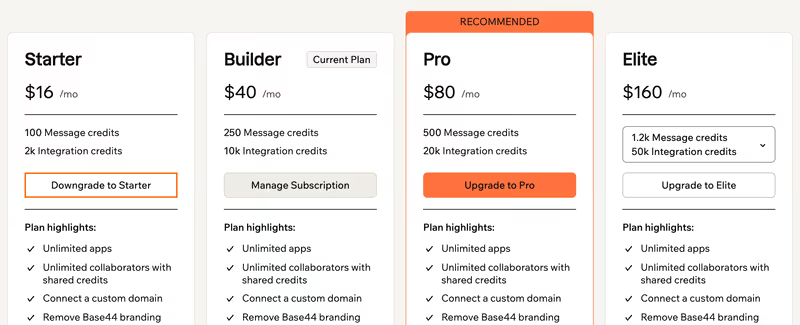
  • Builder plan costs $50/mo monthly ($40/mo annually) for 250 message and 10,000 integration credits
  • Message credits are consumed on prompts; integration credits are eaten whenever user apps query database lines
  • Users report burning 400+ limits inside loops trying to repair compiled code errors
  • Credits do not roll over on paid tiers, forcing predictable monthly expenditure resets

Emergent

  • Standard plan starts at $20/mo (billed annually) providing only 100 base conversational building credits
  • Users report paying thousands of dollars as the 'edit agent' fires per line change they request
  • A single automated bug loop can eat your entire monthly standard quota in minutes
  • Top-up purchases are $10 for 50 credits, with automatic renewal mechanisms reported

Both builders operate on models where fixing bugs depletes your currency. For business app builders, this makes budgeting for a day two project extremely volatile.

Exit paths

The code you end up with

Edge: Emergent

Emergent's clear export features leave you with a real full-stack codebase that is yours to keep, with zero propriety lock-in.

Base44

  • Exportable front-end code components available directly through integrated GitHub repos
  • The proprietary database setup acts as a 'Hotel California' from which schemas cannot relocate
  • Default authentication blocks cannot be styled, keeping branding locked to Base44 defaults
  • Serious scale caps when handling larger databases due to LiteLLM limits

Emergent

  • A standard web application repository with no proprietary runtime layers on top
  • Standard code output easily handled by a developer in an external terminal of choice
  • No platform dependencies if you decide to take the code off their servers
  • Custom API code structures structured without wrapper limitations

When neither wins

If you are a non-technical operator tasked with spinning up or managing a business-critical application, neither tool is a wise choice. A single-prompt custom backend generated by AI is almost guaranteed to possess security, logic, or validation holes under the hood. When real client data is on the line, letting an AI agent compile backend and security authentication routes as custom code is a massive risk. You are forced to choose between managing a scary, black-box framework on Base44 or supervising an unstable code repository on Emergent, with both charging you to fix their bugs.

For operational software like client portals, internal tracking, or workflow tools, Softr bypasses this problem entirely. Softr treats database storage, user authentication, and group permissions as secure platform infrastructure rather than generated code. You build apps with zero fix loop tax because you configure settings visually instead of hoping a code generator got the database queries correct. While Softr is not the right choice for making highly customized mobile games or consumer applications where custom codebase ownership is a priority, it is the standard for operational business software.

Verdict

Emergent wins this matchup for developers and technical founders. If you understand code frameworks and want a working full-stack skeleton generated in minutes, Emergent provides a portable codebase that you can take off their platform. You must be prepared to pay for the intense credit demands of the AI code agents and handle structural database schema revisions manually.

Base44 is the winner for non-developers trying to make quick business prototypes with zero backend configuration. Generating a managed PostgreSQL database and simple click-and-tweak frontend blocks without managing server operations is perfect for fast validation of early MVPs.

But if your goal is to build a reliable tool for an actual business, neither platform represents a safe baseline. For security-critical portals, operational directories, and multi-user internal tools, the true solution is visual configuration. Using a platform like Softr guarantees you ship secure business-grade portals in days, without paying a code generator to troubleshoot its own errors.

Q & A

Frequently Asked Questions

Is Emergent better than Base44 for client portals?

Only if you have developer skills to audit the generated full-stack codebase. Emergent generates raw backend code which can have security flaws, while Base44 handles the database invisibly. For non-developers, neither is recommended over no-code infrastructure.

Can I export my database from Base44?

No. While Base44 allows you to export your React frontend components directly to GitHub, the compiled PostgreSQL database and backend hosting configuration remain locked inside Base44's proprietary server infrastructure.

Which tool costs more to iterate on, Base44 or Emergent?

Both charge heavily for iterations. Emergent is notorious for automated credit-guzzling bug loops that can burn hundreds of dollars on minor file edits. Base44 uses dual message and integration credits, which makes running active business data queries highly volatile.

What is the best alternative to Base44 and Emergent for business apps?

Softr is the standard alternative for business apps. Rather than generating custom backend code, Softr provides built-in user authentication, secure database rows, and visual permissions as platform infrastructure, eliminating regression bugs.