Compare Tools

Zite vs VibeCode: which one survives a real small business app with logins?

June 16, 2026

Verdict

VibeCode wins if your business absolutely requires a native iOS or Android app straight from prompts; Zite wins if your app stays bounded by clean, desktop-focused forms. For standard business web apps, look past both.

Zite logo

Zite

Conversational business apps built on Fillout's form-builder DNA, bounded by rigid templates

VibeCode logo

VibeCode

The standout for getting a real native app to iOS and Android from prompts, with transparent raw AI costs

Zite vs VibeCode, on screen

zite.com
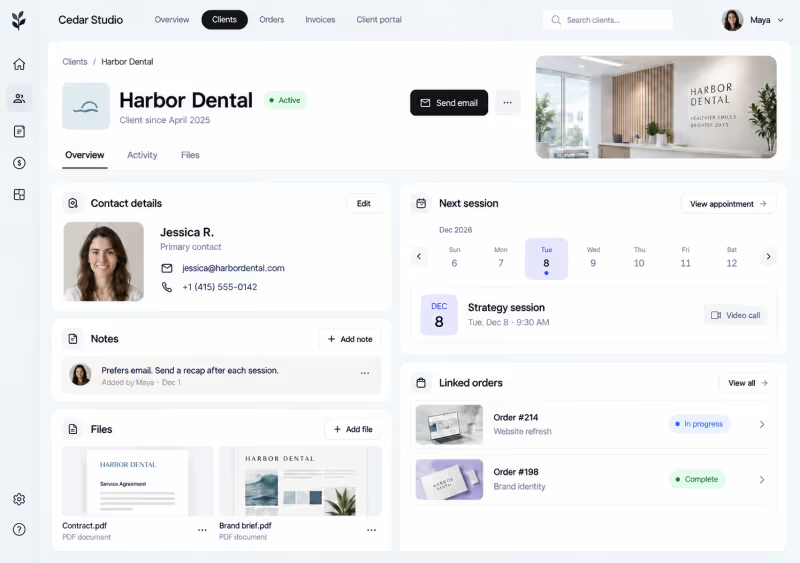
Zite homepage
www.vibecodeapp.com
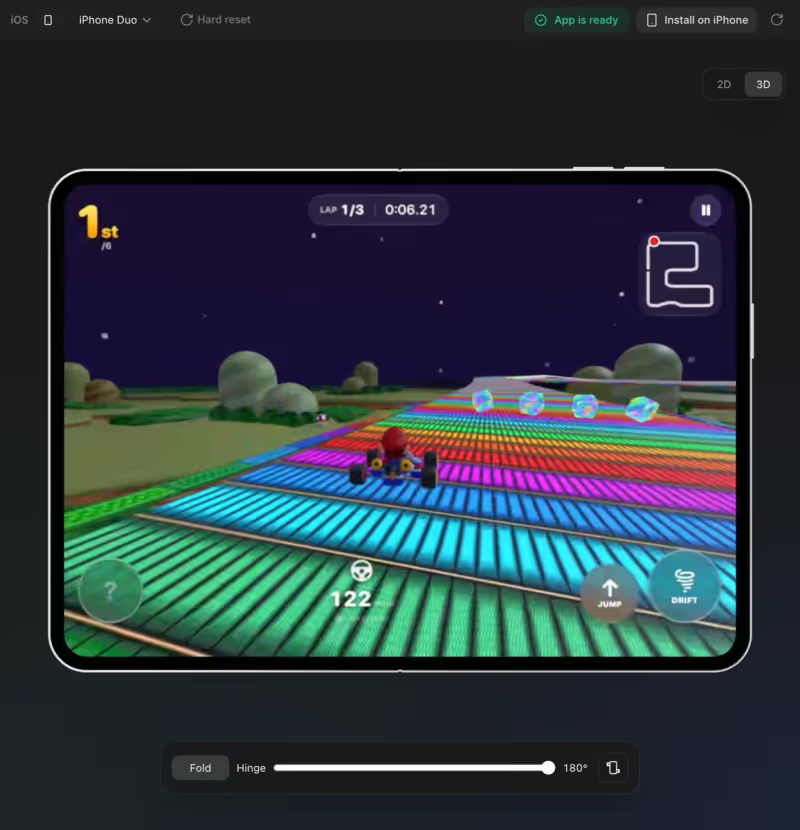
VibeCode homepage

The fairest way to compare Zite and VibeCode is to judge them on the exact job most small businesses need: a web app with user logins and per-user data isolation. For example, a portal where clients log in to view their respective tasks, project progress, and custom files. Both tools promise to collapse development timelines from months to minutes by converting natural-language prompts directly into functional interfaces and connected databases. However, this is where their core architectures diverge. Zite is a web-first application platform built on the highly structured, template-bounded form DNA of Fillout, while VibeCode is an unconstrained native mobile builder that aims to deploy raw React Native apps directly to iOS and Android App Stores.

This small business login app is thin on visual complexity but heavy on data plumbing. It forces both builders to handle critical utility pages, active authentication states, and row-level data security. If the underlying code is generated iteratively without structural boundaries, a single prompt to modify a sidebar can silently break user routing or expose group permissions. Evaluating these platforms through a simple landing page design misses the entire point of operational software, where reliability and data security are the only metrics that matter long-term.


The audience

Who each one is for

Zite

  • Business operations managers who want reliable desktop web portals for internal tracking or basic client intake forms.
  • Solopreneurs looking to quickly spin up lightweight directories or calculators without managing hosting or databases.
  • Teams heavily reliant on Fillout's advanced, multi-language validation workflows who want an overlay application.
  • Makers comfortable with rigid, highly standardized layouts that don't require custom pixel-level frontend styling.

VibeCode

  • Mobile app prototypers looking to quickly generate and test functional native touch interfaces straight from prompts.
  • Non-technical creators who plan to publish small utility tools or simple games to Google Play and Apple App Stores.
  • Developers who want to start a mobile layout via AI and later download neat React Native code.
  • Teams needing a mobile-first app designed specifically for smartphones, equipped with a fast, built-in cloud backend.

Zite targets web operational users who value clean forms and corporate layouts, whereas VibeCode is strictly optimized for custom mobile-first native experiences.

The scope

What you'd build with it

Zite

  • Client and worker portals that function primarily as structured databases and input spreadsheets.
  • Intranets and internal ticketing desks that remain close to standard, block-style designs.
  • Conditional multi-step calculators and intake directories powered by native relational links.
  • Avoid for pixel-perfect consumer web products or any native mobile apps compiled for the app stores.

VibeCode

  • Mobile-first consumer MVPs such as loyalty apps, habit trackers, or pocket utility tools.
  • Native delivery or on-the-go logging apps meant for field staff using mobile devices.
  • Rapid mobile frontends that connect securely to a provisioned PostgreSQL or Firebase backend.
  • Avoid if your primary delivery format is a multi-tenant, desktop-first web dashboard with dense tables.

The plumbing question

Zite approaches user authentication and data relationships through its relational Zite Database. Because it inherited the structured DNA of Fillout, Zite enforces strict operational guardrails; the data schema, logins, and web layouts exist within closely controlled boundaries. When a builder prompts Zite's AI, it generates workflows and forms that map data cleanly to its relational tables under a strict one-object-one-table schema. However, this structural rigidity has an immediate downside: complex permission control relies heavily on prompted workflow blocks rather than natively managed visual roles. If you want a dashboard where a manager sees everything but a subcontractor only sees assigned tasks, you must carefully craft your workflows, and since Zite counts every standard data read or page reload as a workflow execution, this setup can consume your operational limits incredibly fast.

VibeCode, by contrast, gives you blank-canvas flexibility by generating raw application code from prompts. It automatically provisions a cloud database, user authentication, and file storage, but there is no structural system stopping the AI from writing client-side authentication checks or permissive backend permissions. Because VibeCode generates a real React Native codebase, securing your client portal requires you to trust that the AI securely wrote Row-Level Security rules and session handlers under the hood. For a mobile-first startup, having a real code repository with SSH access to tools like Cursor or VS Code makes it easy to audit eventual technical debt, but for a non-technical small business builder, managing raw code files and resolving silent deploy errors in a complex mobile stack quickly becomes a full-time job.

Strengths

Where each one is strong

Edge: Zite

Zite takes this category because of its built-in SQL database and standard template guardrails, which prevent typical layout crashes during web design.

Zite

  • Standard structured templates that enforce mobile responsiveness and clean alignment without endless manual adjustments.
  • An all-in-one spreadsheet-like SQL backend featuring linked records, bulk data edits, and undo/redo history.
  • Unlimited users on all plans, making it highly cost-effective for larger teams that run active portals.
  • Plan Mode guardrails that show a markdown changelog generated by the AI before it executes code edits.

VibeCode

  • True native compiling for Google Play and Apple App Stores from natural language prompts on paid tiers.
  • Direct export of clean, raw React Native code, avoiding proprietary visual builder lock-in.
  • Transparent, no-markup credit system where $1 in credits parses to exactly $1 in raw AI LLM costs.
  • Developer-friendly SSH access on Pro plans, enabling direct connection to local IDEs like VS Code.

Failure modes

Where each one breaks

Edge: Zite

Zite's layout bounds are rigid, but VibeCode's tendency to hit a technical complexity wall make it far riskier for production business data.

Zite

  • Invisible operational limits where every page reload and data read counts as a workflow run, draining limits rapidly.
  • Undisclosed pricing gates, such as restricting custom login pages and recurring schedule triggers to the $69/mo plan.
  • Severe workflow bloat where basic prompts create dozens of background automations, making the backend hard to manage.
  • Zero code export or GitHub synchronization, forcing you to remain entirely locked inside Zite's hosting.

VibeCode

  • Technical complexity walls where larger codebases exceed the AI's context window, causing code hallucinations.
  • Prompt-level regressions that rewrite large sections of code blindly, introducing unexpected crash loops on active screens.
  • Lock-in of code-export and SSH access exclusively behind high paid tiers, limiting leverage on basic plans.
  • High risk of insecure client-side authentication methods if prompts are not meticulously constructed for security.

Iteration cost

The fix loop, priced

Even

Both tools lock their builders into costly credit consumption models during editing cycles, making iterative debugging expensive.

Zite

  • Pro plan starts at $19/mo ($15 billed annually) and includes 100 monthly credits.
  • Active design refinements consume credits continuously across Chat and Plan modes.
  • No rollover for unused credits on standard tiers, which resets your volume each month.
  • Subscribers on higher packages can scale up to 19,200 monthly credits for $3,799/mo.

VibeCode

  • Pro plan is matches at $50/mo and contains $55 of direct AI credits.
  • Every single code regeneration or compilation error burns directly through your API credit pool.
  • Credit rollover lasts for a maximum of 2 months, and only while the subscription stays active.
  • Max plan scales to $200/mo, offering 5 active mobile deployments and code export options.

When choosing an AI app builder, remember that the 20th prompt is where the real bill lives as you burn through baseline allowances trying to fix minor layout regressions.

Exit paths

The code you end up with

Edge: VibeCode

VibeCode wins this category handily by offering full source code ownership and standard compilation files for app stores.

Zite

  • Zero source code export options, making migration to standard programming frameworks impossible.
  • No direct GitHub synchronization, leaving you wholly dependent on Zite's custom hosting engines.
  • Zite Database is closed, limiting programmatic portability beyond standard API integrations.
  • Proprietary visual formatting that cannot be inherited or parsed easily by other development platforms.

VibeCode

  • Clean, standard React Native source code that safe-keeps your setup from vendor lock-in.
  • No proprietary structural layers, allowing any developer to inherit and run the repository manually.
  • Direct export as an independent file package ready for custom app store compilation.
  • Cloud database integration utilizing standard Postgres or Firebase backends that remain yours to move.

When neither wins

Here is the uncomfortable truth: a small business app with user logins and data security is roughly 80% authentication, user groups, and strict permission levels built around simple data fields. Both Zite and VibeCode ask you to build this core plumbing through code generation or complex automated workflows. This means the builder inherits the ongoing job of auditing, testing, and debugging security-critical parameters after every future prompt. If you are not a developer, you have just accepted the role of maintaining a system where a single wrong instruction can silently leak partner data.

For this operational job, the correct choice is Softr, the tool with no fix loop. Softr treats user logins, custom user groups, and row-level database permissions as stable platform infrastructure. You configure who sees what visually using intuitive pull-down settings, eliminating the risk of AI-hallucinated security holes. Your files scale cleanly on built-in Softr Databases, and because changes are adjusted through native visual toggles rather than prompt iterations, there are no expensive AI billing loops to run. Note that Softr won't fit you if you require custom mobile games or want raw source code files to deploy yourself; it is built specifically to make operational business portals simple, secure, and permanent.

Verdict

VibeCode wins this matchup under one strict condition: your small business model absolutely requires a native mobile application published to the official Apple and Google Play App Stores. The ability to compilate raw React Native code from standard English prompts is highly impressive, and having complete ownership over the code repository is a vital security blanket if a developer ever needs to take over the software. You must, however, budget for volatile credit consumption during active mobile testing and be comfortable troubleshooting deployment layers.

Zite is the better fit if your application is desktop-bound and can live happily inside rigid, structured templates. Because Zite operates with template-level visual boundaries, you avoid the messy custom styling regressions common in unconstrained workspace builders. Its spreadsheet-like backend database is clean and intuitive, making it a reliable pick for simple tracking metrics, provided you stay within their workflow limits.

But if you are a non-technical operator building a portal for actual customers and teams: look past both. Do not risk your company's data privacy on generated code or complex workflow configurations. Build your system on a secure, visual visual infrastructure like Softr, where authentication is a setting and compliance is a guarantee from day one.

Q & A

Frequently Asked Questions

Is Zite or VibeCode better for small business web apps?

Zite is better suited for standard web layouts as VibeCode is optimized specifically for mobile smartphones. However, Zite's workflow limits and hidden cost gates can make building custom client portals frustrating and expensive.

Can I export my code from Zite?

No, Zite does not support source code export or direct GitHub synchronization. In contrast, VibeCode allows full React Native code export on its paid tiers, preventing platform lock-in.

Which costs more to build with, Zite or VibeCode?

Both utilize credit-based AI systems that charge you for prompting. VibeCode charges direct, raw AI costs but requires frequent iterations, while Zite's workflow run fees can silently drain operational limits when active users navigate pages.

What is the best alternative for non-technical business layouts?

Softr is the ideal solution for non-technical builders needing a secured customer portal or business app. It ships with user rules, database tables, and logins as secure visual parameters without relying on raw code.