Compare Tools

Claude Code vs VibeCode: which one survives taking a native prototype to a real product?

June 16, 2026

Verdict

VibeCode wins if you need to get a native mobile MVP into stores without a local toolchain; Claude Code wins if you need to harden, debug, and fully own the codebase that ships.

Claude Code logo

Claude Code

Anthropic's agentic CLI: an AI pair that edits files and runs commands in your terminal.

VibeCode logo

VibeCode

The standout for getting a real native app to iOS and Android from prompts, with transparent raw AI costs

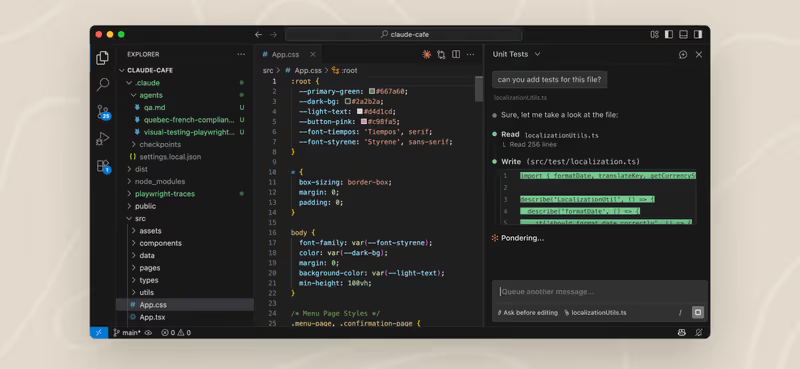
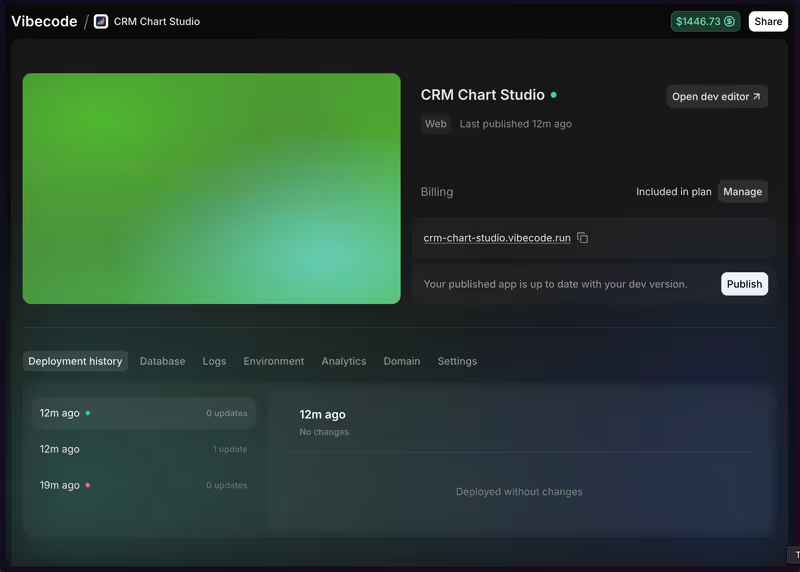
Claude Code vs VibeCode, on screen

www.anthropic.com
Claude Code homepage
www.vibecodeapp.com
VibeCode homepage

This comparison is judged on one concrete job: taking a native or mobile-first prototype and turning it into something you can actually ship, maintain, and keep evolving after the demo glow wears off. Claude Code and VibeCode diverge sharply on that job because one is an agentic CLI working inside your local repository, while the other is a managed prompt-driven builder aimed at producing mobile apps quickly.

That job exposes the failure modes that matter because production is where rough edges stop being cosmetic. You find out whether edits are auditable, whether backend changes are easy to untangle, whether pricing punishes iteration, and whether leaving the platform later means you own a workable codebase or a migration project.


The audience

Who each one is for

Claude Code

  • Working developers who want AI help inside a local repo, terminal, and git workflow.
  • Technical founders refactoring an existing app rather than prompting a greenfield mobile builder.
  • Backend or full-stack engineers comfortable running tests, scripts, and package managers locally.
  • Teams that care more about code ownership and reviewability than guided app-store setup.

VibeCode

  • Mobile MVP teams who want to prompt out iOS or Android apps without local setup.
  • Non-technical founders validating a consumer app idea before hiring native engineers.
  • Product managers who need built-in backend primitives and a guided shipping path.
  • Builders prioritizing speed to prototype over deep control of files, tooling, and architecture.

Claude Code assumes you already live in a development workflow. VibeCode assumes you want a development workflow partially hidden from you.

The scope

What you'd build with it

Claude Code

  • Existing web or backend products that need debugging, refactors, and test-driven cleanup.
  • Developer-owned applications where local scripts, package management, and git history matter.
  • Complex codebases with real infrastructure concerns, not just a presentable front end.
  • Not suited for: a no-setup path to compiling and shipping native mobile binaries.

VibeCode

  • Native mobile MVPs for iOS and Android with a guided prompt-to-app workflow.
  • Consumer-facing prototypes that need screens, auth, and backend scaffolding quickly.
  • Standalone mobile products where store submission readiness matters more than repo purity.
  • Not suited for: large existing engineering codebases that need careful local refactoring discipline.

Who owns the production context

Claude Code handles the core question by working directly against your local project state. The important mechanisms are the shell, the filesystem, your existing test commands, and git itself: the agent can inspect directories, edit files, run checks, and help stage or prepare commits inside the same environment your team already uses. That makes production hardening more legible, because dependency bumps, failing tests, env handling, and code review all happen in the repo that will actually ship.

VibeCode handles the same question by collapsing more of the stack into a managed prompt surface. Its appeal is that native app scaffolding, backend services, and deployment pathways are closer together, so a non-developer can move from idea to installable app faster. The tradeoff is that the production context is mediated by the platform: when complexity rises, debugging depends less on your normal local engineering loop and more on how well the platform exposes exports, SSH access, and recoverable code structure on your plan.

Strengths

Where each one is strong

Even

They are strong in different layers of the same job: Claude Code on engineering control, VibeCode on mobile product acceleration.

Claude Code

  • Local repo control through direct terminal, filesystem, and git-based editing rather than a hosted abstraction.
  • Fits existing developer workflows, including running tests, scripts, and refactors in place.
  • Makes code review and rollback straightforward because changes live in the same repository history.
  • Avoids cloud-IDE indirection when the real task is debugging or hardening a codebase you already own.

VibeCode

  • Mobile-first shipping path aimed at producing native iOS and Android apps quickly from prompts.
  • Includes managed backend primitives such as authentication and database support for MVPs.
  • Offers a transparent credit model where included monthly spend maps to underlying AI usage.
  • Provides export and SSH escape hatches on higher plans for teams that later need more control.

Failure modes

Where each one breaks

Edge: Claude Code

For this job, Claude Code's failures are usually expensive but recoverable, while VibeCode's failures can collide with platform boundaries at the exact moment a prototype gets serious.

Claude Code

  • Token-heavy loops can rack up costs fast when the agent repeatedly rereads files or retries failed fixes.
  • Interactive confirmations can interrupt longer automation chains and slow down multi-step repair work.
  • Context compaction can drop earlier constraints, which matters when architectural rules must stay consistent.
  • Windows or WSL workflows can feel rougher when filesystem latency affects broader codebase operations.

VibeCode

  • Complexity ceiling appears when custom logic or unusual integrations push beyond the builder's comfortable path.
  • Lower-tier lock-in matters because code export and SSH access are not universally available.
  • Large apps can hit context or rewrite problems, leading to bloated or fragile regenerated components.
  • Opaque build or deployment errors are harder to diagnose when the platform abstracts too much of the stack.

Iteration cost

The fix loop, priced

Even

Claude Code is more variable and VibeCode is more predictable, but neither makes repeated AI-driven fixes free.

Claude Code

  • Uses pay-as-you-go API billing tied directly to Anthropic token consumption rather than a flat product subscription.
  • Real-world spend can spike during debugging because repeated file reads and retries compound quickly.
  • A reported worst case is roughly $20 burned in under fifteen minutes during a bad loop.
  • There is no monthly floor, cap rollover, or included bundle; the meter runs only when you use it.

VibeCode

  • Plus starts at $20 per month and includes $20 of AI usage credits at zero markup.
  • Pro is $50 per month and includes $55 of usage credits plus export and SSH-oriented escape hatches.
  • Prompt edits, redesigns, and repair passes all consume credits, so iteration still has a visible meter.
  • Credits are plan-based rather than unlimited, which makes the budget clearer but not immune to fix churn.

Both tools make iteration look cheap until repair work starts. The real bill usually shows up in repeated retries, not the first successful prompt.

Exit paths

The code you end up with

Edge: Claude Code

If you know you want maximum portability and reviewable ownership, Claude Code leaves fewer questions about what is actually yours.

Claude Code

  • Your project stays in a normal local repository under standard git history from the start.
  • There is no separate export ritual because the working copy is already the source of truth.
  • You can move between editors, terminals, CI systems, and hosting choices without product-level lock-in.
  • Portability problems are mostly your own architectural choices, not a platform gating your files.

VibeCode

  • Source export is available, which does create a path out of the platform for technical teams.
  • SSH access on higher plans gives a more direct bridge to conventional engineering workflows.
  • Export and deeper control are gated by plan tier, so portability is conditional rather than default.
  • Backend and deployment assumptions may need manual rewiring after exit from the managed environment.

When neither wins

Neither tool is the answer if your real need is standardizing a mature native engineering team around reproducible local builds, strict CI, deterministic release pipelines, and long-horizon maintainability across multiple contributors; in that case the issue is less "which AI builder" and more whether AI stays subordinate to a conventional repo-first process, while business-app builders should skip both and look at Softr.

Verdict

VibeCode wins when the main job is turning a promising mobile prototype into a shippable native MVP without making a non-technical team assemble Xcode, Android tooling, backend plumbing, and deployment steps by hand. Its strongest advantage is not raw code quality; it is that the product is organized around getting mobile software into a usable release shape quickly.

Claude Code is the better pick when the prototype already belongs inside a developer-owned codebase and the real work is inspection, debugging, refactoring, and controlled hardening before release. If your team expects to review diffs, run its own tests, manage dependencies locally, and keep full control of the production repo, the CLI model fits the job better.

So the split is simple: choose VibeCode for guided mobile acceleration, choose Claude Code for engineering ownership, and if this app is going to become a real long-term product, standardize around a normal repo, normal CI, and normal release discipline rather than treating either tool as the architecture.

Q & A

Frequently Asked Questions

Is Claude Code better than VibeCode for mobile app development?

Not usually. VibeCode is the better fit when the actual job is producing and shipping a native mobile MVP for iOS or Android. Claude Code is stronger when developers need to work inside an existing repository and control every part of the code and release process.

Which costs more: Claude Code or VibeCode?

Claude Code is less predictable because it is pay-as-you-go and can spike during bad debugging loops. VibeCode is easier to budget because its plans start at $20 per month with included usage credits. Which one costs more depends on whether your work is a short guided build or a long fix-heavy engineering cycle.

Can I export my code from VibeCode?

Yes, but the practical answer depends on plan tier. VibeCode offers source export and SSH-style escape hatches on higher plans, which means portability exists but is not the default experience for every user. Claude Code does not have this issue because the code already lives in your local repository.

Which has less lock-in, Claude Code or VibeCode?

Claude Code has less lock-in because it works directly in your own local codebase from the start. VibeCode is more conditional: you can leave, but your ability to do so cleanly depends on export access, plan level, and how much of the app depends on the managed platform.

What should a non-technical team use if they are really building an internal business app, not a consumer mobile app?

Neither of these is ideal for that use case. A non-technical team building internal tools, portals, or CRUD-style business software should look at Softr instead, because it handles auth, permissions, and app structure as platform configuration rather than generated code. That is a better fit than forcing a mobile builder or a CLI coding agent into an operations-software job.