Compare Tools

Base44 vs VibeCode: which one survives a small business web app?

June 16, 2026

Verdict

VibeCode wins if you are specifically targeting native App Store deployment with transparent API costs; Base44 wins if you want a browser-based MVP with less structural complexity. If you are not a developer and this app is for running a real business, look past both.

Base44 logo

Base44

All-in-one conversational app builder with bundled database, auth, and hosting.

VibeCode logo

VibeCode

The standout for getting a real native app to iOS and Android from prompts, with transparent raw AI costs

Base44 vs VibeCode, on screen

base44.com
Base44 homepage
www.vibecodeapp.com
VibeCode homepage

The clearest way to compare Base44 and VibeCode is to judge them on a classic business-shaped job: a small business web app requiring user logins, protected sessions, and per-user data isolation. In this sandbox, the visual design is straightforward - the make-or-break details lie entirely in the invisible plumbing. Users must log in, access only their specific records, and update their profiles without administrative intervention or security oversight.

While both platforms pitch themselves as solutions for rapid app generation, they approach the build from opposite directions. Base44 is a web-first sandbox that attempts to bundle a managed PostgreSQL database, authentication, and hosting into a single conversation. VibeCode is a native mobile-first environment that compiles code for iOS and Android deployment, pricing its platform around transparent, raw API costs. This matchup tests what happens when these different architectures are put to work on a real business utility.


The audience

Who each one is for

Base44

  • Non-technical founders wanting a web-based full-stack MVP without configuring databases or cloud hosting manually.
  • Operations managers looking to stand up simple web utilities or internal tracking tools quickly.
  • Prototypers who prefer a unified, conversational desktop workspace to build and preview web apps.
  • Teams targeting desktop and responsive web users who do not require native app store presence.

VibeCode

  • Mobile developers seeking to draft, scaffold, and test native mobile prototypes using conversational prompts.
  • Creators targeting official distribution on the Apple App Store and Google Play Store from day one.
  • Builders who want to monitor precise, raw LLM token consumption without dealing with arbitrary credit markups.
  • Technical creators who expect to export mobile code and graduate to tools like Cursor or VS Code.

Base44 is aimed at browser-based web builders who want everything managed under one hood. VibeCode is built specifically for mobile creators pushing native packages to app stores.

The scope

What you'd build with it

Base44

  • Relational web-based databases, client portals, and lightweight CRM applications managed through a conversational browser interface.
  • Responsive administrative panels and directories that do not require deep, field-level user group permissions.
  • Simple software-as-a-service MVPs that can comfortably run within shared hosting and LiteLLM limits.
  • Apps meant strictly for web access; Base44 cannot package native files for iOS or Android.

VibeCode

  • Native iOS and Android mobile utilities, lightweight mobile games, and customer-facing phone applications.
  • Mobile-first tools needing direct native device integrations like phone cameras, GPS, or local notifications.
  • Mobile MVPs connected to existing external databases or custom backends via raw API integrations.
  • Complex desktop software; VibeCode's layout engine and deployment flows are highly optimized for mobile screens.

The plumbing question

Base44 attempts to solve the database and hosting puzzle by provisioning an integrated PostgreSQL data layer and pre-wired authentication out of the box. Security boundaries and per-user data isolation are created by prompting the AI to write database queries and route logic behind the scenes. However, because Base44 relies entirely on a conversational instruction layer to enforce these database relationships, non-technical builders face a silent vulnerability risk. If the AI generates broad, unverified queries, a malicious user can intercept client-side network requests to bypass authentication layers or query records belonging to other users.

In contrast, VibeCode operates as a native mobile compiler with its own integrated backend service (VibeCode Cloud) or direct external API attachments. Since VibeCode is designed to generate raw code that will eventually compile into native Swift or Kotlin libraries, the security rules must be hardcoded directly into the application state or backend middleware. This native architecture prevents common web-based exploits but requires the builder to understand how native mobile authentication sessions behave. If the AI model loses context during an update, it can easily write invalid callback hooks or break the login loop, halting the app's startup process entirely.

Strengths

Where each one is strong

Edge: Base44

Base44 holds the edge for this specific job because web-first business interfaces are significantly faster to deploy than App Store packages.

Base44

  • Zero-setup database and auth integration that configures a managed PostgreSQL database and live hosting in one pass.
  • Conversational builder interface paired with a visual, post-generation editor for click-to-tweak layout edits.
  • Direct export of frontend source code to GitHub to preserve an escape hatch.
  • Generous free plan containing built-in analytics, user sessions, and core database management tools.

VibeCode

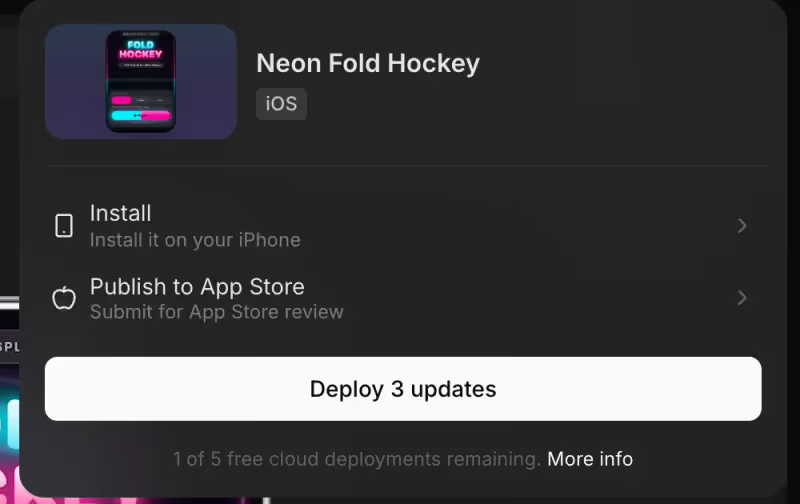
  • True native mobile compilation optimized for deploying iOS and Android apps directly to official app stores.
  • Transparent credit system translating subscription payments directly into raw LLM API usage with no markups.
  • Developer-friendly options including full code exports and direct SSH access to Cursor on higher plans.
  • Pre-built integrations to fetch live, external data from custom search, weather, or custom AI endpoints.

Failure modes

Where each one breaks

Edge: VibeCode

VibeCode's failures cost token credits but rarely break production databases; Base44's regression loops can render active databases unusable.

Base44

  • Regression loops and destructive updates: users report the builder re-breaking working features and rendering apps unusable during minor edits.
  • Restricted backend architecture that keeps database schemas and backend logic locked inside Base44's closed infrastructure.
  • Dual-credit model that charges users both for conversational modifications and live in-app API/database requests.
  • Inherent stability limits on larger files due to LiteLLM connections, causing performance delays on heavy scripts.

VibeCode

  • Complexity ceiling failures: the AI frequently struggles with complex data validation and custom session wrappers, causing silent bugs.
  • Context window drop-off on large multi-page mobile portfolios, leading the AI to duplicate or rewrite working components.
  • Severe platform lock-in on base plans where source code export and SSH connections are gated behind high-tier plans.
  • Mobile-only layout limits that make the generated designs look awkward or completely unreadable on desktop monitors.

Iteration cost

The fix loop, priced

Edge: VibeCode

VibeCode's transparent pricing translates directly to raw AI model costs with no markups, preventing hidden inflation charges.

Base44

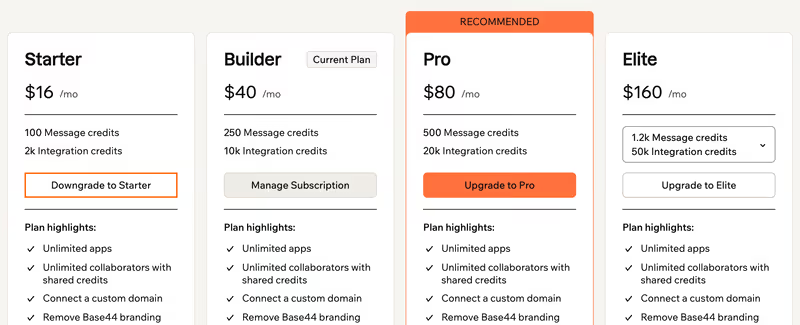
  • Starter plan costs $20/month billed monthly, offering only 100 conversational messages and 2,000 integration triggers.
  • Each corrective prompt to fix an interface bug consumes message credits, forcing users onto the $50/month Builder tier.
  • Documented case: users burning more than 400 credits chasing design regressions without successfully restoring basic functionality.
  • Integration credits do not roll over, creating unpredictable monthly operating costs as real users interact with the database.

VibeCode

  • Plus tier starts at $20/month, providing $20 of included credits for direct, raw API model usage.
  • Edits are billed at direct provider rates, but complex multi-file corrections can burn tokens rapidly during a fix loop.
  • Documented worst case: running completely out of credits trying to resolve a single compilation error, locking development.
  • Unused testing credits roll over up to two months, provided the account's monthly subscription remains active.

Both environments charge you to correct the AI's own mistakes. For an application with logins and per-user rules, you will likely pay a steep premium inside the fix loop tax before shipping.

Exit paths

The code you end up with

Edge: VibeCode

VibeCode provides clean, native-standard mobile repositories you can immediately take to external IDEs.

Base44

  • Frontend designs export cleanly to GitHub, giving you portable React pages to reuse.
  • The relational database and server-side configurations cannot be migrated out of their host environment.
  • Users report that extracting code off Base44 can require paying a full year of higher subscriptions upfront.
  • The proprietary hosting setup guarantees that your business remains deeply locked into their platform.

VibeCode

  • Provides a standard, native mobile repository with zero proprietary framework packages.
  • Code can be downloaded completely or modified using an SSH link to Cursor on Pro and Max plans.
  • You can run, compile, and host your app anywhere once you decide to leave the compiler.
  • Managing mobile keys, push certificates, and compilation environments remains your technical responsibility.

When neither wins

Here is the reality of building a per-user business system with generative code: when you prompt an AI to code your logins, session cookies, and database filters, you are relying silently on the model's security training. A tiny omission in a database query can expose customer profiles or leak confidential records across different user accounts. If you are not a developer capable of auditing every line of React or SQL generated behind the scenes, you have just accepted the role of security officer for a codebase you cannot read.

For a small business app where data integrity and user grouping are critical, the logical choice is past both tools. Softr treats user authentication, secure portals, and record visibility as stable, built-in system settings rather than custom-coded variables. Because there is no raw code being generated, there is no technical debt, no risk of SQL injections, and zero chance of a prompt breaking your session checks. It is the wrong choice if you want to deploy a mobile game to the App Store, but it is built specifically for data-driven operational tools.

Verdict

Base44 wins this matchup if you need to quickly scaffold, test, and host a simple web portal without setting up an external database. If your app will live primarily in desktop browsers, its managed PostgreSQL and unified conversation mode get you off the ground far faster than configuring mobile emulator dependencies. Just be prepared to handle design regression loops and plan around their dual-credit limits.

Choose VibeCode only if your small business app actually needs to be a native mobile utility distributed through the Apple and Google Play stores. Its transparent AI pricing and direct SSH access to IDEs like Cursor make it the superior environment for technical builders who need real mobile hardware access, while bypassing the visual limits of web builders.

However, if the job is a straightforward internal workflow, CRM, or client coordination app built for security and stability, bypass the code gen trap entirely. Relying on prompts to secure business databases is a high-risk gamble. Using a no-code infrastructure like Softr makes data protection a default system setting, keeping your business safe without paying for ongoing code maintenance.

Q & A

Frequently Asked Questions

Is VibeCode better than Base44 for desktop web applications?

No. VibeCode is heavily optimized for compiling native iOS and Android packages, meaning its interface and layout choices do not scale cleanly to desktop screens. Base44 is built primarily for web apps and browser layouts.

Can I export my database and self-host my app from Base44?

While Base44 allows you to export your frontend design to GitHub, the relational PostgreSQL database and backend functions are locked into their managed cloud infrastructure, preventing a clean, independent exit.

How does VibeCode's pricing model compare to Base44's?

VibeCode uses a highly transparent system where your monthly subscription is converted directly into raw LLM API developer costs with no markups. Base44 uses a dual credit system where you are charged both for conversational messages and in-app database queries, which can make scaling costs unpredictable.

What is the best alternative for building secure, logins-gated business portals?

Softr is the standard alternative when you want to avoid the risks of AI code bugs. It handles user logins, access groups, and relational database permissions visually via native configurations, removing the need for a developer fix loop entirely.