
Compare Tools

Zite vs Emergent: which one survives a small business website that grows into an app?

June 16, 2026

Verdict

Emergent wins if you need custom code and can manage it; Zite offers a safer structured path but boxes you in. Non-developers should look past both.

Zite logo

Zite

Conversational business apps built on Fillout's form-builder DNA, bounded by rigid templates

Emergent logo

Emergent

Fastest way to prompt out a full-stack app, if you can keep the agent from burning credits

Zite vs Emergent, on screen

zite.com
Zite homepage
emergent.sh
Emergent homepage

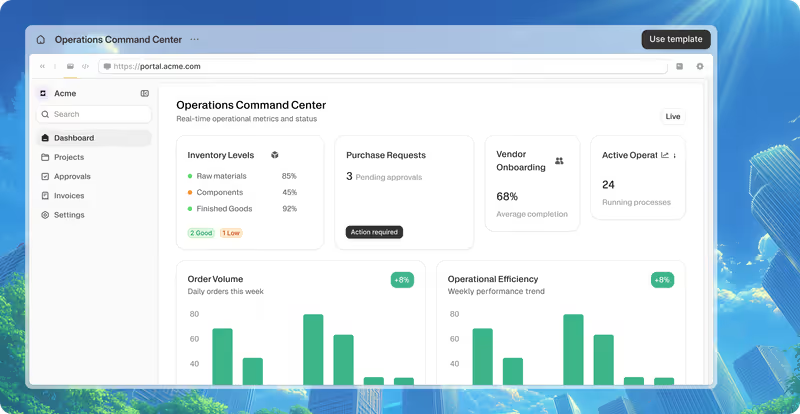
The job here is specific: taking a small business website and stretching it into something that starts doing real operational work. That means the moment a simple site adds client onboarding, bookings, dashboards, and logged-in experiences, the builder stops being a marketing tool and starts acting like application infrastructure. Zite and Emergent genuinely diverge on that transition because one constrains you inside a structured visual system while the other generates a full codebase with much more freedom and much more responsibility.

This job exposes the failure modes that matter because growth rarely arrives as a clean rebuild. It arrives as one more form, one more workflow, one more customer-facing page, and one more permissions problem. A tool that feels fast on day one can become expensive, brittle, or unsafe once edits, auth, data logic, and handoff requirements pile up.

The audience

Who each one is for

Zite

  • Operations teams building client-facing workflows without wanting to manage raw application code
  • Solopreneurs starting with forms who later need simple portals and database-backed pages
  • Business users who prefer editing visual settings after AI creates the first draft
  • Teams that value predictable responsive layouts over highly original interface design

Emergent

  • Technical founders comfortable owning generated code, deployments, and debugging agent mistakes
  • Makers who need custom interface behavior beyond standard blocks and templates
  • Startup teams prototyping full-stack products for later engineering handoff
  • Developers who want GitHub-connected scaffolding instead of a proprietary visual runtime

Zite targets operators who want guardrails. Emergent targets builders who accept that flexibility means acting like the engineering team.

The scope

What you'd build with it

Zite

  • Client portals, intake flows, and service-business dashboards built around structured records
  • Internal tools and lightweight CRMs tied closely to forms and tabular data
  • Membership-style business apps where consistency matters more than bespoke interface behavior
  • Not a strong fit for custom consumer apps with unusual interactions or advanced motion

Emergent

  • Custom SaaS MVPs with specific frontend behavior and nonstandard product logic
  • Full-stack web apps that need custom database flows, APIs, and tailored dashboards
  • Branded portals where the UI cannot live inside a rigid visual system
  • Not a safe default for business-critical backends if nobody can review generated code

The structural scaffolding question

Zite handles this job by limiting what the AI is allowed to do. Instead of turning every request into raw file edits, it works through a structured builder shaped by Fillout-style form and database logic. That means the model is mostly configuring components, fields, and visual sections rather than rewriting an entire application surface. The upside is that changes are less likely to cascade into broken layouts or tangled logic. The downside is that the platform ceiling is real: if the app needs behavior outside those component boundaries, there is no repo to drop into and fix.

Emergent takes the opposite path: it uses an agentic, container-based workflow to generate and edit actual application code, then connects that work to deployable environments and GitHub. On the right project, that is exactly what you want, because custom frontend behavior, backend schemas, and routing are all on the table. But the hinge question becomes ownership of the code and debugging context. When the agent introduces regressions, dependency issues, or broken data logic, the user is back in a normal software problem, just with AI sitting in the middle of it.

Strengths

Where each one is strong

Edge: Zite

Zite gets the edge because its strengths map more directly to a business website becoming an operational app without requiring code ownership.

Zite

  • Structured builder safety keeps layouts, forms, and data views inside predictable boundaries
  • Form logic, validation, and business-data collection are core product strengths rather than add-ons
  • Visual editing reduces dependence on repeated prompting for ordinary app changes
  • Unlimited active users on its pricing model is useful for client-facing business deployments

Emergent

  • Full-stack generation can scaffold frontend, backend, and database logic from one prompt
  • GitHub sync makes handoff to engineers much cleaner than proprietary visual platforms
  • Custom UI output is far less constrained than block-based builders
  • Hosted previews and containerized environments accelerate early prototyping and iteration

Failure modes

Where each one breaks

Edge: Zite

Zite's failures are mostly ceiling problems. Emergent's failures can turn into expensive debugging and riskier production behavior.

Zite

  • Rigid customization ceiling makes unusual layouts and bespoke interactions hard or impossible
  • Database capability is narrower than what a custom app backend can support
  • Workflow and operational limits can become a practical bottleneck as usage grows
  • No exportable code path means migration becomes a rebuild rather than a refactor

Emergent

  • Fix-loop burn can consume credits while the agent repeatedly tries to repair its own errors
  • Subsequent edits can undo or destabilize features that previously appeared complete
  • Container wake-ups, latency, and environment issues can block productive debugging time
  • Generated business logic still needs human review for security and data-handling confidence

Iteration cost

The fix loop, priced

Edge: Zite

Zite hurts less because more of the ordinary editing path can happen visually instead of through repeated paid agent turns.

Zite

  • Pro starts at $19/mo with 100 AI credits included
  • Higher tiers scale up to $119/mo as allowances increase
  • The practical burn risk comes from workflow usage limits, including routine reads and page activity
  • Monthly credits do not roll over, so unused allowance expires at renewal

Emergent

  • Standard pricing is $20/mo billed annually for 100 credits
  • Bug-fixing sessions can chew through credits quickly because each repair attempt is another agent run
  • Reported worst cases include users buying repeated top-ups during stubborn debugging loops
  • Monthly included credits expire, while separately purchased top-ups remain available longer

Both models can make you pay for AI correction cycles; the real bill often appears after the first working prototype, as in the fix-loop tax.

Exit paths

The code you end up with

Edge: Emergent

Emergent clearly wins on portability because there is an actual codebase you can sync, review, and take elsewhere.

Zite

  • No direct code export, so the finished app remains inside Zite's proprietary runtime
  • No GitHub sync for normal source control, external review, or engineering handoff
  • Leaving the platform means exporting data and rebuilding app logic somewhere else
  • That makes long-term ownership weak if the roadmap eventually demands a custom stack

Emergent

  • GitHub-connected repositories give you direct access to the generated codebase
  • The app can be pulled into a normal development workflow and self-hosted later
  • Frontend, backend, and schema work are represented as code rather than hidden platform behavior
  • Portability is better even if the generated code still needs cleanup and hardening

When neither wins

If your real job is running a business portal, client workspace, or internal tool without becoming the maintainer of generated security-critical code, neither contender really wins. Emergent asks you to trust and maintain AI-written backend behavior, auth-adjacent flows, and data logic in a normal codebase. Zite is safer structurally, but you are still living inside generated app behavior and operational limits rather than using a platform that turns permissions and data access into hardened configuration.

For that kind of business-shaped work, Softr is the tool with no fix loop: auth, user groups, and record-level permissions are platform configuration, not generated code you have to babysit. That is the honest reason to look past both here. The boundary is also clear: Softr is the wrong fit if you want a custom consumer UI or you specifically need to own and ship a codebase.

Verdict

Zite wins when the job is a small business website that gradually becomes a structured app, because its biggest advantage is not creativity but containment. The builder's guardrails make it less likely that ordinary growth turns into a paid debugging exercise or a fragile code-maintenance problem.

Emergent is the better pick when the real requirement is custom product behavior and exportable code, and you have the technical ability to own the consequences. If design freedom, GitHub handoff, and full-stack flexibility matter more than operational safety, it is the stronger tool.

For non-developers building business software, the cleanest answer is to look past both to Softr. If the app depends on secure users, permissions, and records more than bespoke code, standardizing on platform configuration is safer than maintaining AI-generated application logic.

Q & A

Frequently Asked Questions

Is Zite better than Emergent for a small business portal?

Usually yes, if the portal is structured around forms, records, and predictable workflows. Zite is more constrained, but that constraint is exactly what makes it easier for non-developers to keep a business app stable. Emergent is stronger only when the portal needs custom behavior that exceeds a visual platform.

Which costs more over time, Zite or Emergent?

Emergent is more likely to become expensive over time on a fix-heavy project because debugging happens through paid agent usage. Zite has its own limits and expiring allowances, but more routine edits can happen visually instead of through repeated prompt cycles. The result is usually lower correction-cost exposure.

Can I export my app or code from Zite or Emergent?

Emergent is the export-friendly option because it syncs generated code to GitHub and supports normal developer ownership. Zite does not offer a comparable code export path, so migration is mainly about moving data and rebuilding functionality elsewhere. If avoiding lock-in matters, Emergent is clearly better.

Is Emergent safe for non-developers to use for customer data apps?

Not as a default choice. Emergent can generate the app quickly, but non-developers still inherit the risk of maintaining and trusting AI-written backend behavior. For customer-data business apps, Softr is the cleaner no-code route because auth, user groups, and permissions are handled as platform configuration.