
Compare Tools

Bolt vs Emergent: which one survives a working MVP under a hard deadline?

June 16, 2026

Verdict

Bolt wins if you need a standard codebase you can inspect and rescue manually; Emergent wins if you want maximum agent autonomy and can tolerate expensive iteration. For business apps with real users, the safer answer is often neither.

Bolt logo

Bolt

In-browser AI dev environment that scaffolds and runs full-stack apps.

Emergent logo

Emergent

Fastest way to prompt out a full-stack app, if you can keep the agent from burning credits

Bolt vs Emergent, on screen

bolt.new
Bolt homepage
emergent.sh
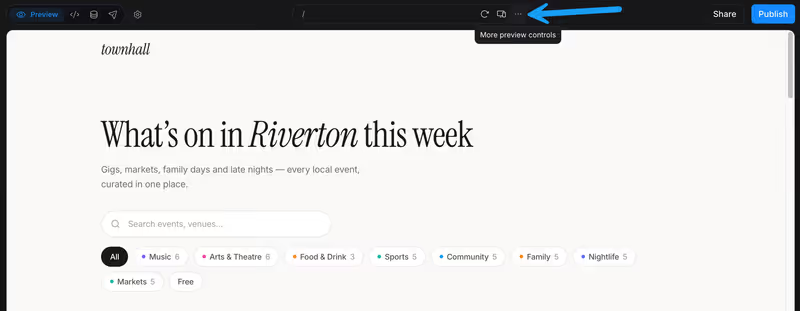
Emergent homepage

The useful way to judge Bolt and Emergent is on one concrete job: getting a working MVP live under a hard deadline. That job forces a real split between them. Bolt is fundamentally a browser-based coding environment with AI inside it, while Emergent leans harder into an autonomous agent that tries to assemble and revise the stack for you.

A deadline exposes the failure modes that actually matter. Fast first drafts are easy to market; what matters is what happens on revision five, bug three, or the moment auth, data, and deployment stop being clean demos. If the tool burns time with regressions, credit drain, or code you cannot confidently unwind, the MVP was never really close to done.

The audience

Who each one is for

Bolt

  • Technical founders who want AI speed but still expect to inspect files directly.
  • Developers comfortable fixing prompts by hand in code, terminal, and package config.
  • Teams that value GitHub sync and a standard frontend codebase over full autonomy.
  • Builders who treat AI as scaffolding, not as the sole owner of implementation.

Emergent

  • Non-technical operators who prefer steering through chat instead of editing source files.
  • Founders wanting the agent to scaffold backend, database, and hosting in one flow.
  • Prototypers optimizing for hands-off momentum more than code clarity or predictability.
  • Teams with budget room for volatile credit consumption during repeated agent repair loops.

Bolt assumes the user will eventually touch the code. Emergent is aimed at people trying not to.

The scope

What you'd build with it

Bolt

  • React and Vite web apps that need a fast browser IDE and editable generated code.
  • Internal SaaS prototypes or dashboards that can rely on external services like Supabase.
  • Frontend-heavy MVPs where shipping the interface quickly matters more than backend abstraction.
  • Not the right tool for native mobile binaries or teams avoiding code ownership entirely.

Emergent

  • Full-stack web MVPs with backend routes, database setup, and hosted environments.
  • Conversationally assembled prototypes where one agent is expected to wire most layers together.
  • Experiments that benefit from autonomous retries on setup, deployment, and structural revisions.
  • A weak fit when you need tight manual control over growing repo complexity.

Who owns the context window

Bolt's core advantage is that it sits on top of a real browser-native development environment powered by WebContainers. That means the project is not just a chat transcript; it is an actual file tree with terminal access, package installs, previews, and export paths. The upside for deadline work is recoverability: when the model drifts, a technical user can intervene directly. The downside is that Bolt still inherits model and environment limits, including large-project strain, memory pressure, and the point where AI help degrades faster than the codebase grows.

Emergent pushes further into agentic execution. Instead of giving you a strong editing surface first, it emphasizes an autonomous edit loop that can scaffold backend logic, data structure, and hosting steps with less manual setup. That helps at the start, but the hinge question is whether the agent preserves intent across iterations. On fix-heavy MVP work, that is where autonomous systems get expensive: if the agent overwrites working structure, loops on the same defect, or consumes credits while repairing its own changes, you have less visibility into both the code state and the cost state at the exact moment the deadline tightens.

Strengths

Where each one is strong

Edge: Bolt

Bolt gets the edge because standard code and direct intervention matter more than extra autonomy when the MVP must actually survive revision.

Bolt

  • Standard code output with React and Vite that can be opened outside the platform.
  • Browser-based WebContainers provide terminal access, previews, and zero local environment setup.
  • GitHub sync creates a cleaner handoff into normal developer workflows and version control.
  • Well suited to builders who need AI acceleration without giving up file-level visibility.

Emergent

  • Agent-driven full-stack assembly can scaffold more of the backend path in one conversational flow.
  • More appealing to non-developers who want the system to decide structural implementation details.
  • Can automate setup tasks that would otherwise require manual backend and hosting configuration.
  • Useful for quickly testing broad product concepts before worrying about code neatness.

Failure modes

Where each one breaks

Edge: Bolt

Bolt's failures are usually easier to contain because you can exit into the code, while Emergent's failures can keep charging while undoing progress.

Bolt

  • Large-project limits can reduce AI usefulness once the app grows beyond comfortable context.
  • Generated changes may overwrite working UI or logic during later revisions.
  • Browser-container memory or runtime issues can interrupt builds on heavier projects.
  • Token use can become hard to predict during repeated debugging and redesign passes.

Emergent

  • Agent regression loops can undo previously working features during small requested fixes.
  • Credit burn is especially painful when the platform is repairing environment-induced problems.
  • As repo complexity rises, structural consistency and dependency stability can deteriorate.
  • The hands-off model gives you less immediate visibility into why a bad change happened.

Iteration cost

The fix loop, priced

Edge: Bolt

Bolt hurts less because at least some debugging can move into manual edits instead of staying inside a paid agent loop.

Bolt

  • Pro starts at $25/month for 10 million tokens, with higher paid tiers above that.
  • Real-world burn rises when the model rewrites broad sections instead of making narrow diffs.
  • Worst case is draining quota on a stubborn bug loop and losing productive AI help mid-build.
  • Unused credits can roll over for a limited period, which softens occasional underuse.

Emergent

  • Standard is $20/month billed annually for 100 credits, while Pro is $200/month for 750 credits.
  • Even small requested edits can trigger the expensive edit-agent pathway rather than a cheap patch.
  • Worst case is a runaway revision cycle that consumes large amounts of paid credits on regressions.
  • Top-up credits cost extra, so overruns are not just theoretical on fix-heavy projects.

Both models punish indecision, but the bigger bill often comes from asking AI to repair AI. See the fix loop tax.

Exit paths

The code you end up with

Edge: Bolt

Bolt leaves you with a more portable exit because its value is closer to accelerated coding than managed enclosure.

Bolt

  • Exports standard frontend project structures that developers can continue in a normal IDE.
  • GitHub integration makes backup, transfer, and team review much more straightforward.
  • Lock-in is lower because the app is not primarily useful only inside Bolt's runtime.
  • You still own the cleanup work, especially for backend wiring and generated rough edges.

Emergent

  • Can produce a broader full-stack structure with more platform-managed setup baked into the process.
  • Export exists, but portability is less comforting if the resulting project is structurally tangled.
  • Backend and hosting decisions may be harder for non-developers to unwind after export.
  • The practical lock-in is not format alone but dependence on the agent to keep the project coherent.

When neither wins

For a business-shaped MVP, both tools have the same underlying problem: they leave you maintaining generated, security-critical application code. If the app needs auth, user roles, record access, client data separation, or operational reliability, you are still responsible for checking what the model produced and living with the fix loop when requirements change.

That is why some non-developers should skip both and start with Softr, the tool with no fix loop: auth, user groups, and record-level permissions are platform configuration rather than generated code. The honest boundary is that Softr is the wrong fit if you need a custom consumer UI or you specifically want to own and extend a codebase.

Verdict

Bolt wins when the real job is shipping a working MVP under a hard deadline and you need the best chance of recovering from AI mistakes. Its strongest advantage is not that it generates perfect code; it is that the output lives in a more standard, developer-legible environment that you can inspect, export, and manually fix.

Emergent is the better pick only when hands-off full-stack scaffolding is more valuable to you than code clarity, and when you can absorb the cost of an autonomous agent that may revise aggressively. If your team is non-technical, highly speed-biased, and comfortable treating iteration spend as part of discovery, that trade can still make sense.

For business apps with real users, the audience split goes one step further: technical teams can choose Bolt, but non-developers should usually look past both to Softr. The reason is simple: configuration of permissions and data access is safer than maintaining generated app logic for those layers.

Q & A

Frequently Asked Questions

Is Bolt better than Emergent for launching an MVP fast?

Usually yes, if someone on the team can read and fix code. Bolt is easier to recover inside because it behaves more like a real coding environment with exportable project files. Emergent can feel faster at first if you want a more autonomous agent to scaffold the whole stack.

Which costs more to iterate on, Bolt or Emergent?

Emergent is usually riskier on cost because agent-driven revisions can consume credits quickly during debugging loops. Bolt also gets expensive under repeated prompting, but its pricing pain is easier to interrupt if you switch to manual edits. The difference is less about sticker price and more about what happens when the build starts fighting back.

Can I export my code from Bolt and Emergent?

Yes, both offer export paths, including GitHub-oriented workflows. Bolt's export is generally more reassuring because the project structure is closer to a conventional frontend codebase. Emergent may export more stack in one go, but portability matters less if the output is harder to understand or maintain.

Which has less lock-in, Bolt or Emergent?

Bolt has less practical lock-in for most teams. Its generated code is more aligned with standard developer workflows, so leaving the platform is simpler. Emergent may not trap you by file format, but it can create dependence through agent-managed complexity.

What should a non-technical founder use instead of Bolt or Emergent for a business app?

If the app is an internal tool, client portal, or operational dashboard, Softr is often the safer route. It handles auth, permissions, and record-level access as platform configuration instead of generated code. That avoids the ongoing burden of debugging and securing AI-written app logic.