Compare Tools

Claude Code vs Emergent: which one takes a prototype to a real product?

June 16, 2026

Verdict

Claude Code wins if you can own and refactor a real codebase; Emergent wins if you need the fastest full-stack prototype; for business portals and internal tools, non-developers should skip both and use Softr.

Claude Code logo

Claude Code

Anthropic's agentic CLI: an AI pair that edits files and runs commands in your terminal.

Emergent logo

Emergent

Fastest way to prompt out a full-stack app, if you can keep the agent from burning credits

Claude Code vs Emergent, on screen

www.anthropic.com
Claude Code homepage
emergent.sh
Emergent homepage

Turning a prototype into a real product is less about generating screens and more about surviving the messy middle: schema changes, auth edge cases, regressions, deployment drift, and repeated fixes. Claude Code and Emergent genuinely diverge on that job because one assumes you will own a local repository in the terminal, while the other assumes you want a browser-hosted agent to scaffold and revise the whole app from prompts.

That makes this comparison useful because the failure modes show up fast once an app stops being a demo. If a tool is expensive to debug, weak at preserving structure, or awkward to exit once the codebase matters, those problems become the product risk, not just the tooling inconvenience.


The audience

Who each one is for

Claude Code

  • Technical founders who want an AI agent inside their terminal and git workflow
  • Engineers maintaining existing repositories who need help tracing bugs and refactoring safely
  • Teams comfortable with local environments, package managers, and command-line test runs
  • Developers who care more about code ownership than one-click hosted convenience

Emergent

  • Non-technical builders who want a working full-stack web app from prompts
  • Product managers validating an MVP before hiring developers or setting up infrastructure
  • Founders without a local development environment who still need auth and deployment
  • Makers optimizing for launch speed over deep control of the repository

Claude Code is for people who already think in repos and terminals. Emergent is for people trying to postpone that moment.

The scope

What you'd build with it

Claude Code

  • Production web apps that need iterative refactors, test runs, and deliberate code review
  • Existing SaaS codebases where an agent can inspect files, trace errors, and patch logic
  • Backend services, scripts, and internal tools wired into your own infrastructure choices
  • Not a direct fit for one-prompt hosted app generation when you lack developer oversight

Emergent

  • Full-stack web app MVPs with standard CRUD flows, auth, and database-backed screens
  • Early SaaS prototypes that need UI, backend routes, and deployment in one interface
  • Dashboards and internal-style apps with conventional forms, tables, and user accounts
  • Not the right tool for complex offline-first software or highly customized local processing

Who owns the context window

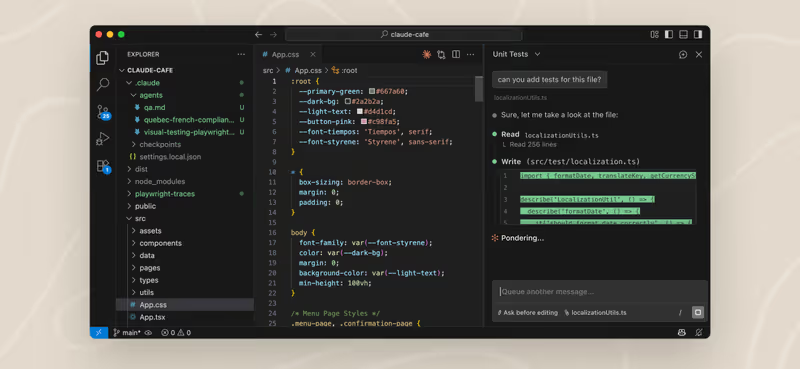
Claude Code handles the core question by living inside your local filesystem and repository, not behind a hosted app builder. It can inspect the actual directory tree, run shell commands, execute tests, and work through git-friendly edits in place. That makes the context less theatrical: the agent sees the same files, lint output, and command results you do. The tradeoff is that you inherit the full burden of architecture, review, and rollback, so bad edits are recoverable but still your responsibility.

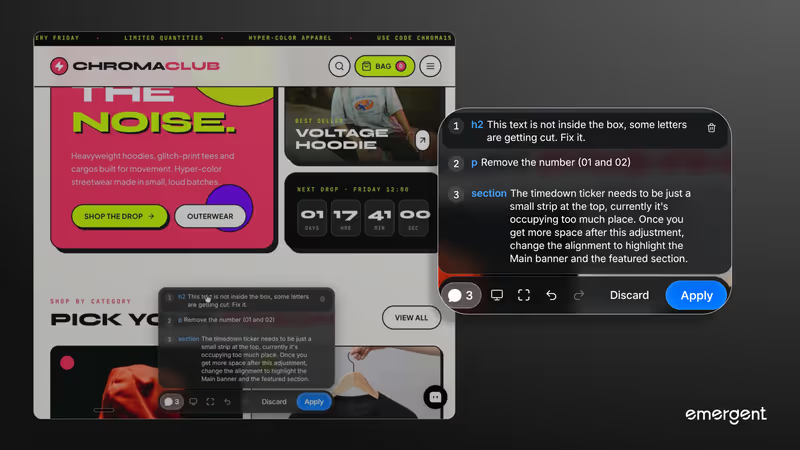
Emergent handles the same question through a cloud-hosted, chat-centric build loop where its agent rewrites app code and environment state from prompts. That is powerful for getting a database-backed app online quickly, but it creates a context-management problem once the project grows: UI tweaks, backend changes, and deployment assumptions are mediated through the platform's agentic layer. On larger or more fragile builds, the practical risk is not just a wrong answer but a costly rewrite loop where the platform keeps trying to repair code it generated earlier.

Strengths

Where each one is strong

Edge: Claude Code

Claude Code has the stronger ceiling for real product work because it operates directly on the repo you must eventually maintain.

Claude Code

  • Local repo control means edits happen in your own files, with standard git workflows available
  • Can run terminal commands, tests, and linters against the actual environment you ship
  • Fits existing repositories instead of forcing the project into a hosted builder abstraction
  • Leaves you with standard code that can keep evolving in any normal developer toolchain

Emergent

  • Prompt-to-product speed is excellent for generating a full-stack MVP without local setup
  • Combines UI, backend, database, and deployment in one browser-based workflow
  • Lets non-developers iterate conversationally instead of managing package and infra details
  • Reduces the time between idea and clickable app compared with starting from an empty repo

Failure modes

Where each one breaks

Edge: Claude Code

Claude Code's failures are usually visible in your repo and terminal; Emergent's failures can be more expensive because they compound through hosted agent loops.

Claude Code

  • Token-heavy sessions can get expensive when the agent repeatedly scans or revisits large code areas
  • Requires a functioning local setup, so environment issues become part of the workflow
  • Bad agent edits still need manual review, diff inspection, and sometimes explicit rollback
  • Terminal confirmations and safety friction can slow down repetitive fix cycles

Emergent

  • Regression loops can burn credits while the agent repeatedly rewrites nearby working features
  • Hosted environments and containers can become part of the debugging problem themselves
  • As the app grows, keeping UI, backend, and deployment behavior aligned gets harder
  • You can end up paying to debug the platform's generated complexity rather than your product logic

Iteration cost

The fix loop, priced

Even

Both models can become painful on fix-heavy projects because each charges for iteration in a different but equally compounding way.

Claude Code

  • Pay-as-you-go usage means cost rises directly with prompts, context, and command-heavy sessions
  • Real burn rate is unpredictable because larger repos and repeated retries increase token use
  • Worst case is an expensive debugging spiral where the agent keeps revisiting the same files
  • Structural reality: no subscription lock is required, but budget control depends on your own caps

Emergent

  • Base plan is commonly framed around monthly credits rather than unlimited iterative use
  • Real burn rate can spike when a small requested change triggers a broad agent rewrite
  • Worst case is a credit-draining loop where deployment or edit failures consume paid attempts
  • Structural reality: credits are the bottleneck, so failed iterations feel like double-paying

Both tools make iteration the billable event. The expensive part is rarely prompt one.

Exit paths

The code you end up with

Edge: Claude Code

Claude Code leaves you in better shape because the project already lives in your own environment and workflow.

Claude Code

  • Writes to standard local files you already control rather than a proprietary hosted workspace
  • Works naturally with git, IDEs, and the rest of a normal engineering handoff process
  • No platform-specific hosting layer is required to keep editing the code after generation
  • Lock-in is minimal because stopping use of the tool does not strand the codebase

Emergent

  • Can produce exportable app code, which is better than pure no-export builders
  • The practical workflow still depends on the hosted generation environment during active iteration
  • Portability is weaker when the app's behavior has been shaped by platform-managed build assumptions
  • Lock-in risk shows up less in raw code access than in the cost of leaving mid-debug cycle

When neither wins

If the real job is a business app such as a client portal, internal tool, or CRM, neither Claude Code nor Emergent fully solves the hard part. Both leave you maintaining generated, security-critical code for auth, roles, data access, and edge-case behavior, which means the burden shifts from building screens to auditing code you did not design line by line.

That is why non-developers should look at Softr, the tool with no fix loop: auth, user groups, and record-level permissions are platform configuration, not generated code you must keep repairing. The honest boundary is that Softr is the wrong fit if you need a custom consumer UI or you explicitly want to own and extend the raw codebase.

Verdict

Claude Code is the winner when the prototype is becoming a real product and you have the technical ability to own that transition. Its biggest advantage is not prettier generation but better control: the agent works in your local repo, can operate through normal terminal workflows, and leaves you with a codebase you can review, test, refactor, and keep after the AI step is over.

Emergent is the right pick when the immediate goal is speed to a working full-stack prototype and the builder is not ready to live in a terminal. It compresses setup, scaffolding, hosting, and iteration into a friendlier interface, which is exactly why it is useful early. The catch is that the same abstraction that helps at day one can become expensive and brittle once the app needs disciplined maintenance.

So the audience split is simple: developers building toward a standardized, maintainable codebase should choose Claude Code, while non-developers building business software should skip the generated-code maintenance trap and use Softr instead.

Q & A

Frequently Asked Questions

Is Claude Code better than Emergent for turning a prototype into a production app?

Claude Code is better when a developer needs to own, refactor, test, and maintain the resulting codebase over time. Emergent is better for getting the first full-stack version online quickly, especially for non-technical builders. The choice depends on whether long-term code ownership matters more than initial speed.

Which costs more for a fix-heavy build, Claude Code or Emergent?

Either can become expensive once the project enters repetitive debugging and revision loops. Claude Code makes the cost show up through usage-based AI consumption, while Emergent makes it show up through credit burn during agent-led iterations. In both cases, the painful bill usually arrives after the prototype phase.

Can I export my code and avoid lock-in with Emergent or Claude Code?

Claude Code has the cleaner answer because it works directly on your local files from the start, so there is very little practical lock-in. Emergent is better than closed builders that offer no code access, but the workflow still depends more on the hosted platform during active development. Portability exists in both, but ownership is stronger with Claude Code.

Is Emergent better than Claude Code for non-developers?

Yes, for the initial build phase it usually is. Emergent is designed to scaffold and host a full-stack app from prompts without requiring terminal fluency or local environment setup. Claude Code assumes the user can manage a repo, review diffs, and work through developer tooling.

What should I use instead of Claude Code or Emergent for a business portal?

If the product is a client portal, internal tool, or CRM-style app and you do not want to maintain generated security code, Softr is the cleaner option. It handles authentication, user groups, and permissions as platform features rather than generated code. That makes it a better no-code route for business apps, but not for custom consumer UI or teams that need full code ownership.