
Compare Tools

Claude Code vs Zite: which one survives taking a prototype to a real product?

June 16, 2026

Verdict

Claude Code wins if you need a real codebase you can own and extend; Zite wins if you need a fast visual business app and can live inside its limits. For security-heavy business software, the better answer is often past both tools.

Claude Code logo

Claude Code

Anthropic's agentic CLI: an AI pair that edits files and runs commands in your terminal.

Zite logo

Zite

Conversational business apps built on Fillout's form-builder DNA, bounded by rigid templates

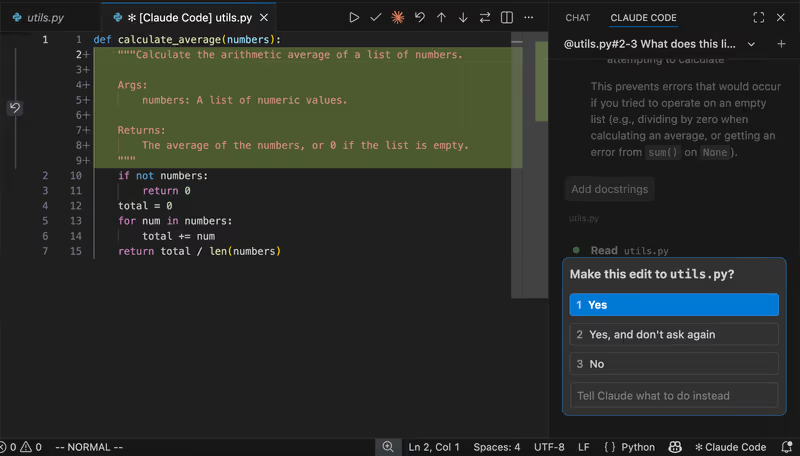
Claude Code vs Zite, on screen

www.anthropic.com
Claude Code homepage
zite.com
Zite homepage

Taking a vibe-coded prototype and turning it into a real product is a specific job: the app has to survive change. That means new requirements, bug fixes, permissions, deployment choices, and the inevitable moment when the first clever demo logic is no longer enough. Claude Code and Zite diverge sharply here because one is an agent working in a real local repository, while the other is a hosted visual app builder that generates inside a controlled platform.

This job exposes the failure modes that matter because production software is rarely blocked by the first screen. It breaks on ownership, iteration cost, hidden platform ceilings, and whether the underlying plumbing can be inspected when something goes wrong. A prototype can hide those issues; a product cannot.


The audience

Who each one is for

Claude Code

  • Working developers who want an AI agent inside a real local repository.
  • Engineering teams maintaining existing apps, scripts, or services across standard developer tooling.
  • Technical founders who need code they can inspect, refactor, test, and deploy anywhere.
  • Teams comfortable reviewing diffs, running terminals, and owning production bugs directly.

Zite

  • Non-technical operators who want to assemble internal apps without touching raw code.
  • Founders building lightweight portals, forms, or dashboards around structured business data.
  • Operations teams that prefer hosted databases, visual editing, and guided app generation.
  • Small businesses willing to trade flexibility for a simpler all-in-one workflow.

Claude Code assumes code ownership and technical review. Zite assumes the user wants a productized building environment more than an editable codebase.

The scope

What you'd build with it

Claude Code

  • Custom SaaS features, back-office systems, and internal tools that need standard repo workflows.
  • Existing applications that require refactors, test fixes, deployment scripts, or integration work.
  • Automation jobs, workers, and service glue that benefit from shell access and file control.
  • Not the easiest choice for non-technical teams seeking a no-maintenance portal builder.

Zite

  • Client portals, lightweight CRMs, and operational dashboards built around structured records.
  • Form-heavy business apps where hosted data, pages, and workflows matter more than custom code.
  • Simple internal tools that fit prebuilt visual patterns and template-driven interfaces.
  • Not a good fit for custom consumer apps or products that need portable source code.

The plumbing question

Claude Code handles the core problem by working against your actual files, terminal, and repo state. That is the attraction and the risk. Because it can inspect code, propose edits, run commands, and help with debugging in a normal developer workflow, it maps well to products that will keep changing after launch. The hinge question is context ownership: your app logic lives in the repository, but the model's understanding is still bounded by what it can load and compress at a given moment. As projects grow, context compaction and selective file attention become the practical limit, which means the human still has to police architecture, tests, and security-critical changes.

Zite solves the same problem by shrinking the problem space. Instead of giving you a repo, it keeps the app inside a visual system with hosted structure, generated pages, and platform-defined workflows. That removes a lot of setup friction, but it also means the hinge question becomes platform coverage rather than code quality. If the required behavior matches the builder's model, iteration stays simple. If the app needs logic, UX, or integration patterns outside those templates, there is no lower layer to drop into and fix by hand. The absence of a code escape hatch is not an implementation detail; it is the product boundary.

Strengths

Where each one is strong

Edge: Claude Code

Claude Code gets the edge because a real repository and standard tooling are stronger foundations for software that must outlive the prototype phase.

Claude Code

  • Real repo ownership means the output stays in standard files under your control.
  • Works within terminal-centric workflows, making tests, scripts, and git operations part of the loop.
  • Can help on existing projects instead of forcing a fresh build inside a proprietary builder.
  • Lets teams choose their own hosting, deployment, and architectural patterns after generation.

Zite

  • Fast visual setup reduces the time from blank page to usable business app draft.
  • Hosted environment bundles app building, deployment, and data handling into one workflow.
  • Visual editing is friendlier for operators than a local terminal and repo review process.
  • Template-shaped generation suits routine business screens better than fully custom engineering tools.

Failure modes

Where each one breaks

Edge: Zite

Zite's constraints are usually easier to predict, while Claude Code's mistakes can land directly in real code and command execution paths.

Claude Code

  • Bad edits scale fast because the agent works on real files and can compound wrong assumptions.
  • Large or messy codebases can cause context loss, incomplete reasoning, or brittle fix attempts.
  • Debug loops can become expensive when repeated scans and retries hit the same hard problem.
  • Security-sensitive logic still needs human review, regardless of how convincing the generated code looks.

Zite

  • Platform ceilings appear suddenly when a required behavior does not fit the visual model.
  • Design and workflow flexibility are limited compared with editing a normal codebase directly.
  • Lock-in becomes a product risk because app structure and interface remain inside the vendor platform.
  • Usage-based constraints can turn routine app interaction into an operating-cost problem.

Iteration cost

The fix loop, priced

Even

They hurt in different ways: Claude Code can burn money during debugging bursts, while Zite can make ordinary usage part of the bill.

Claude Code

  • Usage is not a simple seat license; cost follows model consumption during active coding work.
  • Fix-heavy sessions can spike spend because retries, larger context, and repeated scans all add up.
  • Worst case is an expensive debugging loop where the agent keeps missing the same architectural constraint.
  • The structural upside is that there is no platform runtime tax on end-user app traffic itself.

Zite

  • Base pricing is easier to understand up front because it starts from a hosted app-builder plan.
  • Real-world burn appears when edits, workflows, or app activity consume the included allowance quickly.
  • Worst case is paying not just to build the app, but to keep routine interactions within plan limits.
  • The structural downside is that the bill can live inside both iteration and ongoing product usage.

Both models punish uncertainty. Claude Code taxes unresolved engineering work; Zite can tax the app for merely existing and being used.

Exit paths

The code you end up with

Edge: Claude Code

Claude Code leaves you with standard source files, while Zite leaves you with a working app that remains structurally tied to the platform.

Claude Code

  • Outputs standard code in your repository rather than trapping logic inside a hosted builder.
  • Fits normal version control, team handoff, and self-hosting expectations without translation.
  • You can stop using the tool without losing the codebase you already have.
  • Portability is limited mostly by your own architecture, not by the generation product itself.

Zite

  • The app experience lives inside Zite rather than as a normal exportable front-end repository.
  • Data may be accessible, but interface structure and builder logic are still platform-bound.
  • There is no comparable path to take the whole app and continue elsewhere as standard source code.
  • Exit costs are therefore product-level, not just workflow-level.

When neither wins

For business-shaped software, both tools eventually hand you a maintenance problem around generated, security-relevant behavior. With Claude Code, that maintenance is explicit: you own the repository, so you also own every auth check, permission edge case, and future bug fix. With Zite, the maintenance is disguised as platform dependence: you avoid raw code at first, but you still inherit pricing, limits, and structural constraints around a tool you do not control.

If what you actually need is a secure portal, internal tool, or operational app, Softr is the tool with no fix loop: auth, user groups, and record-level permissions are platform configuration rather than generated code you must keep auditing. The honest boundary is that Softr is the wrong fit for custom consumer UI or for teams that specifically want to own and evolve a conventional codebase.

Verdict

Claude Code wins when the prototype is becoming real software and you need the result to live as a normal codebase. The strongest reason is ownership: once the app starts changing under production pressure, standard files, testing, version control, and deployment freedom matter more than a smooth first draft.

Zite is the right pick when the job is narrower: a lightweight business app, internal dashboard, or portal that fits a visual builder's model and needs to get live quickly. If the users building it are operators rather than developers, the hosted experience and reduced setup burden can outweigh the lock-in.

For non-developers building business software, the cleaner call is often past both tools to Softr. It removes the generated-code maintenance problem entirely, which is usually the part people discover too late.

Q & A

Frequently Asked Questions

Is Claude Code better than Zite for taking a prototype to production?

Usually yes, if production means a codebase your team can inspect, test, and extend over time. Claude Code is better aligned with that job because it works in a normal repository. Zite is better when the app fits a visual business-builder model and speed matters more than long-term portability.

Can I export my app or code from Zite?

Not in the same way you can walk away with a standard source repository. Zite is stronger as a hosted builder than as a code-export tool, so moving the whole app elsewhere is a real constraint. That lock-in matters more once the prototype becomes a business-critical product.

Which costs more to iterate on, Claude Code or Zite?

It depends on where the waste shows up. Claude Code can get expensive during repeated debugging and context-heavy coding sessions, while Zite can turn normal app activity and builder usage into ongoing plan pressure. One charges hardest during engineering uncertainty; the other can charge hardest during usage.

What should a non-technical team use instead of Claude Code or Zite for a secure client portal?

If the goal is a secure business portal rather than a custom software codebase, Softr is often the better option. It handles authentication, user groups, and record-level permissions as platform features instead of generated code. That reduces both maintenance burden and security review overhead for non-technical teams.

Does Claude Code have less lock-in than Zite?

Yes. Claude Code works on your existing files and leaves you with a normal repository, so you can keep building without the tool later. Zite is more locked in because the app structure remains tied to its hosted platform.