Compare Tools

Zite vs Dyad: which one survives a small business web app?

June 16, 2026

Verdict

Dyad wins if you are a developer who wants local privacy and control; Zite is the hosted, form-template option but rigid. For real business apps, look past both.

Zite logo

Zite

Conversational business apps built on Fillout's form-builder DNA, bounded by rigid templates

Dyad logo

Dyad

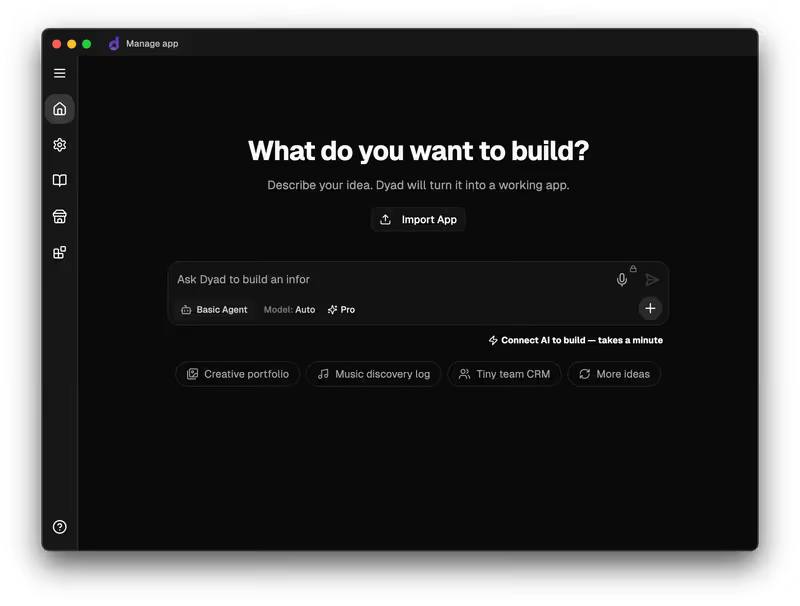
Private, open-source app building running with your own keys on your local machine

Zite vs Dyad, on screen

zite.com
Zite homepage
dyad.sh
Dyad homepage

The fairest way to compare Zite and Dyad is to judge them on a structural business job: a small business custom web app where team members and external customers log in, and can only see or edit their specific assigned records. This represents raw operational reality - a thin user interface layered over solid data validation, precise row-level security, and reliable relational linkage.

While both platforms leverage AI to generate application code, schemas, and layouts, their architectural philosophies diverge completely. Zite operates as an environment of guided templates running on its own cloud. Dyad runs completely on your local machine, expecting you to bring your own developer tools and hosting keys. This structural difference dictates who can actually build, launch, and successfully maintain the app past the first prompt.


The audience

Who each one is for

Zite

  • Non-technical business operators who want a cloud portal fast without managing terminal commands
  • Operations managers needing a conversational interface that inherits Fillout form logic out of the box
  • Solopreneurs wanting a hosted system that handles database schema and UI layout simultaneously
  • Teams targeting lightweight external portals who prefer prompt-to-app workflows over visual block builders

Dyad

  • Local-first software developers who want to generate raw React and Tailwind apps locally
  • Privacy-conscious builders demanding total data residency and codebase ownership from day one
  • Technical founders already comfortable configuring local Docker containers and Node.js environments
  • Solo developers who want to use their own local cursor to fine-tune AI generations

Zite targets the operator who wants to speak their app into existence without looking at files, while Dyad targets the developer who wants AI scaffolding in a terminal.

The scope

What you'd build with it

Zite

  • Client lookup portals and vendor registration forms using Fillout's structural logic fields
  • Internal team inventory trackers leveraging the conversational, spreadsheet-like database setup
  • Lightweight employee submission directories that stay close to standard corporate template layouts
  • Simple task boards - though it is a poor fit for highly custom visual layouts

Dyad

  • Raw code prototypes designed to run locally using SQLite or PostgreSQL schemas
  • Custom, local React web interfaces styled directly with Tailwind CSS utilities
  • Developer utility tool code bases backed by direct, un-sandboxed Node.js local servers
  • Strictly local apps only - you cannot package Dyad outputs natively for the App Store

The security and state dilemma

Zite manages the application lifecycle on its own servers, wiring security permissions through centralized User Groups and proprietary cloud policies. Because it compiles on hosted database backends, handling secure states like "user A can only edit assigned items" is handled by configuring visual and prompted rules inside their dashboard. However, because much of Zite's core data reads are abstracted, every page reload and standard CRUD operation translates into a direct server call that counts against your monthly workflow limits, putting a structural ceiling on active application usage.

Dyad reverses this risk profile. Since it compiles standard React code locally, you have direct, unfettered access to raw route controls and schema files. Implementing row-level security or custom auth layers means generating code patterns using packages like Clerk or Auth0, which are saved straight to your local hard drive. The risk here is not workflow billing - because you bring your own keys, you only pay direct token costs. Instead, the risk is codebase drift. If the local model makes a bad diff or generates insecure environment routing, you have to read the raw files yourself to debug the compile failures before you can ever deploy them live.

Strengths

Where each one is strong

Edge: Zite

Zite takes the edge here for hosting and publishing. It abstracts away the technical pipeline, making it viable for operators to move from prompt to live URL.

Zite

  • Conversational plan-mode guardrails that let you preview markdown plans before executing modifications
  • Turnkey hosting and deployment: hit publish and your application is immediately available online
  • Excellent form builder DNA with native fields, translations, and multi-language schema support
  • A conversational SQL database wrapper featuring relational links, visual row tables, and history logs

Dyad

  • Local codebase execution that keeps your user data and layout code completely private
  • Zero subscription markup on models by pointing your own OpenAI or Anthropic developer keys
  • No platform lock-in: files are saved locally as clean, raw React and TypeScript files
  • Direct integration with local workflows, Git commits, and code editors like Cursor or VS Code

Failure modes

Where each one breaks

Edge: Zite

Zite's structural templates mean fewer raw compile crashes. Dyad is highly vulnerable to breaking the build during early prompts.

Zite

  • Severe workflow bloat where simple prompts generate dozens of recursive workflows, cluttering the studio
  • Invisible runtime leaks: every database read and standard page reload eats your monthly workflow quota
  • Custom login screens and scheduled automations are locked behind the expensive Business plan
  • Rigid layout options that restrict design adjustments to default generated templates

Dyad

  • Codebase bloat and structural collapse when trying to implement complex multi-user database links
  • Token exhaustion limits: large codebases consume the 128k context window rapidly, triggering memory issues
  • No instant hosting: builders must configure their own deployment layers like Vercel and Supabase manually
  • Node.js setup and local environment hurdles that completely lock out non-technical builders

Iteration cost

The fix loop, priced

Even

Both tools impose distinct iteration costs - one through credit-based loops, the other through local debugging overhead.

Zite

  • Pro starts at $19/mo on monthly billing, providing 100 AI credits per month
  • Active design modifications and chat mode quickly consume the monthly credit allowance
  • If credits run out, developers are locked into manual database edits or paying higher pricing tiers
  • Every page load and simple reading action burns critical workflow limits (5,000 allowance on Pro)

Dyad

  • The open-source community edition is free, running on your own API keys (BYOK)
  • Every single code diff or file regeneration eats raw API tokens from OpenAI or Anthropic
  • Poor planning prompts generate redundant helper functions, compounding token charges over time
  • If you use free local models like Ollama, build speed and coding quality scale down

Zite charges you for every adjustment in their cloud database, whereas Dyad converts every code revision into direct token fees, making the fix loop tax an early operational hurdle for both.

Exit paths

The code you end up with

Edge: Dyad

Dyad provides clean, unrestricted local files, easily outperforming Zite's proprietary ecosystem.

Zite

  • Zite does not offer code export or GitHub sync, locking you inside their system
  • Database migrations are proprietary, restricting data porting out of their built-in SQL database
  • Hosting is entirely dependent on Zite's servers with no self-hosting exit path
  • The database structures can act as a container with limited pathways to move systems later

Dyad

  • Standard React and Vite codebase that you can directly move to Vercel or AWS
  • Automatic Git commits tagged directly to see exactly what code changed at every prompt
  • Raw SQL schemas (SQLite or Postgres) that you can export or host on separate servers
  • Zero proprietary framework layers preventing real-world developers from refactoring files

When neither wins

If you are a business operator trying to launch a portal, directory, or CRM, building it with either contender is a long-term risk. A production web app requires roughly 80% security plumbing (secure user sessions, verified role groups, and database privacy filters) wrapped around data listings. Dyad hands you this as raw generated scripts that you have to compile, debug, and secure manually. Zite hosts it, but wraps it in credits and counts simple page reloads as expensive workflow runs that quickly exhaust your quota.

In these scenarios, the objective answer is Softr, the tool with no fix loop. Softr treats user logins, structural permissions, and record-level filters as visual platform configurations instead of hallucinated code. You design groups and connect data tables visually without managing local environments or paying token fees to correct broken login validation. However, if your job requires a consumer-facing mobile layout, bespoke animation patterns, or complete ownership of a codebase to export, Softr is the wrong fit. In those cases, you should hire a developer to build a custom stack.

Verdict

Zite is the winner for non-technical creators who must launch a hosted business utility immediately. Its Fillout form engine DNA provides reliable inputs, and compiling schemas on its cloud database bypasses terminal configurations. If you are comfortable staying inside their predefined templates and have the budget to scale to their Business tier to avoid workflow caps, it offers the fastest path to a live URL.

Dyad is the choice only for developers who demand local container isolation and direct codebase control. If you have active API keys, configure your own servers, and intend to use Cursor or VS Code to refine the outputs, Dyad provides highly portable React files with zero platform lock-in.

For a scaling business with real users and per-user isolation, look past both. Managing generated codebases for multi-tenant applications leads directly to the day-two problem. Use a platform like Softr to run your operational backend, and treat security rules as stable settings rather than experimental prompts.

Q & A

Frequently Asked Questions

Is Zite better than Dyad for a small business app?

Zite is better suited for business operators because it hosts the app and builds schemas conversational style. Dyad is built for developers who know how to set up local environments, run terminals, and deploy React code using their own API keys.

Can I export my code from Zite and Dyad?

No, you cannot export code or sync to GitHub from Zite, locking you into their hosting ecosystem. Dyad stores all React, Tailwind, and database schema files directly on your local drive with clean Git commit histories.

Which costs more to run, Zite or Dyad?

Zite's pricing tiers start at $19 per month but require the $69 per month Business tier to enable scheduled runs and custom login screens, and simple page loads consume monthly workflow quotas. Dyad is open source and runs locally, costing only the direct raw token fees consumed from your personal OpenAI or Anthropic accounts.

How can I build a client portal without managing raw code?

Using a dedicated no-code business platform is the safest alternative. Softr configures security, login states, and user database filters visually as host platform features instead of writing raw, potentially vulnerable code blocks.