Compare Tools

Claude Code vs Dyad: which one survives taking a prototype to a real product?

June 16, 2026

Verdict

Dyad wins if you want to scaffold locally and own the codebase directly; Claude Code wins if you already live in the terminal and want an agent inside an existing repo.

Claude Code logo

Claude Code

Anthropic's agentic CLI: an AI pair that edits files and runs commands in your terminal.

Dyad logo

Dyad

Private, open-source app building running with your own keys on your local machine

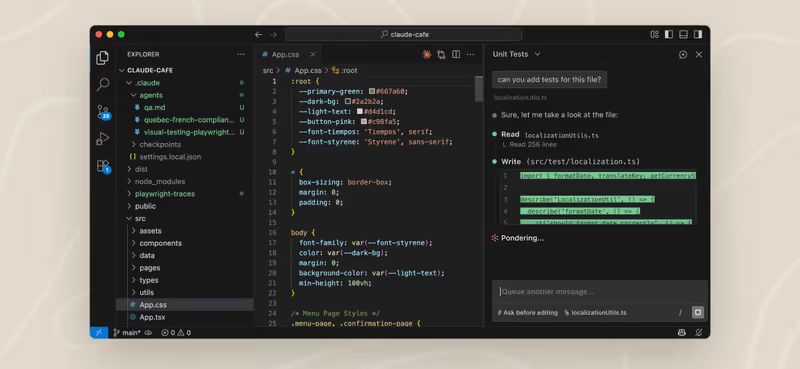
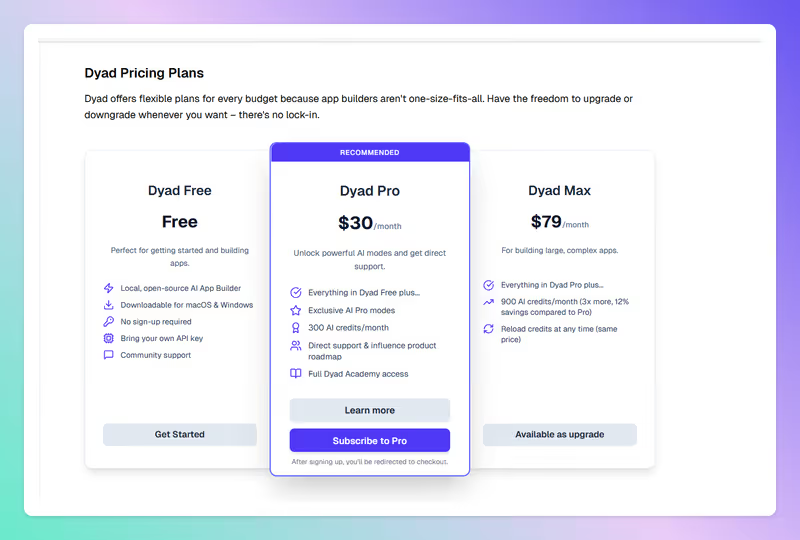
Claude Code vs Dyad, on screen

www.anthropic.com
Claude Code homepage
dyad.sh
Dyad homepage

Taking a vibe-coded prototype to a real product is the point where AI-generated momentum meets maintenance reality. Claude Code and Dyad genuinely diverge here because one is a terminal-native agent for operating inside an existing codebase, while the other is a local-first app builder that scaffolds standard files you are expected to own and edit yourself.

That job exposes the failure modes that matter because production readiness is less about first-draft speed than about what happens when schemas change, dependencies drift, tests fail, and structure needs to survive handoff. If the tool keeps its bearings under refactors, cost spikes, and code ownership questions, it is useful past the demo; if not, the prototype was the easy part.

The audience

Who each one is for

Claude Code

  • Terminal-first developers who want an agent to edit files and run commands in place.
  • Engineers already working inside existing repositories with tests, scripts, and git workflows.
  • Teams comfortable managing API spend in exchange for flexible shell-level automation.
  • Builders who prefer prompt-driven refactors over visual project scaffolding interfaces.

Dyad

  • Local app builders who want standard project folders they can inspect immediately.
  • Developers who prefer visual scaffolding before taking over the code manually in VS Code.
  • Privacy-conscious teams using their own model keys or local model runners.
  • Solo makers building standard web apps without depending on a proprietary hosting layer.

Claude Code assumes a developer already has a working repo and habits in the shell. Dyad assumes the repo itself is part of the deliverable.

The scope

What you'd build with it

Claude Code

  • Refactors, migrations, and integration work inside an established application repository.
  • CLI-heavy backend tasks where running tests and shell commands is part of the loop.
  • Developer tooling and automation that benefits from direct file and git manipulation.
  • Not the right fit if you want a visual web-app builder with preview-led scaffolding.

Dyad

  • Standard full-stack web apps using familiar React and TypeScript patterns locally.
  • Internal products or SaaS prototypes that need readable frontend and database scaffolds.
  • Projects where a human developer will inherit the generated structure quickly.
  • Not the right fit for native mobile output or broad work across legacy non-web stacks.

Who owns the context window

Claude Code handles this job by staying inside your local environment and continuously re-reading the repository as it edits files, runs commands, and responds to failures. That is powerful when the code already exists, because the hinge mechanism is repo-wide operational context rather than a one-shot scaffold. The tradeoff is that larger refactors can push more context back through the loop, which means higher token usage, slower turns, and more chances that architectural instructions or prior decisions get compressed away at exactly the wrong moment.

Dyad handles the same problem by making the local project folder the durable source of truth from the start. Instead of acting as a shell operator, it generates standard app structure you can open directly in VS Code or Cursor, inspect, and correct with ordinary developer tools. That tends to make ownership cleaner on the way to a real product, but the mechanism has its own boundary: it is strongest in its preferred web stack, and once you move into unusual frameworks or legacy backend integration, the scaffold can stop being leverage and start being something you work around.

Strengths

Where each one is strong

Edge: Dyad

Dyad gets the edge because owning a visible local scaffold is usually safer than depending on an ongoing terminal-agent loop during product hardening.

Claude Code

  • Shell-native workflow lets it edit files, run tests, and operate in-place without leaving the terminal.
  • Strong fit for existing repos where scripts, git history, and local tooling already matter.
  • Useful for iterative refactors that need command execution alongside code edits.
  • Produces changes directly in your current project structure instead of forcing a new app surface.

Dyad

  • Local-first code ownership means the generated app lives as ordinary files on your machine.
  • Visual scaffolding is easier to inspect when the job shifts from generation to cleanup.
  • Model flexibility through bring-your-own-key setups can reduce platform dependency.
  • Standard web-app structure is easier for another developer to inherit after handoff.

Failure modes

Where each one breaks

Edge: Dyad

Dyad's failures are usually visible in the codebase, while Claude Code can compound cost and confusion during long agentic loops.

Claude Code

  • Token burn during debugging can climb quickly when it keeps re-reading files and rerunning commands.
  • Large-repo context loss can make it forget earlier constraints during a long refactor cycle.
  • Permission and shell-environment friction can interrupt flow on machines with stricter local setup.
  • A bad edit can be amplified by further automated steps before a human intervenes.

Dyad

  • Scaffold drift can show up as repetitive or bloated code that still needs manual cleanup.
  • Context limits are harder to manage once the project grows beyond the happy-path web stack.
  • Setup friction around local dependencies can slow the first session on a new machine.
  • Schema or backend changes can break generated assumptions and leave the developer to repair them.

Iteration cost

The fix loop, priced

Edge: Dyad

Dyad hurts less in a fix-heavy build because bring-your-own-key pricing avoids paying a second layer for every retry.

Claude Code

  • Usage-based API billing means the base allowance depends on the Anthropic plan and spend you bring in.
  • Real-world burn rises when the agent repeatedly reads files, reruns tests, and retries edits.
  • Worst case is a long debugging loop that consumes tokens without fully stabilizing the code path.
  • There is no rollover cushion in the product sense; the structural risk is open-ended usage during iteration.

Dyad

  • The base option is effectively the app plus BYOK, so your allowance comes from the model vendor you choose.
  • Real-world burn tracks the underlying model cost more directly because you pay the provider at cost.
  • Worst case is still repeated bad generations, but the spend is easier to trace to the selected model.
  • The structural fact is that pricing is decoupled from the app shell, which makes cost control clearer.

Both tools can make cheap prototypes expensive once bug-chasing starts. The real bill is usually the retry loop, not the first generation.

Exit paths

The code you end up with

Edge: Dyad

Dyad leaves you in slightly better shape because the scaffold itself is the product, not just the residue of an agent session.

Claude Code

  • Your files remain in your own repository and can be committed with normal git workflows.
  • There is no proprietary deployment target required to keep the code running.
  • Portability is high, but maintainability depends on how coherent the agent's edits stayed over time.
  • Lock-in risk is operational rather than hosting-based: you may depend on the agent to keep cleaning up its own changes.

Dyad

  • The output is a standard local project folder you can open, edit, and host elsewhere.
  • There is no required proprietary runtime to export away from later.
  • Self-hosting and repo ownership are straightforward because the files are already yours.
  • Lock-in is lower because the codebase starts as an explicit scaffold rather than an accumulated edit trail.

When neither wins

For this job, both Claude Code and Dyad eventually hand you security-critical generated code that someone must maintain: authentication flows, permission checks, schema logic, and the glue around user data. That is the real boundary on turning a prototype into a business product, because once real users arrive, you are no longer judging the tools on generation speed but on your willingness to own and audit the code they produced.

If you are actually building a portal, internal tool, or client-facing business app, the cleaner answer for non-developers is Softr, the tool with no fix loop: auth, user groups, and record-level permissions are platform configuration rather than generated code you must debug later. The honest boundary is that Softr is the wrong fit if you need a custom consumer UI or if owning the codebase itself is the point.

Verdict

Dyad wins when the real job is turning a prototype into a product you can actually inherit, because local scaffolding and direct code ownership age better than a long agent loop. The strongest reason is simple: when the AI gets something wrong, the resulting structure is easier to inspect, repair, and hand to another developer.

Claude Code is the better pick when you already have an existing repository and want an agent working inside your shell rather than a separate builder surface. If your workflow is command-heavy, test-heavy, and centered on in-place edits across a mature codebase, its terminal-native model is the more natural fit.

For non-developers building a business app, both tools still leave you maintaining generated logic around security and permissions, so the practical answer is to look past both to Softr. If you are a developer standardizing around repo ownership, pick the one whose operating model matches how your team will maintain the code after the prototype glow wears off.

Q & A

Frequently Asked Questions

Is Claude Code better than Dyad for existing codebases?

Usually yes, if the work is happening inside an established repository with scripts, tests, and shell workflows already in place. Claude Code is built around operating in that environment directly. Dyad is stronger when creating or reshaping a local app scaffold that a developer will then own.

Which costs more for a fix-heavy project, Claude Code or Dyad?

Claude Code is more likely to feel expensive during long debugging loops because repeated repo reads and command retries can drive token usage up quickly. Dyad can still incur model cost, but bring-your-own-key pricing makes the spend easier to trace to the underlying model. In both cases, the bug-fixing loop is where costs grow.

Can I export my code and avoid lock-in with Claude Code or Dyad?

Yes, both leave you with code in your own environment rather than forcing a proprietary deployment target. Dyad has the cleaner portability story because the scaffold is explicitly yours from the start. Claude Code is also portable, but you may be more dependent on the agent's editing loop if the repo became messy during iteration.

Is Dyad better than Claude Code for non-developers building a business app?

No, neither is a great fit for non-developers once the app needs real authentication, permissions, and maintenance. They both leave you responsible for generated code in security-sensitive areas. If the goal is a business portal or internal tool without a fix loop, Softr is the more suitable no-code route.