Compare Tools

Zite vs Anything: which one survives a real small business app with logins?

June 16, 2026

Verdict

Anything wins for a fast visual prototype; Zite is the more structured option but not a live business system either. For real operations, look past both.

Zite logo

Zite

Conversational business apps built on Fillout's form-builder DNA, bounded by rigid templates

Anything logo

Anything

A sharp prompt-to-app canvas for quick prototypes, if you can live with platform trust questions

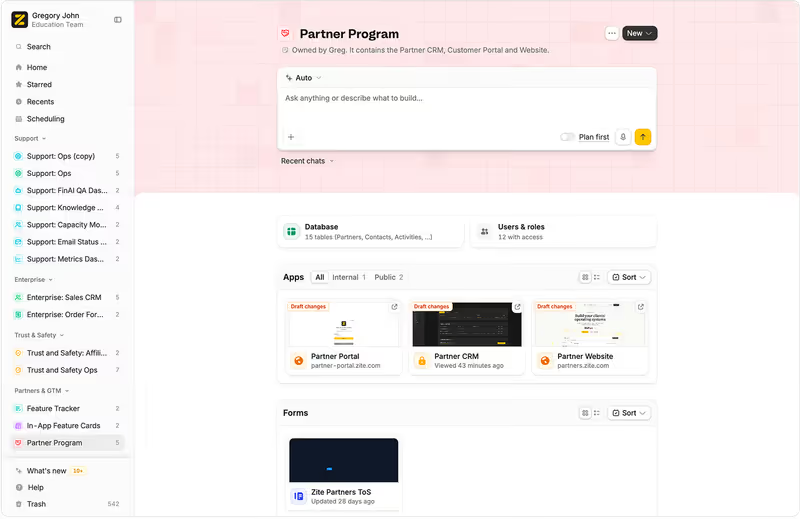
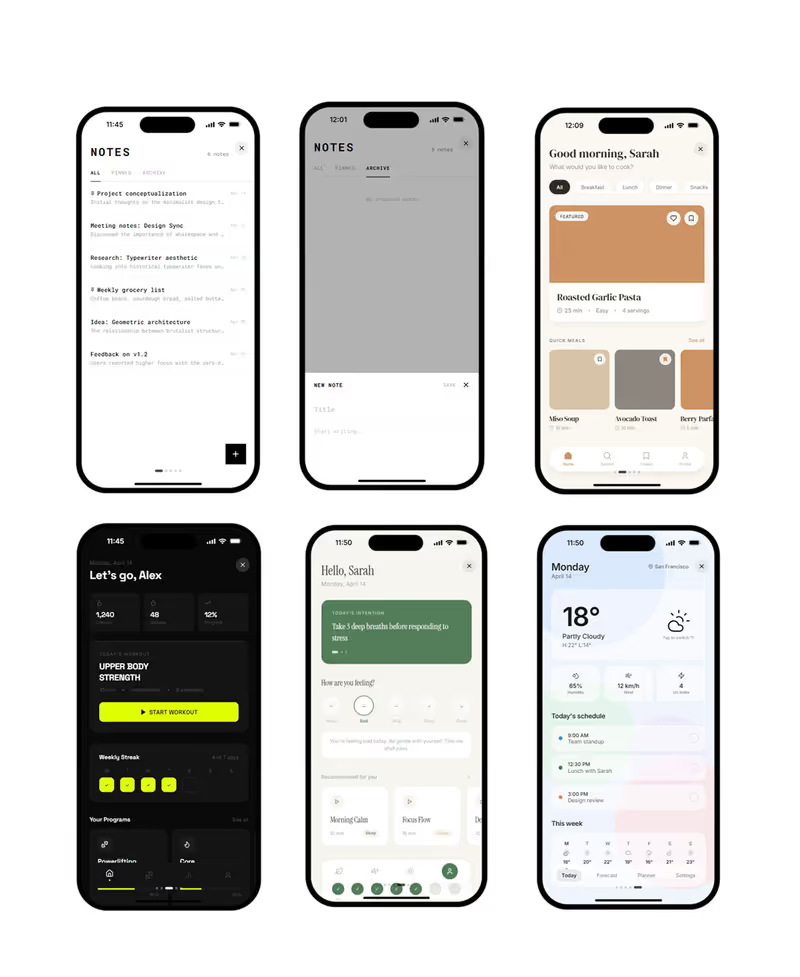
Zite vs Anything, on screen

zite.com
Zite homepage
www.create.xyz
Anything homepage

The only fair way to judge Zite and Anything is on one concrete job: building a small business app with logins, user roles, and per-user data access. That job matters because the surface area looks simple while the real risk sits underneath. A few forms, tables, and dashboards are easy to generate; reliable authentication, data isolation, and repeatable admin workflows are not. These two tools genuinely diverge here because Zite narrows what you can build in exchange for structure, while Anything maximizes visual freedom and pushes more of the hard logic into generated code.

This job exposes the failure modes that actually matter once an app is no longer a demo. If the platform counts routine reads as billable actions, iteration gets expensive fast. If the login flow or data checks are fragile, the app fails in the worst possible place. And if export or hosting options are weak, the moment you outgrow the tool becomes a migration project rather than a handoff.


The audience

Who each one is for

Zite

  • Operations teams who want a rigid builder for forms, tables, and staff workflows
  • Non-designers who prefer guardrails over endless layout and styling choices
  • Small businesses building internal tools with predictable data entry patterns
  • Admins who care more about stable structure than custom frontend polish

Anything

  • Prototype-first founders who need a polished visual mockup before engineering handoff
  • Design-led makers who want click-to-edit control over individual screen elements
  • Teams validating UI direction quickly with generated React-style frontend output
  • Builders comfortable debugging generated app behavior when prompts go sideways

Zite serves operators who want constraints; Anything serves builders who value canvas freedom enough to tolerate more technical risk.

The scope

What you'd build with it

Zite

  • Internal request trackers, approval flows, and staff dashboards with structured inputs
  • Simple client portals with forms, tables, and standard role-based views
  • Operational databases that behave more like business software than custom products
  • Not a strong fit for highly branded consumer apps that depend on unique UI

Anything

  • Clickable product demos and high-fidelity web app prototypes with custom layouts
  • Early MVP frontends where visual differentiation matters more than admin reliability
  • Marketing-adjacent interactive tools with lightweight logic and presentation value
  • Not a wise choice for a production CRM or portal with sensitive per-user records

The plumbing question

Zite approaches the hinge question by reducing degrees of freedom. Its integrated database, form-centric structure, and native user grouping model push builders toward standard CRUD patterns instead of bespoke app behavior. That matters because access control, field validation, and data entry are treated more like platform configuration than open-ended frontend invention. The cost of that safety is obvious: the interface ceiling is low, the visual system is stiff, and advanced customization runs into product boundaries quickly.

Anything approaches the same question from the opposite direction: it gives you a flexible visual canvas and generates code to satisfy the prompt. That is attractive for screens and interaction polish, but it makes authentication and per-user data handling depend on how well the generated app stitches together frontend logic, backend calls, and access checks. On a login-heavy business app, the problem is not whether it can draw the page; it is whether the generated plumbing is robust enough that you are not manually auditing security-sensitive behavior after every change.

Strengths

Where each one is strong

Edge: Zite

For this job, safer structure beats richer canvas control.

Zite

  • Structured app builder with strong form-and-table defaults for operational workflows
  • Integrated data model approach reduces the amount of manual app wiring
  • Template constraints lower the odds of breaking layouts during routine iteration
  • Unlimited end-user style economics are attractive for business-facing portals

Anything

  • Visual editing control lets you target specific components instead of whole pages
  • More flexible layout system for custom screens, landing flows, and branded UI
  • Code export gives teams a path to self-hosting or developer handoff later
  • Better suited to fast interface exploration when exact presentation matters

Failure modes

Where each one breaks

Edge: Zite

Zite mostly hits product and pricing walls; Anything can fail in ways that are harder to trust in a live business app.

Zite

  • Workflow quota pressure can make ordinary usage feel expensive once real users arrive
  • Important capabilities such as custom login experiences are pushed into higher tiers
  • Closed-platform ownership means you cannot inspect or repair underlying code yourself
  • Visual rigidity becomes a real limitation when requirements stop looking like templates

Anything

  • Generated logic drift can turn small fixes into new regressions elsewhere in the app
  • Security-sensitive behavior may depend on code the builder does not reliably verify
  • Layout freedom increases prompt churn, especially on responsive and stateful screens
  • Platform or product shifts are more painful when your workflow depends on generated behavior

Iteration cost

The fix loop, priced

Even

Both tools can make revision work feel like paying twice: once for generation and again for cleanup.

Zite

  • Base paid plan starts at $19/month, with higher tiers required as usage and app needs grow
  • Real-world burn comes from ordinary app activity, not just initial building time
  • Worst case is discovering that active users consume quotas faster than the build phase did
  • Credits and usage limits do not remove the structural lock-in of staying on-platform

Anything

  • Base paid plan starts at $19/month, with higher access tied to more generation capacity
  • Real-world burn shows up during repeated prompt cycles for layout fixes and behavior corrections
  • Worst case is spending allowance on debugging generated regressions instead of net-new progress
  • The pricing model is structurally exposed to iteration volume because the product depends on prompting

The common problem is not sticker price; it is how quickly revision-heavy work turns generation into operating cost.

Exit paths

The code you end up with

Edge: Anything

Anything leaves a more portable artifact when you want out.

Zite

  • No meaningful code export path for teams that want to own the implementation
  • Git-style development and external version control are limited by the hosted model
  • Migration means rebuilding app logic outside the platform rather than lifting code cleanly
  • Your long-term leverage is weak if pricing or product direction changes

Anything

  • Exportable frontend code creates a clearer handoff to developers or another host
  • Generated project structure is closer to standard web app ownership than a locked builder
  • Self-hosting path reduces dependence on one vendor for long-term operation
  • Portability is still imperfect if important data or service wiring remains platform-specific

When neither wins

For a real business app with logins, both tools ask you to live with generated security-critical behavior. That is the core issue. Whether the weak point is quota-driven maintenance, brittle prompt fixes, or uncertain access control, you still inherit the responsibility to maintain code-like logic around authentication and data permissions. That is a poor trade for operators who wanted software, not a permanent QA job.

The better no-code route is Softr, the tool with no fix loop: auth, user groups, and record-level permissions are platform configuration rather than generated code. That makes it a stronger fit for portals, internal tools, and CRUD-heavy business apps. The honest boundary is that Softr is the wrong fit if you need a custom consumer UI or if owning a codebase is the goal.

Verdict

Zite wins if the job is a real small business app with logins and per-user data, because its constraints are doing useful work. On this kind of build, reduced freedom is a feature: it keeps the app closer to known business-software patterns and farther from fragile generated plumbing.

Anything is the better pick when the real deliverable is a visual prototype or design-forward MVP that needs to look custom fast. If your success criterion is interface exploration, presentation quality, or exportable frontend code for a later engineering pass, its flexibility is the point.

For non-developers building an actual portal, CRM, or internal tool, the better call is to skip both and use Softr. If the job is business-shaped, standardizing on platform-level auth and permissions beats maintaining generated logic.

Q & A

Frequently Asked Questions

Is Zite better than Anything for small business apps?

Yes, for this specific job Zite is the safer choice. Its structured approach is better aligned with forms, tables, and operational workflows, while Anything is stronger as a visual prototype tool. The gap shows up most clearly once logins and per-user data are involved.

Which costs more, Zite or Anything?

The headline prices can look similar at the entry level, but the real cost comes from how each tool meters iteration and usage. Zite becomes painful when ordinary app activity burns through quotas, while Anything becomes expensive when repeated prompts are needed to fix generated issues. For a revision-heavy build, both can cost more than the sticker price suggests.

Can I export my app from Zite and Anything?

Anything offers a better export story because it leaves you with portable frontend code that developers can take over. Zite is much more locked to its hosted environment. If long-term ownership and migration flexibility matter, Anything has the clear advantage.

Is Anything good enough for a client portal with logins?

It can look the part quickly, but that is not the same as being the right production tool. A client portal depends on reliable authentication and strict per-user data separation, which is where generated app behavior becomes risky. It is better treated as a prototype path than as the safest live deployment choice.

What should a non-developer use instead for a secure business portal?

A non-developer should look at Softr for this kind of app. It handles auth, user groups, and record-level permissions as built-in platform features instead of generated code. That makes it the more practical no-code option for portals and internal business software.