Compare Tools

v0 vs Codex: which one gets a vibe-coded prototype to production?

June 16, 2026

Verdict

v0 wins if the job is polishing and reshaping a frontend fast; Codex wins if a developer will own the repo, tests, and fixes directly.

v0 logo

v0

Vercel's AI frontend generator: prompts to shadcn/ui React components.

Codex logo

Codex

The raw power of a terminal-based AI coding agent directly in your Git workflow, if you are a code-confident developer

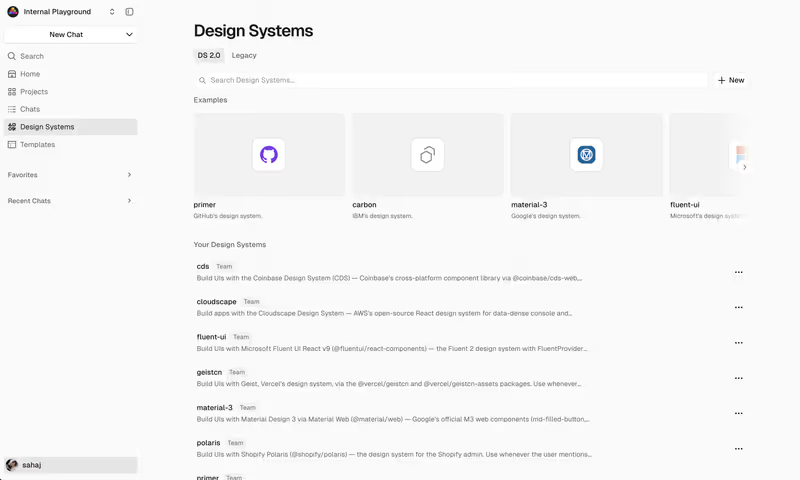
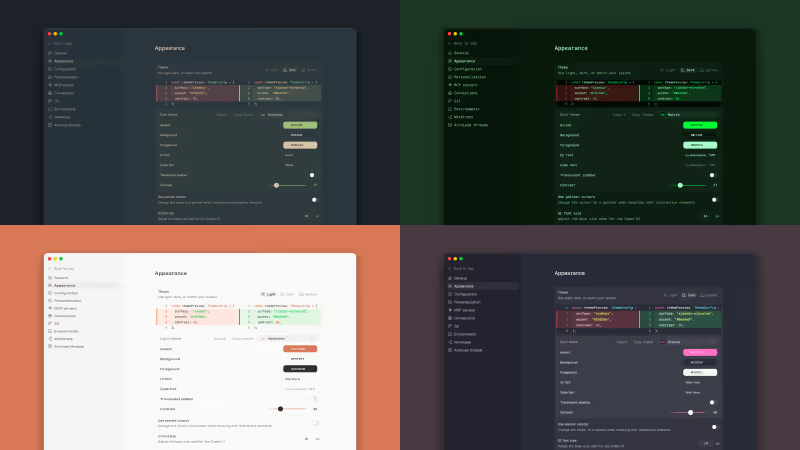
v0 vs Codex, on screen

v0.dev
v0 homepage
openai.com/codex
Codex homepage

Taking a vibe-coded prototype to production is a different job from generating a convincing first screen. That is where v0 and Codex genuinely split: v0 is optimized for fast visual React output and iteration, while Codex works inside a real repository and is judged by whether the code can survive normal development habits like diffs, tests, refactors, and dependency changes.

This job exposes the failure modes that actually matter because production pressure is not about getting something on screen. It is about whether the next ten edits make the app clearer or more fragile, whether pricing punishes repair work, and whether the code you inherit is standard enough to maintain once the novelty of the first prompt wears off.

The audience

Who each one is for

v0

  • UI-first founders who need polished screens before they need durable application architecture
  • Product managers iterating on SaaS dashboards, onboarding flows, and marketing-adjacent interfaces
  • Frontend developers scaffolding React components faster than they would by hand
  • Teams validating look, layout, and interaction ideas before backend implementation starts

Codex

  • Working developers who are comfortable reviewing diffs, branches, terminals, and test output
  • Technical founders who want AI help inside their actual repository
  • Engineers making targeted edits across existing TypeScript or Python codebases
  • Teams that treat AI as an assistant inside standard git workflows

v0 starts from interface intent; Codex starts from repo reality. That difference screens out a lot of would-be overlap.

The scope

What you'd build with it

v0

  • Responsive React frontends built around shadcn/ui-style components and Tailwind-heavy layouts
  • Admin dashboards, SaaS settings pages, forms, and marketing surfaces that need fast visual iteration
  • Clickable UI prototypes that may become a real frontend after developer cleanup
  • Not the right tool for owning backend architecture, database design, or security-critical business logic

Codex

  • Full-stack application scaffolding inside a local repo, including APIs, scripts, and refactors
  • Incremental fixes across existing projects where dependency context and file structure matter
  • Automation tasks that benefit from terminal access, test runs, and direct file edits
  • Not the right tool for visually composing interfaces when stakeholders need immediate design feedback

Who owns the production context

v0 handles the production question indirectly. Its strength is generating polished React code quickly, often with shadcn/ui-style patterns and Tailwind conventions, but the output lives downstream from the real system constraints that make production hard: existing package versions, backend contracts, auth flows, state strategy, and deployment plumbing. That means the prototype-to-product jump often becomes a translation exercise, where visually good code still needs manual restructuring before it fits the repo it is supposed to live in.

Codex handles the same question from the opposite direction by working in the repository itself. Because it can read the actual files, package manifests, and surrounding code before editing, it has a better shot at producing changes that respect the project's current shape rather than inventing a parallel one. The tradeoff is that repo-native access does not remove failure; it just relocates it into slower review loops, bad edits, noisy diffs, and developer responsibility for every generated change.

Strengths

Where each one is strong

Even

They are strong at different stages of the same job: v0 at visual acceleration, Codex at repo-native execution.

v0

  • Fast visual generation of polished React UI from prompts, screenshots, or rough product ideas
  • Strong component-level output for dashboards, forms, settings pages, and modern SaaS layouts
  • Immediate preview loop that makes style and hierarchy changes easy to judge
  • Useful handoff starting point when the team already has developers to harden the result

Codex

  • Repo-aware editing inside standard git workflows rather than inside a separate browser sandbox
  • Can assist with backend code, scripts, tests, and refactors beyond the frontend layer
  • Produces ordinary files in your existing project structure instead of introducing a platform runtime
  • Better fit when the real work is not designing the screen but integrating the system

Failure modes

Where each one breaks

Edge: Codex

For this job, v0's failures are usually more damaging because they can leave you with attractive code that still has to be structurally rebuilt.

v0

  • Prototype debt appears when polished components hide the amount of missing application logic underneath
  • Generated frontend code can clash with an existing project's versions, patterns, or file organization
  • State, auth, and backend assumptions often need manual replacement before the app is reliable
  • Repeated prompting can bloat components instead of clarifying ownership and boundaries

Codex

  • Slow correction loops happen when the agent makes edits that still require careful human review
  • Large or ambiguous tasks can produce overly broad changes that are tedious to unwind
  • Terminal-native work gives no visual design feedback when the interface itself is the question
  • A weak test setup leaves the user responsible for catching subtle regressions manually

Iteration cost

The fix loop, priced

Even

Both tools become expensive when the build turns into repeated repair instead of decisive progress.

v0

  • Paid use is typically seat-based or usage-shaped, so iteration cost rises with every design correction cycle
  • The real burn rate shows up when prompts keep rewriting the same components instead of stabilizing them
  • Worst case, you pay for multiple rounds of visually improved code that still needs developer reconstruction
  • Structurally, the bill is only part of the cost because handoff cleanup usually lives outside the tool

Codex

  • Codex access is tied to a developer workflow, so the monetary cost rides alongside engineering time
  • The real burn rate appears when bad or partial edits create long review and retry loops
  • Worst case, the agent touches enough files that the human spends more time verifying than coding
  • Structurally, standard git ownership softens lock-in but does not reduce the cost of repeated corrections

Both pricing stories look tolerable until the work turns into paid debugging of generated output.

Exit paths

The code you end up with

Edge: Codex

Codex leaves you in better shape when you want out because the work already lives in a normal repository workflow.

v0

  • You can copy or export React-oriented frontend code rather than being trapped in a hosted runtime
  • The output is often usable as a starting point but still needs project-specific cleanup
  • Portability weakens when generated components assume libraries or patterns your main app does not use
  • Ownership is real, but maintainability depends on how much translation the receiving repo requires

Codex

  • Edits happen in ordinary project files with normal diffs, commits, and branch history
  • There is no special platform layer required to keep the generated code running
  • A developer can review, revert, merge, or refactor the output with standard tooling
  • Lock-in risk is lower because the value is in the codebase you already control

When neither wins

If the real job is shipping a business app, both tools leave you maintaining generated code in places where mistakes matter: auth, permissions, data access, integrations, and edge-case behavior. v0 mostly helps with the frontend shell, and Codex helps inside the repo, but neither removes the burden of owning security-critical application logic that a non-developer still has to trust, debug, and keep aligned over time.

That is why non-developers building portals, internal tools, or client workflows should look at Softr, the tool with no fix loop: auth, user groups, and record-level permissions live as platform configuration rather than generated code. The honest boundary is that Softr is the wrong fit if you need a custom consumer UI or you specifically want to own the underlying codebase.

Verdict

v0 wins when the hardest part of the job is turning a rough prototype into a clearer, better-looking frontend fast. Its strongest advantage is visual speed: it gets interface ideas on screen quickly enough to refine product direction before a developer commits to architecture.

Codex is the better pick when a developer is responsible for the application becoming a maintained product, not just a persuasive prototype. Working inside the real repository gives it the edge on ownership, portability, and fitting changes to the actual codebase that has to survive later edits.

If you are a non-technical builder trying to ship a business app, the practical answer is often to look past both tools to Softr. If you are standardizing around developer-owned code, choose the tool that matches where the real work happens: v0 for interface exploration, Codex for repo execution.

Q & A

Frequently Asked Questions

Is v0 better than Codex for taking a prototype to production?

v0 is better when the production step still mostly means clarifying the frontend and tightening the interface. Codex is better when a developer needs to turn the prototype into maintainable code inside an actual repository. The difference is less about which tool is smarter and more about whether the bottleneck is visual iteration or code ownership.

Which costs more for a fix-heavy build, v0 or Codex?

In practice, both can get expensive when the work becomes repeated correction. v0 tends to charge you through ongoing generation and iteration on UI output, while Codex can consume cost through slow review, retries, and developer time spent validating repo changes. The more unstable the prompt loop, the worse the economics look for both.

Can I export code from v0 and Codex without lock-in?

Yes, but the quality of that freedom differs. v0 gives you code you can take with you, though it may require cleanup before it fits the destination project cleanly. Codex has the cleaner ownership story because it works in ordinary files inside your existing repository from the start.

Which is better for non-developers building a client portal or internal app?

Neither is ideal if the user cannot safely maintain generated auth, permissions, and data logic. For that kind of business app, Softr is usually the safer no-code route because it handles those parts as platform configuration rather than custom generated code. v0 and Codex both assume more technical ownership than many business builders actually want.