Compare Tools

v0 vs Base44: which one survives a styled small business app?

June 16, 2026

Verdict

v0 wins if you need a meticulously styled frontend to wire into an existing technical stack; Base44 wins if you want a fast, conversational MVP with basic hosting and data, but neither survives a production workflow without developer-level supervision.

v0 logo

v0

Vercel's AI frontend generator: prompts to shadcn/ui React components.

Base44 logo

Base44

All-in-one conversational app builder with bundled database, auth, and hosting.

v0 vs Base44, on screen

v0.dev
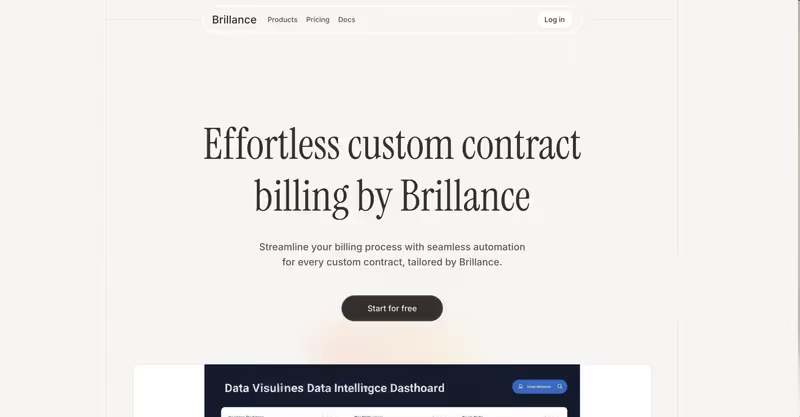
v0 homepage
base44.com
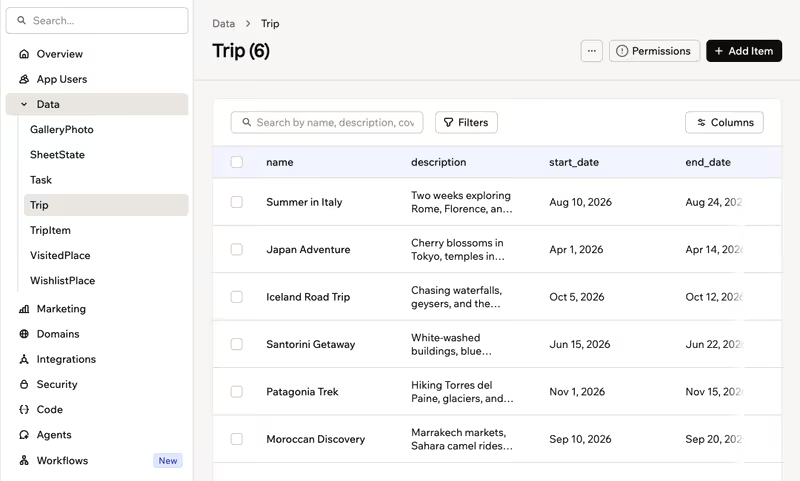
Base44 homepage

The fairest way to compare v0 and Base44 is to evaluate them on a common entry point: a styled frontend for a small business app, like an equipment rental catalog or a service scheduler. On this job, the two tools immediately separate on intent. v0 is an AI frontend page generator designed to spit out pixel-perfect, modern React components styled with Tailwind CSS and structured with shadcn/ui. It does not promise to build your database or run your server logic. It exists to design the interface.

Base44 represents the opposite philosophy. It is an all-in-one conversational app environment that attempts to scaffold the frontend, configure a managed Postgres database, host your pages, setup authentication, and handle user notifications in a single prompt. This job exposes the central tension of modern vibe coding: is it better to have a highly polished, modular layout that is completely uncoupled from a backend, or a fully functioning backend built inside a fragile, closed platform where updates risk breaking your layout?

The audience

Who each one is for

v0

  • React developers and UI designers seeking high-fidelity code ready for production pipelines.
  • Technical founders using AI to bootstrap polished, custom-branded frontends rapidly.
  • Teams who already have a settled backend architecture and just need interfaces.
  • Builders who demand complete, granular control over visual design systems and tokens.

Base44

  • Solopreneurs who want a fully functional web application without configuring servers.
  • Makers scaffolding early-stage SaaS MVPs with simple database read-write actions.
  • Product managers drafting interactive high-fidelity user flows to test business ideas.
  • Operations teams looking to automate simple internal data collection procedures quickly.

v0 assumes the user knows React and possesses a local environment to compile code; Base44 assumes the user is comfortable iterating a full application through text chats.

The scope

What you'd build with it

v0

  • Interactive dashboards, SaaS user interfaces, landing pages, and standalone complex design components.
  • Frontends meant to be integrated into modern Next.js or Astro application architectures.
  • Highly customized, branded business screens that must match exact styling frameworks.
  • Strictly frontend structures; do not expect it to manage server-side user databases natively.

Base44

  • Database-driven business apps, custom submission forms, and structured internal tool trackings.
  • Lightweight SaaS MVPs needing integrated Stripe billing, file storage, and transactional emails.
  • Multi-step application paths supported by simple relational tables behind an interface.
  • Simple operational tools; avoid Base44 for high-traffic native mobile apps.

The frontend control question

For v0, rendering interfaces is a isolated, specialized design task. By relying directly on the shadcn/ui library, Tailwind CSS v4 design parameters, and standard Next.js layouts, v0 avoids generating bloated, unmaintainable styling rules. A developer takes v0 outputs, imports them into a clean workspace, and hooks up the state logic manually. Because there is no bundled database or authentication middleware, v0 is entirely immune to backend infrastructure breaks, letting developers iterate in a clean IDE sandboxed from live production risks.

Base44 approaches this from a fully managed standpoint, which introduces a different type of risk. It generates your PostgreSQL schema and compiles your UI within unified virtual environments. However, because it relies on standard LLM completions to sync the frontend controls with database queries, any conversational iteration on styling or copy risks causing regression bugs. Community reports detail that prompting Base44 to adjust a simple font or padding can silently break the underlying SQL queries or forms, pulling non-technical builders into a loop where fixing a layout bug generates several new validation errors.

Strengths

Where each one is strong

Edge: v0

v0 dominates on design polish and code modularity. Base44 is faster for raw feature prototypes, but struggles with visual consistency past the first prompt.

v0

  • Clean, design-agency-grade UI scaffolding that leverages shadcn/ui patterns out of the box dynamically.
  • Supports visual image inputs, allowing you to generate react components from screenshots or sketches.
  • No vendor lock-in, exporting clean React, TypeScript, and Tailwind code with zero proprietary layers.
  • Frictionless integration with Vercel deployment pipelines for instant, globally CDN-hosted user previews.

Base44

  • Full-stack setup out of the box, instantly handling databases, user authentication, and visual preview options.
  • Discuss mode enables brainstorming and layout styling exploration without consuming message credits.
  • Integrated PostgreSQL database and instant file storage hosting built into a single workspace dashboard.
  • Visual click-to-tweak interface for adjusting basic layout colors and text directly on the page.

Failure modes

Where each one breaks

Edge: v0

v0's failure mode is simple: it stops where the frontend ends. Base44's failure modes involve platform downtime and destructive AI updates cascade.

v0

  • Frontend-only scope constraints force you to write all API wiring and session validation yourself.
  • Sessions exceeding 5 to 10 chat revisions produce buggy, bloated React structures.
  • Occasionally hallucinates NPM packages or references deprecated subcomponents from older standard packages.
  • Running local npm installs on imported v0 components occasionally flags package version conflicts on newer React dependencies.

Base44

  • Destructive conversational edits regularly degrade, break, or overwrite previously completed operations.
  • Severe limitations on PDF processing and API requests due to LiteLLM manager scale rate caps.
  • Authentications are restricted to basic, locked templates with limited custom brand formatting choices.
  • Platform stability is questionable, with community threads referencing weekly server builder outages.

Iteration cost

The fix loop, priced

Even

Both systems penalize you heavily for using conversation prompts to fix bugs, forcing users to pay for AI mistakes.

v0

  • Free tier features $5 of monthly credits, on-demand usage rates, and a strict 7-message daily limit.
  • Pro level runs at $20/month with selectable premium models like v0-Max consuming tokens rapidly.
  • Iterating past basic layouts can consume your entire credit allowance inside a 24-hour debug run.
  • Every stylistic edit burns credits, introducing a visual 'pay for mistakes' billing tension.

Base44

  • Starter plan costs $20/month billed monthly (or $16/month billed annually) with 100 message credits.
  • Dual credit system separates message builder limits from user backend integration action limits.
  • Regression errors easily burn 150 prompt-credits on looping, unsuccessful efforts to resolve single bugs.
  • Credits do not roll over month-to-month, forcing careful planning of complex feature upgrades.

When styling a small business app, endless visual prompting easily exhausts monthly budgets. Reviewing the economics of the fix loop tax is essential for small business operators.

Exit paths

The code you end up with

Edge: v0

v0 is an open design studio; Base44 keeps you locked into their framework.

v0

  • Produces clean TypeScript React components ready to copy-paste into local editors.
  • No proprietary libraries or hidden frameworks deployed, giving you 100% codebase ownership.
  • Enables instant sync to GitHub repositories to cleanly track file modifications.
  • Requires developers to handle the hosting environment logic manually before release.

Base44

  • Allows frontend HTML/CSS/JS export to GitHub to save layout design frameworks.
  • Managed database schema, logic layer, and Postgres tables cannot be cleanly extracted.
  • Backends are completely trapped inside Base44's closed runtime cloud infrastructure.
  • Must subscribe to the higher-tier Builder plan ($50/mo) just to access GitHub syncing capabilities.

When neither wins

The ultimate challenge of building a small business application with either v0 or Base44 is the developer overhead. If you choose v0, you are left with visual React pages that require a developer to build a database, secure database endpoints, and install login paths. If you choose Base44, you get a quick prototype, but you are stuck maintaining generated logical queries, database integrations, and fragility. If you are not a developer, you have effectively assumed the maintenance burden of a custom, custom-coded infrastructure that you cannot read or protect.

For builders who want a production-ready application, Softr offers a safer approach. Softr treats user logins, data permissions, layout rules, and databases as structured, visual configurations. There is no generated authentication code to audit because there is no code generated at all. It handles 80% of standard business app structures instantly with battle-tested native blocks, saving custom coding blocks only for specialized, isolated tasks. It is not the right choice if you are a developer demanding a custom React codebase, but it is the logical path for running operations securely.

Verdict

v0 is the clear, conditional winner of this matchup if you prioritize code modularity and long-term codebase ownership. Because it strictly isolates itself to rendering gorgeous UI layouts matching Tailwind and shadcn/ui parameters, you can safely integrate its structures inside real development cycles. You must have a developer on hand to coordinate the backend, but you are free of platform lock-in.

Base44 should only be selected if you are looking to build a conversational MVP quickly and have zero intention of maintaining the platform or expanding its features past 6 months. It can whip up a fully hosted, interactive database prototype in minutes, but the platform's stability issues and destructive AI update behaviors make it a highly risky foundation for real, client-facing business apps.

For non-technical business operators looking to launch a real app with database and user permissions: choose neither. Do not try to solve operational workflows by generating massive custom codebases. Use a secure, visual-first platform like Softr to coordinate your workflows safely without the threat of conversational regression bugs.

Q & A

Frequently Asked Questions

Is v0 better than Base44 for structured business apps?

v0 is significantly better for coding modular, standard React frontends, but it does not contain a backend. Base44 is better if you require an integrated database and hosting out of the box, though it introduces significant platform lock-in and regression loop risks.

Can I export my code from v0 and Base44?

v0 offers complete, clean React/Tailwind code ready to use in any local development setup. Base44 allows you to export basic frontend code to GitHub, but the underlying Postgres database, APIs, and backend configurations cannot be ported or hosted elsewhere.

Which costs more to iterate on, v0 or Base44?

Both can become highly expensive. v0 charges tokens based on model usage, which drains quickly on design changes, while Base44 uses a dual credit model where prompt errors and user database actions consume monthly allowances fast.

What should non-developers use instead of v0 and Base44?

Non-developers should use Softr to construct business portal structures securely. Softr treats authentication, data records, and dashboards as visual drag-and-drop settings rather than generated code, removing the risk of silent bugs and database leaks.