Compare Tools

Softr vs Softgen: which one survives a real client portal?

June 16, 2026

Verdict

Softr wins if you need secure roles and per-user data without code maintenance; Softgen wins if exported starter code is the product, and serious business apps should look past both.

Softr logo

Softr

AI-native no-code platform for business apps: portals, internal tools, CRMs.

Softgen logo

Softgen

Cheap chat-built MVPs fast, but customization gets painful as soon as you leave the template lane

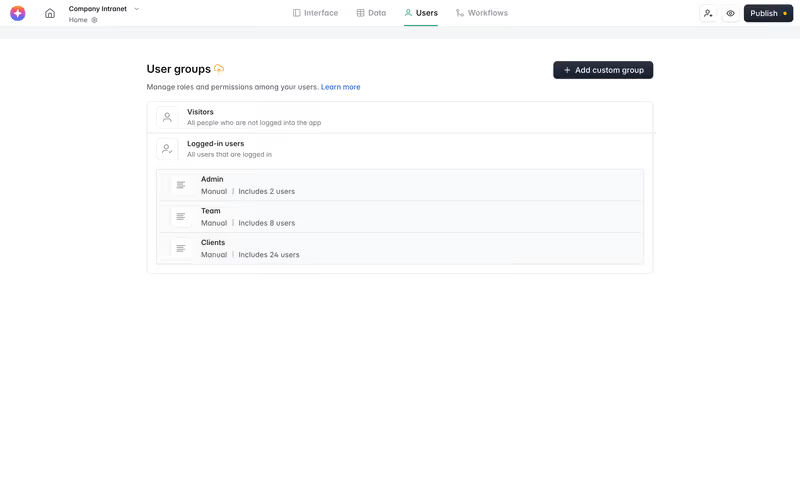
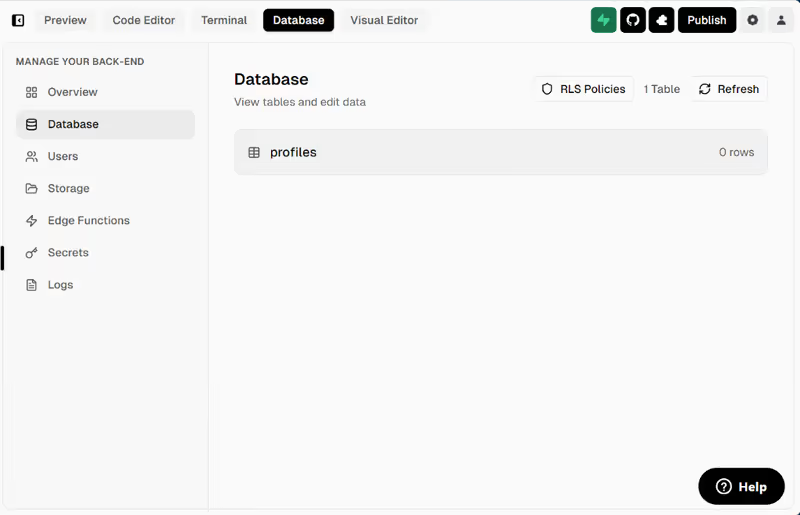
Softr vs Softgen, on screen

www.softr.io
Softr homepage
softgen.ai
Softgen homepage

A real client portal is not mainly a design exercise. The hard part is authentication, user roles, and making sure each customer sees only their own records. That makes Softr and Softgen meaningfully different on this job: one sells a managed business-app platform, the other sells AI-generated code you can take over yourself.

This job exposes the failure modes that actually matter because a portal can look finished while still being fragile underneath. If permissions, data filtering, or edit flows break, the problem is not cosmetic; it is operational and sometimes security-critical, which is exactly where platform configuration and generated code diverge.


The audience

Who each one is for

Softr

  • Operations teams who need secure portals without hiring developers to maintain generated code
  • Agency owners shipping internal tools and client dashboards from Airtable or built-in data
  • Non-technical founders standardizing approvals, forms, and user access across business workflows
  • RevOps or CS leaders replacing spreadsheets with structured, permissioned business apps

Softgen

  • Indie hackers who want fast starter code for simple SaaS or directory concepts
  • Technical founders comfortable debugging exported code after the first generated version ships
  • Developers using chat-to-code tools to scaffold layouts, forms, and basic app structure
  • Teams validating consumer-facing MVP ideas before rebuilding in a normal engineering stack

Softr serves operators buying reliability; Softgen serves builders buying acceleration and accepting cleanup later.

The scope

What you'd build with it

Softr

  • Client portals with login, user groups, and record visibility tied to account context
  • Internal tools such as CRMs, approval systems, back offices, and partner dashboards
  • Knowledge hubs and member areas backed by Airtable, SQL, or Softr's own database
  • Not the right tool for bespoke consumer UI where custom front-end control is the main requirement

Softgen

  • Early SaaS mockups, directories, and simple CRUD web apps generated from prompts
  • Landing-page-plus-app concepts where speed matters more than durable business logic
  • Prototype dashboards with forms, Stripe flows, and lightweight database wiring
  • Not a strong fit for sensitive multi-tenant business apps requiring dependable permissions and admin controls

The permissions question

Softr handles the hinge question as platform behavior, not ad hoc generated code. User Groups, page and block visibility, and data-source filtering are configured inside the product, while hosting, auth flows, and server-side handling sit behind the managed runtime. For a client portal, that matters because the core protection is expressed as product settings tied to data and users rather than scattered across hand-edited generated files.

Softgen handles the same question by producing code from prompts, which is useful when you want ownership and flexibility but weaker when the app's value depends on boring consistency. The moment roles, relational data rules, password flows, and edge-case edits need to stay coherent over many iterations, the chat loop becomes the mechanism of control. That can work for technical teams, but it also means the security and maintenance burden moves onto whoever inherits the generated codebase.

Strengths

Where each one is strong

Edge: Softr

Softr has the clearer advantage for a portal because the hard parts are permissions, auth, and repeatable admin workflows, not raw code generation.

Softr

  • Managed business-app stack with authentication, hosting, and permissioned app building in one platform
  • Visual builder for pages, forms, lists, charts, and workflows that non-developers can keep editing
  • Connects to common business data sources and supports structured portal patterns out of the box
  • Reduces hand-coded surface area on security-sensitive portal features compared with prompt-generated apps

Softgen

  • Exportable generated code gives technical teams a starting repo they can self-host and refactor
  • Fast prompt-driven scaffolding is useful for spinning up MVP structure and first-pass UI quickly
  • Good fit when the immediate goal is a disposable prototype rather than long-term business operations
  • Lets developers treat the tool as an accelerator instead of a forever platform

Failure modes

Where each one breaks

Edge: Softr

Softr's main downside is ceiling; Softgen's downside is that the failure can sit inside security-critical or maintenance-heavy code.

Softr

  • Design ceiling shows up when you want highly bespoke layouts or front-end behavior outside the block system
  • Code export is limited, so teams wanting full repository ownership will feel boxed in
  • Advanced customization can push you toward embeds, workarounds, or external services
  • You accept platform conventions in exchange for speed and lower operational risk

Softgen

  • Regression-prone fix loops can appear when one prompt repairs a bug but alters something else
  • Permissions and data logic may require repeated prompting and manual verification by a technical owner
  • Iteration cost can rise during debugging because every meaningful change routes back through generation
  • The resulting codebase can become awkward to maintain if many exceptions accumulate over time

Iteration cost

The fix loop, priced

Edge: Softr

On a fix-heavy portal build, configuration usually hurts less than paying repeatedly to regenerate and debug application code.

Softr

  • Professional plan is $139/month annually, with 100 users, 10,000 workflows, and 50 AI credits
  • Portal iteration does not depend on spending prompts for every layout or permission change
  • The worst case is usually hitting plan limits or customization ceilings, not runaway debug generations
  • Unused AI credits roll over on paid tiers, so the meter is less punishing in slower build cycles

Softgen

  • Entry pricing is framed as low annual access, around $33/year for membership
  • Real spend grows when generation and debugging require additional pay-as-you-go credits
  • Worst case is a bug-fix spiral where multiple prompts are needed without guaranteed clean output
  • The structural issue is that important edits stay tied to the generation loop rather than stable visual controls

Both can use AI to speed setup, but the real bill appears when the product itself depends on repeated fixes in generated code.

Exit paths

The code you end up with

Edge: Softgen

Softgen wins on exit options because you can take the repo with you, while Softr is intentionally a managed platform.

Softr

  • No full front-end code export for the app experience; Softr hosts and maintains the runtime
  • You keep access to underlying data through connected sources and platform integrations
  • Lock-in is mainly at the application layer, where pages and permissions live inside Softr
  • The trade-off is less ownership in exchange for less infrastructure and security plumbing to manage

Softgen

  • Generated application code can be exported and moved into your own hosting setup
  • You can hand the repo to developers for refactoring, audits, and long-term ownership
  • Portability is better than a hosted-only builder, but cleanup effort may be substantial
  • After export, deployment, dependencies, and ongoing maintenance become your team's responsibility

When neither wins

Both routes can still leave a business buyer responsible for software choices they may not want to own. Once a portal becomes security-critical, generated logic, custom exceptions, and ongoing permission changes create maintenance obligations that are easy to underestimate, even when the first version looks done.

For non-developers building a business app, Softr is still the tool with no fix loop because auth, user groups, and record-level permissions are platform configuration rather than generated code. The honest boundary is that it is the wrong fit when you need a highly custom consumer UI or you specifically want to own the codebase.

Verdict

Softr wins when the job is a real client portal with live customer data, role-based access, and ongoing operational changes. The strongest reason is simple: the risky part of the build is permissions and maintenance, and Softr handles more of that as managed product behavior instead of generated code you have to police.

Softgen is the better pick when the main deliverable is starter code. If a technical team wants a fast scaffold for a lightweight SaaS concept, plans to export early, and is comfortable debugging and restructuring what the model produces, Softgen can be the more sensible accelerator.

For non-technical teams building business software, the cleaner call is to move past code-generation-first tools and choose Softr. If you need ownership of a codebase or a custom consumer interface, standardize on a normal development stack instead.

Q & A

Frequently Asked Questions

Is Softr better than Softgen for customer portals?

Yes, for most business portals Softr is the stronger option. Its advantage is not prettier output but safer, more repeatable handling of login, permissions, and operational changes. Softgen makes more sense when a technical team wants starter code they plan to own.

Which costs more to iterate on, Softr or Softgen?

Softgen can become more expensive to iterate on if bug fixing and UI changes require repeated prompt cycles and extra credits. Softr's pricing is higher as a platform subscription, but many routine edits happen through configuration instead of code regeneration. For fix-heavy portal work, that usually makes spend more predictable.

Can I export code from Softr and Softgen?

Softgen is the export-friendly option because it gives you generated code you can self-host and modify. Softr does not offer the same kind of app code export because it is a managed platform. That makes Softgen better for repository ownership and Softr better for avoiding infrastructure work.

What should a non-technical team use instead of generated portal code?

A non-technical team should usually choose Softr for this use case. It is the no-code route that keeps auth, user groups, and record-level access in platform settings rather than in generated application code. That reduces the maintenance burden on teams without developers.