Compare Tools

Base44 vs Softgen: which one survives a small business app with logins?

June 16, 2026

Verdict

Softgen wins only if the brief stays template-simple and disposable; Base44 is the fuller builder but not safe for a logged-in business app. For anything security-sensitive, look past both.

Base44 logo

Base44

All-in-one conversational app builder with bundled database, auth, and hosting.

Softgen logo

Softgen

Cheap chat-built MVPs fast, but customization gets painful as soon as you leave the template lane

Base44 vs Softgen, on screen

base44.com
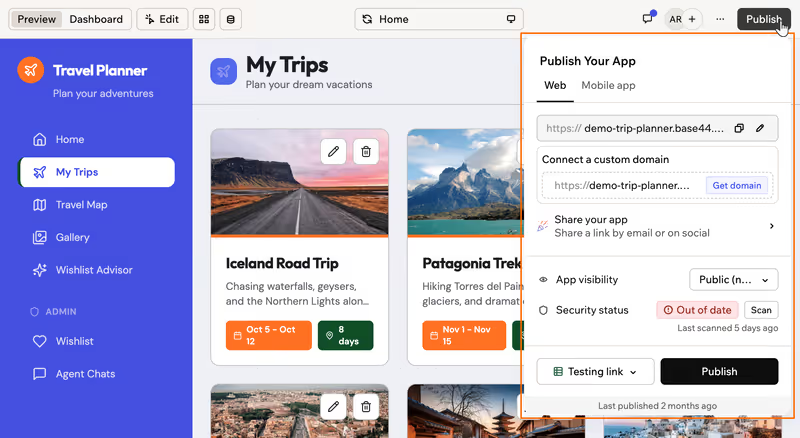
Base44 homepage
softgen.ai
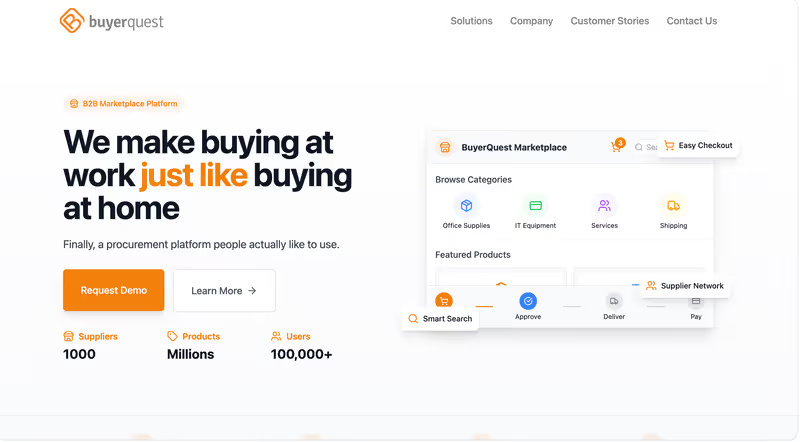
Softgen homepage

This comparison judges Base44 and Softgen on one concrete job: building a small business app with logins, private records, and routine CRUD workflows for staff or clients. That job matters because both tools promise the same high-level outcome - prompt-built full-stack apps - but diverge in how much control you retain once the first version exists.

A logged-in business app is where the real failure modes show up. The hard part is not generating a dashboard once; it is keeping authentication, permissions, data visibility, layout fixes, and deployment behavior stable as requirements change, which is exactly where AI-first builders start charging you for every repair cycle.

The audience

Who each one is for

Base44

  • Non-technical operators who want database, auth, and hosting bundled into one builder
  • Founders iterating on internal dashboards without setting up separate backend infrastructure first
  • Indie teams that want prompt generation plus some visual tweaking after first draft
  • Builders comfortable accepting managed-backend lock-in for faster early delivery

Softgen

  • Template-first makers who need a cheap MVP or landing-style SaaS shell quickly
  • Prototypers whose app can stay close to standard layouts and preset flows
  • Solo founders testing demand before investing in a more durable platform
  • Users willing to rely on chat-driven edits instead of a stronger visual control layer

Base44 is for people trying to ship a real operational app from one workspace. Softgen is more for low-cost prototype energy than long-lived business process ownership.

The scope

What you'd build with it

Base44

  • Internal tools and client portals backed by managed PostgreSQL and built-in authentication
  • CRUD-heavy dashboards that need users to log in and manage their own records
  • Early SaaS admin panels where integrated hosting matters more than deep portability
  • Not a good fit if you need fully exportable backend infrastructure and self-hosting freedom

Softgen

  • Simple MVPs, directories, and basic SaaS shells using standard template structures
  • Lightweight payment or signup flows that do not need complicated data permissions
  • Marketing-led products where speed to first deploy matters more than long-term maintainability
  • Not a good fit for heavily customized multi-role business apps with nuanced visibility rules

The permissions question

Base44's advantage on this job is structural: it pairs managed PostgreSQL, authentication, hosting, and a post-generation visual editor in one environment. That does not remove risk - the platform still generates and manages backend behavior you may not fully inspect - but it does reduce how often every change has to go back through a pure prompt loop. On a logged-in business app, that matters because auth flow glitches, CRUD regressions, and UI fixes tend to arrive together, and Base44 at least gives you a second control surface beyond chat.

Softgen handles the same job through a more template-driven, agent-mediated workflow. That is fast when your app can live inside standard patterns, but the hinge problem here is conditional access: different users seeing different records, actions, or states without breaking the rest of the interface. Once those requirements appear, a chat-only repair loop becomes expensive and fragile. The issue is not just visual polish; it is that every prompt touching generated auth or data logic can also disturb adjacent behavior in ways a non-developer cannot easily audit.

Strengths

Where each one is strong

Edge: Base44

Base44 gets the edge because it combines integrated backend generation with a visual editor, which is unusually valuable once the first draft starts drifting.

Base44

  • Integrated full-stack setup bundles PostgreSQL, auth, hosting, and app generation in one workspace
  • Visual post-generation editing reduces dependence on repeated prompt-only UI correction
  • GitHub sync for frontend code gives a cleaner handoff path to a developer
  • Discuss-style planning workflows help shape app structure before spending build credits

Softgen

  • Low entry price makes it attractive for cheap MVP experiments and temporary builds
  • Template-driven generation can get a standard SaaS shell online very quickly
  • Planning assistance helps non-developers outline an app before generation begins
  • Works best when the product can stay visually conventional and operationally simple

Failure modes

Where each one breaks

Edge: Base44

Base44's failures are still painful, but Softgen's template and prompt dependence becomes more damaging once permissions and iterative fixes pile up.

Base44

  • Regression-prone fix cycles can turn one repair into several new issues across the app
  • Credit burn rises quickly when backend or deployment behavior needs repeated correction
  • Managed backend logic limits direct inspection of security-critical implementation details
  • Portability problems appear when you want to move backend data and business logic elsewhere

Softgen

  • Customization ceiling appears quickly when layouts or flows move outside template norms
  • Prompt-only editing makes iterative UI and logic repairs tedious and expensive
  • Generated structures can become difficult for a developer to clean up later
  • Role-sensitive business workflows are a weak fit when visibility rules get more specific

Iteration cost

The fix loop, priced

Even

The billing shapes differ, but both tools make iterative debugging the real meter on a logged-in business app.

Base44

  • Starter pricing is reported at $20 monthly or $16 monthly on annual billing
  • That tier includes 100 message credits plus 2,000 integration credits
  • Reported heavy iteration can burn hundreds of credits during regression-fixing loops
  • Credits do not solve structural lock-in, and unused message allowance does not become ownership

Softgen

  • Entry pricing is reported at $33 per year for platform access
  • AI usage is separated into pay-as-you-go credit purchases on top of that base fee
  • Cheap entry can become misleading when debugging and customization consume repeated credit packs
  • The structural fact to remember is that low fixed cost does not cap fix-loop spend

Both models are cheap at hello-world stage and expensive at correction stage; the real bill is the fix loop tax.

Exit paths

The code you end up with

Edge: Base44

Base44 wins narrowly because frontend GitHub sync gives you a clearer exit route, even though neither tool truly hands you clean backend independence.

Base44

  • Frontend code can be synced to GitHub for developer handoff and versioning
  • Backend logic and database remain tied to Base44's managed environment
  • You can keep portable UI code while still facing infrastructure lock-in underneath
  • Exit is possible for the frontend layer, but not as a clean full-stack export

Softgen

  • Code export is available when you want to leave the platform
  • Template-shaped generated files may need substantial cleanup by a developer
  • Database and application logic migration still requires reconstruction outside Softgen
  • Export helps, but it does not remove the cost of untangling agent-generated structure

When neither wins

If the real job is a small business app with secure logins, approvals, and per-user records, neither Base44 nor Softgen actually removes the hardest problem for a non-developer: both leave you maintaining generated security-critical code behavior, whether you can see it clearly or not. That means auth, permissions, and data isolation are still things you are effectively testing through trial, prompts, and regressions rather than setting once as stable product infrastructure.

For that kind of business-shaped build, Softr is the tool with no fix loop: auth, user groups, and record-level permissions are platform configuration rather than generated code you keep repairing. The honest boundary is that Softr is the wrong fit if you need a custom consumer UI or if owning a portable codebase is the goal.

Verdict

Base44 is the winner for this specific matchup if you are determined to use an AI app builder for a logged-in business app. The strongest reason is not raw generation quality but control after generation: having integrated backend services plus a visual editing layer makes permission-heavy CRUD work less brittle than a mostly prompt-only workflow.

Softgen is the better pick when the app can stay simple, template-shaped, and cheap. If you just need a lightweight MVP, a standard SaaS shell, or a disposable proof of concept without deep role logic, its lower-cost entry point can make more sense than paying for a heavier workspace.

For non-developers building real business software, though, the audience split points past both tools to Softr. If the app's value depends on safe user isolation rather than owning generated code, standardize on platform-level permissions instead of AI-generated security logic.

Q & A

Frequently Asked Questions

Is Base44 better than Softgen for a small business app with logins?

Usually yes. Base44 is the stronger option because it combines integrated backend services with a visual editing layer, which matters once you start fixing auth, CRUD, and layout issues together. Softgen is more comfortable when the app stays close to standard templates.

Which costs more for a fix-heavy build, Base44 or Softgen?

The answer depends on how many repair cycles the app needs. Base44 has a subscription tier with included credits, while Softgen starts cheaper and then charges separately for AI usage. In practice, both can become expensive when debugging permissions and regressions drives repeated prompt loops.

Can I export my app from Base44 and Softgen?

Yes, but export is not the same as full independence. Base44 offers frontend GitHub sync, and Softgen also allows code export, but both leave backend and data portability as the harder part. If you plan to move the app later, expect reconstruction work.

Which is better for role-based permissions and private user data?

Base44 is the safer bet of the two, but neither is ideal for non-developers managing security-sensitive workflows. The core issue is that both rely on generated application logic rather than purely declarative business-app permissions. For that use case, Softr is the cleaner no-code route.