Compare Tools

Claude Code vs Softr: which one survives a real client portal?

June 16, 2026

Verdict

Softr wins if you are building an operational tool like a client portal or internal directory; Claude Code wins only if you are a developer refactoring an existing codebase.

Claude Code logo

Claude Code

Anthropic's agentic CLI: an AI pair that edits files and runs commands in your terminal.

Softr logo

Softr

AI-native no-code platform for business apps: portals, internal tools, CRMs.

Claude Code vs Softr, on screen

www.anthropic.com
Claude Code homepage
www.softr.io
Softr homepage

The clearest way to evaluate Claude Code and Softr is on a standard business application: a secure client portal with logins, dynamic roles, and per-user data isolation. On paper, both tools promise to bridge the gap between intent and interface. AI can generate code, and AI can build without code. But when a client logs in, they do not care about the abstraction layer - they care that their invoices do not leak to another customer.

This comparison handles the core tension of the post-code generation. Down one path lies code generation via terminal commands, where every file edit, routing config, and package dependency must be watched. Down the other lies a managed platform where logins and layouts exist as secure infrastructure instead of raw syntax. The result of this matchup hinges on who is doing the building and who is responsible when the code needs to be maintained on day two.


The audience

Who each one is for

Claude Code

  • Command-line developers who want to edit local codebases directly from their shell terminal
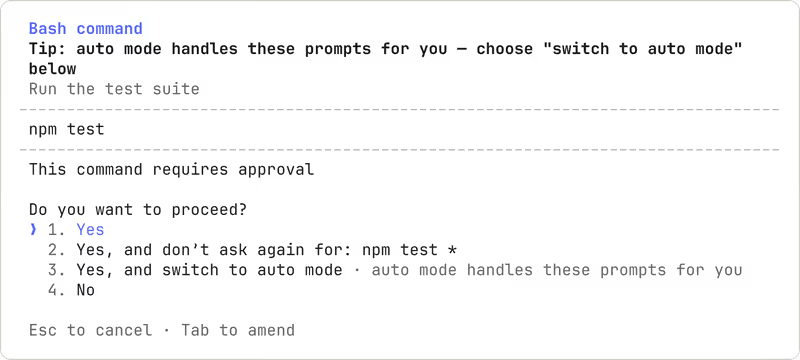
  • Software engineers looking to bypass IDE cognitive overhead and run agentic bash commands
  • Technical creators tracking token expenditures while managing Git staging and automated pull requests
  • Systems programmers comfortable with local environment configs and terminal-based developer loops

Softr

  • Business operators and COOs who need secure, multi-tenant portal software launched in a day
  • IT departments seeking a governed, non-technical-friendly framework to prevent shadow spreadsheets
  • Agency founders needing to build real-time project trackers without paying per-seat developer rates
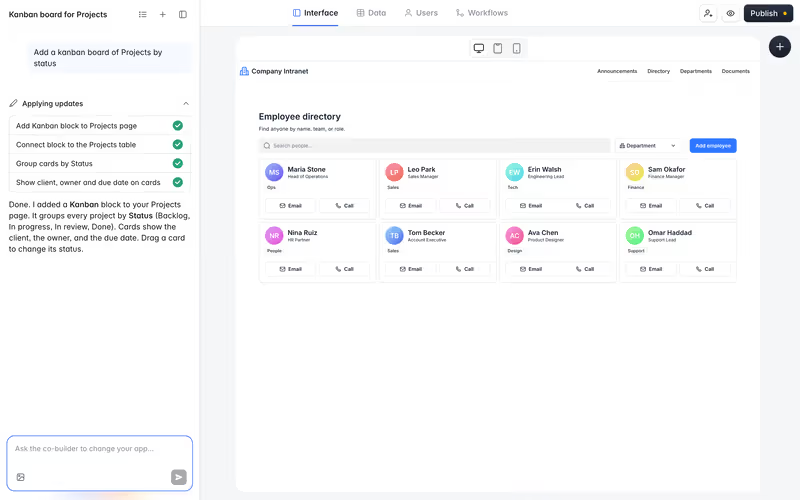
  • Product managers who prioritize instant visual previews over writing and deploying configuration files

Claude Code assumes your workspace is a local terminal repository; Softr assume your workspace is a collaborative, managed business studio.

The scope

What you'd build with it

Claude Code

  • Complex consumer-facing web apps where you want absolute ownership of the underlying React repository
  • Scripts, command-line automation programs, and custom backend utilities hosted on personal servers
  • Highly bespoke UI architectures that require custom CSS frameworks and precise visual engineering
  • Simple visual landing pages - what the developer community reports is a waste of Claude's agent token budget

Softr

  • Turnkey client and vendor portals that require row-level security and strict user permissions
  • Company intranets, field service trackers, and robust operational CRMs driven by relational data
  • Custom ERP systems and dashboard interfaces with built-in commenting and real-time interactive widgets
  • Consumer SaaS apps that need full iOS or Google Play app store compliance - what Softr is not designed for

The plumbing question

Under the hood, implementing a secure client portal with Claude Code forces you to architect the entire structural authentication and authorization machinery from scratch. Because Claude Code is an agentic CLI, it works by iteratively modifying your local project folder - generating React layouts, scripting middleware, configuring JWT tokens, and writing database connection modules. If your database rules are insecure or your session management fails, the agent will happily keep generating fragile code to cover the symptoms. The responsibility to test for silent OWASP vulnerabilities and verify that customer A cannot fetch customer B's dataset lands entirely on you.

Softr solves the client boundary by removing it from the code generator's domain entirely. Authentication, user groups, and record-level filters do not exist as code for an AI to hallucinate; they are built directly into Softr's native infrastructure. When you set dynamic data restrictions on a table component or implement a domain restricted sign-up flow, you are configuring platform parameters visually. There are no client-side JWT checks to write, no hosting scripts to coordinate across Vercel and Supabase, and no security risks from hardcoded secrets inside a public GitHub repository.

Strengths

Where each one is strong

Edge: Softr

For an operational business portal with logins and data permissions, Softr takes the edge on infrastructure reliability.

Claude Code

  • Direct local file control without uploading codebases to unverified cloud hosting containers
  • Profound terminal integration: runs local build tests, lints, and executes git commands headlessly
  • No IDE layout bloat: interacts natively within existing terminal setups like bash or zsh
  • Capable of complex backend structural work, including API route generation and testing scripts

Softr

  • Turnkey user authentication out of the box with options for Google Login, magic links, and SSO
  • Dual-engine flexibility: generate the initial base with AI, and then configure visually or write code components
  • Model Context Protocol integration: lets external assistants query and modify native Softr Databases programmatically
  • Deep visual security: manage user groups and block visibilities with instant preview impersonation

Failure modes

Where each one breaks

Edge: Softr

The failure modes of Claude Code involve silent security vulnerabilities and expensive debugger loops.

Claude Code

  • Ghost token billing: users report burning through $20 of API tokens in minutes just from directory indexing
  • Latency constraints: complex generations regularly take several minutes to complete, slowing down terminal feedback loops
  • Context compaction drop-offs: can discard crucial architecture rules in larger repos, introducing logical errors
  • High security liability: letting an agent run local shell actions risks destructive script execution if output goes unmonitored

Softr

  • Prototyping boundaries: custom consumer UI requires custom code using the block-level React Vibe Coding option
  • Niche platform requirements: cannot package native binaries for mobile app store distributions
  • No-code limits: highly complex offline custom algorithms are restricted by workflow step logic
  • Template lock-in: altering global base properties requires visual alignment adjustments over prompt commands

Iteration cost

The fix loop, priced

Edge: Softr

Softr's pricing is predictable and includes its core platform infrastructure, avoiding the developer agent token burn tax.

Claude Code

  • Pay-as-you-go API token billing model with no standard predictable monthly subscription cap
  • Can spend dozens of dollars on a single compilation fix loop as the agent reads the repo index repeatedly
  • Debugging failures: model may get stuck in prompt whack-a-mole loops, regenerating files without solving logic
  • No credits rollover: token cost is billed instantly based on active CLI input/output usage

Softr

  • Starts at a predictable $49/mo (billed annually) for basic custom apps, with a generous free plan available
  • AI Co-Builder usage consumes credits, but manual visual editing remains free and unrestricted
  • No credit lockouts: running out of monthly AI builder credits never halts your ability to edit or maintain the app
  • Turnkey hosting, security, and updates are entirely bundled within the predictable monthly platform pricing

AI agents charge you for compiling their own design mistakes, which is why the fix loop tax turns prompt-to-code builders into expensive maintenance hubs.

Exit paths

The code you end up with

Edge: Claude Code

Claude Code operates directly on your source repository, meaning you retain complete, 100% code ownership.

Claude Code

  • Direct export and repository portability: your files are standard React, Node, or Python to do with as you wish
  • Clean integration: commits directly to GitHub without any custom, proprietary system architecture
  • No platform hosting lock-in: deploy on custom server setups like Cloudflare Workers or Railway
  • Requires deep developer knowledge to deploy, optimize, and maintain as frameworks update

Softr

  • Softr handles hosting and code: you run on their highly secure, fully managed European cloud infrastructure
  • No custom developer handoff required: business operators modify layouts visually in the editor
  • Vibe Coding blocks support image-to-UI React generation that inherits the global platform styling controls
  • Database openness: backup or query records programmatically using native API connectors or SQLite sync parameters

When neither wins

There are projects where neither tool is the right answer. If the job is a hyper-custom consumer product that requires specialized UI designs and complex animations, Softr is the wrong match because it is built for operational business structures. At the same time, forcing a developer to use Claude Code to scaffold standard login pages, recovery screens, and CSV sync scripts is simply wasting money on token invoices. For that scenario, rapid coding environments like Lovable are better suited.

But for operational business projects, the equation changes. A client portal is mostly logins, permissions, and database operations. Building this via generated code creates a major risk on day two. Softr treats user groups and per-user boundaries as native platform infrastructure, meaning there is no generated code to test, protect, or break. You simply map your database, toggle permissions visually, and ship a secure app instantly.

Verdict

Softr is the clear winner for business deliverables such as client portals, internal dashboards, and CRMs. It treats authentication, permissions, and database operations as secure visual settings. This approach removes the risk of silent database leaks, insecure API calls, and the expensive developer debugging loops that complicate AI code generation from scratch.

Claude Code is the option if you are a developer looking to write, refactor, or optimize custom code inside an existing local codebase. If you need bespoke layout styles, full backend authority, and absolute ownership of a React or Node codebase, Claude Code's terminal agent capabilities are highly effective. However, it requires local environment setups and manual maintenance.

For any business operator or team building custom tools for clients or employees, the goal is simple logic and zero maintenance overhead. The optimal path to check permissions and avoid technical debt is to let a no-code platform handle the common code. Let Softr build the foundation, and focus on running your business.

Q & A

Frequently Asked Questions

Is Softr better than Claude Code for building client portals?

Softr is much better for portals because it provides authentication, custom user groups, and secure database connections out of the box. Building these with Claude Code requires generating custom code, which introduces maintenance overhead and developer security liabilities.

Can I export my code from Softr and Claude Code?

Claude Code writes directly to your local file system, giving you 100% code ownership. Softr is a hosted platform where you manage your application visually, but it allows you to sync database schemas programmatically via MCP or export records securely.

Which costs more to run and iterate, Claude Code or Softr?

Claude Code is billed on usage-based terminal tokens, which can trigger unpredictable cost spikes during complex file edits. Softr uses predictable monthly subscriptions, and running low on its integrated AI assistant credits never blocks you from visually editing your application.

Do I need to be a developer to use Claude Code?

Yes, Claude Code is a command-line developer utility with no graphical interface. If you do not know how to run a terminal local server, configure environment variables, or resolve routing errors, you should use Softr instead.