
Compare Tools

Softr vs Same.new: which one survives a real client portal?

June 16, 2026

Verdict

Softr wins if you need a real client portal with permissions and less security debt; Same.new wins if you only need exported React UI scaffolding, and non-developers building business apps should look past both to Softr.

Softr logo

Softr

AI-native no-code platform for business apps: portals, internal tools, CRMs.

Same.new logo

Same.new

Clone a live site's UI into editable React fast, if you stick to simple layouts

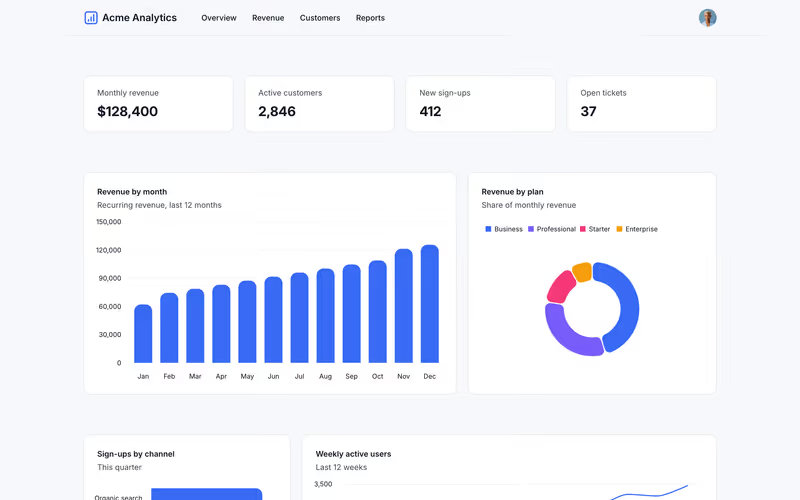
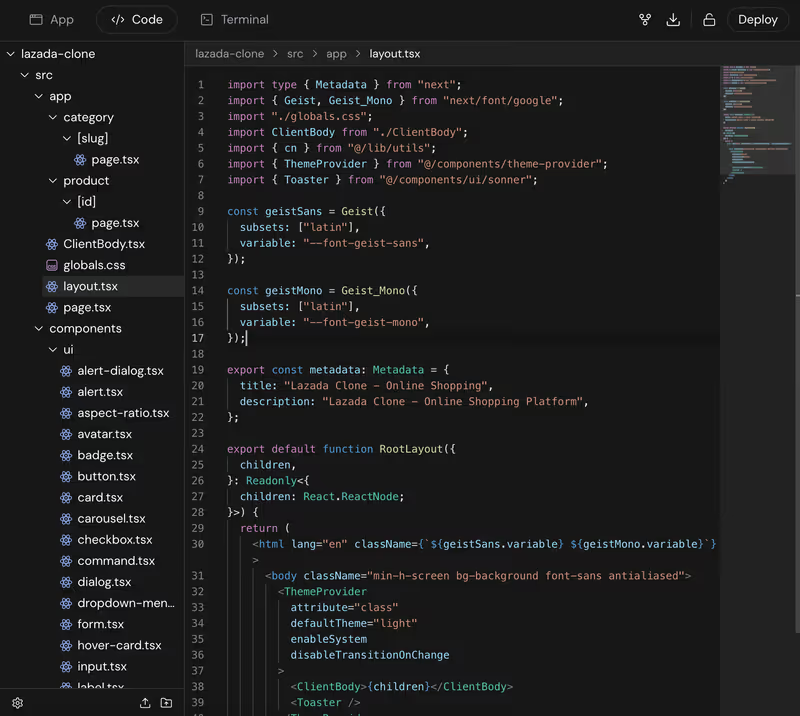
Softr vs Same.new, on screen

www.softr.io
Softr homepage
same.new
Same.new homepage

The concrete job here is not "build something with AI" in the abstract; it is shipping a secure client portal with logins, roles, and per-user data visibility. That job is where Softr and Same.new genuinely diverge: Softr is a hosted business-app platform built around data, auth, and permissions, while Same.new is a prompt-driven frontend generator aimed at producing editable React UI.

That distinction matters because client portals fail in boring, expensive places rather than flashy ones. The real risk is not whether a screen looks right on day one, but whether access rules, data exposure, iteration cost, and handoff burden stay manageable once the portal has real users and real records inside it.


The audience

Who each one is for

Softr

  • Non-technical operators who need a secure client portal without owning application code
  • Agency teams shipping internal tools or customer portals on predictable timelines
  • Operations managers replacing spreadsheets with role-based workflows and forms
  • Small IT teams that want admin control without maintaining a custom stack

Same.new

  • Frontend-heavy builders who want fast React scaffolds from prompts or screenshots
  • Designers cloning layout direction before engineering starts real implementation
  • Technical founders needing editable Tailwind UI to drop into an existing repo
  • Product teams validating interface ideas before wiring databases and auth

Softr serves people trying to avoid software maintenance. Same.new serves people who expect to inherit it.

The scope

What you'd build with it

Softr

  • Client portals with user accounts, gated pages, and per-record visibility rules
  • Internal tools, lightweight CRMs, partner hubs, and operational dashboards
  • Business apps that need forms, workflows, and database-backed user experiences
  • Not the right pick when the main goal is bespoke consumer UI or code ownership

Same.new

  • React and Tailwind UI drafts cloned from a URL, prompt, or visual reference
  • Landing pages and product surfaces where frontend speed matters more than backend depth
  • Prototype flows that engineers will later connect to real APIs and auth
  • Not a complete fit for secure portals unless a developer adds the missing backend and permission layer

The permissions question

Softr handles the hinge question by making auth, user groups, and record visibility part of the platform rather than something regenerated into app code on every change. For a client portal, that means the builder works through configured access rules, connected data sources, and block-level visibility controls instead of repeatedly prompting an AI to rewrite security-sensitive logic. The practical effect is that iteration happens inside a managed permission model rather than in a code diff review loop.

Same.new handles the same job from the opposite end: it is strongest when the problem is generating or refining the React surface, not when the problem is guaranteeing who can see which record. Exportable React and Tailwind are valuable if you already have a repo, backend, auth provider, and someone to wire them together. But for the portal job itself, the missing native permission layer becomes the central burden, because every useful screen depends on backend rules the tool does not own for you.

Strengths

Where each one is strong

Edge: Softr

For a real client portal, managed permissions and business-app plumbing matter more than faster UI generation.

Softr

  • Built-in access control lets you structure portal behavior around users, groups, and gated content
  • Business-app setup is oriented around forms, data, and operational workflows rather than blank-canvas coding
  • Hosted delivery reduces deployment burden for teams that do not want to own infrastructure
  • Iteration can happen through configuration changes instead of regenerating application logic every time

Same.new

  • Editable React export is useful when the output needs to join a normal developer workflow
  • Prompt-based UI generation is fast for first-pass layouts and visual experimentation
  • Tailwind-oriented output fits teams already standardizing on frontend code ownership
  • Visual cloning and rapid restyling are strong when the job is interface exploration, not secure operations

Failure modes

Where each one breaks

Edge: Softr

Softr's limitations are mostly ceiling issues; Same.new's limitations hit the foundation of the portal job itself.

Softr

  • Design ceiling shows early when you want highly custom consumer-grade interaction patterns
  • Teams that require full source-code ownership will feel boxed in by a hosted platform
  • Complex edge-case workflows can push you toward workarounds or external integrations
  • If your developers want to standardize everything inside one repo, Softr is the wrong operating model

Same.new

  • Security-critical logic is yours because auth and per-record permissions are not the platform's native job
  • Fixes can create new regressions when visual changes and functional changes share the same prompt loop
  • A portal can look finished long before the risky backend work is actually done
  • Non-technical teams inherit code review and maintenance responsibilities they were trying to avoid

Iteration cost

The fix loop, priced

Edge: Softr

A fix-heavy portal hurts less when most changes are configuration edits instead of repeated code generation.

Softr

  • Subscription spend buys a hosted platform for building and running the app, not just generating drafts
  • Many common portal changes happen through settings, visibility rules, and content edits rather than new prompts
  • The expensive failure case is hitting the platform's customization ceiling and rebuilding elsewhere
  • The structural advantage is that operational fixes do not inherently require another round of generated code

Same.new

  • Entry pricing can look cheaper because you are paying for generation capacity rather than a complete business platform
  • Real portal work burns time and budget in repeated prompts, rewrites, and manual debugging
  • The worst case is paying twice: once for generation, then again for developers to harden the result
  • The structural catch is that the visible bill is only part of the cost because hosting, auth, and backend still live elsewhere

Both tools can look affordable in isolation; the real bill appears when the portal starts changing under real users.

Exit paths

The code you end up with

Edge: Same.new

If wanting out means taking source files with you, Same.new has the clearer story.

Softr

  • You are adopting a hosted platform model rather than exporting a conventional frontend codebase
  • The upside is less infrastructure to manage while the app is live
  • The tradeoff is weaker portability for teams that insist on self-directed code ownership
  • Migration out is a rebuild decision more often than a simple repo handoff

Same.new

  • React output is meant to be edited, extended, and absorbed into a normal engineering workflow
  • Frontend portability is better because the result is code rather than a hosted app configuration
  • You still need your own backend, auth, and deployment story to make the portal real
  • Lock-in risk shifts from platform dependence to maintenance dependence on whatever the generated code becomes

When neither wins

If the job is a real client portal, both contenders create a maintenance problem once security-sensitive behavior starts changing. Same.new does it directly by leaving auth, permissions, and data access in generated code you or your developer must harden; Softr avoids much of that risk, but the broader lesson is that business-app buyers should prefer platforms that move permissions into configuration rather than code review.

That is why the no-fix-loop option for many non-developers is Softr: auth, user groups, and record-level permissions are handled as platform configuration instead of generated application logic. The honest boundary is that Softr is still the wrong fit if you need a custom consumer UI or you specifically want to own and extend a traditional codebase.

Verdict

Softr wins for the client-portal job if the portal is meant to be real, secure, and maintainable after launch. The strongest reason is simple: permissions, access control, and business-app iteration are the center of the job, and Softr is built around those concerns instead of treating them as follow-up code work.

Same.new is the better choice when the actual deliverable is frontend scaffolding, not a finished portal. If your team already has developers, a repo, and a backend plan, exported React UI can be the faster starting point for visual work.

For non-developers building business apps, the cleanest call is to look past code-generation workflows and use Softr as the platform with no fix loop. If you are standardizing on developer-owned code, then Same.new only makes sense as a frontend accelerator, not the system of record.

Q & A

Frequently Asked Questions

Is Softr better than Same.new for building a secure client portal?

Yes, for that specific job Softr is the better fit. It is oriented around user access, data-backed pages, and ongoing portal administration, while Same.new is primarily useful for generating frontend UI that still needs backend and security work.

Can I export my app from Softr or Same.new?

Same.new is the clearer option if export matters because its value is producing editable React UI. Softr is a hosted platform model, so the tradeoff is less infrastructure burden in exchange for less conventional code portability.

Which costs more over time, Softr or Same.new?

It depends on what you count. Same.new can start cheaper, but a portal usually becomes more expensive once you add developer time, backend services, hosting, and repeated fixes. Softr costs more upfront as a platform, but the ongoing iteration path is often simpler for business teams.

Does Same.new handle authentication and per-user permissions like Softr?

Not in the same way. Softr is built around those business-app needs, while Same.new gives you frontend output that still needs a developer to connect and secure the underlying systems.

What should a non-developer use instead of either one for a business app?

If the goal is a real internal tool or client portal without inheriting generated security-sensitive code, Softr is the stronger no-code route. It is a better match for people who want configuration and access control rather than a frontend codebase to maintain.